
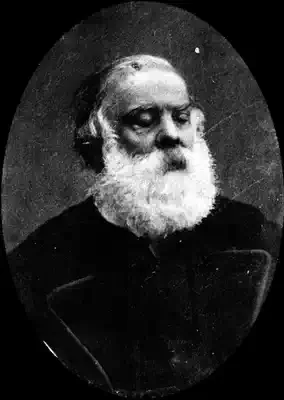
António Feliciano de Castilho
 PT
PT
António Feliciano de Castilho was an influential Portuguese writer, poet, and translator, a prominent figure of the 19th century. Known for his vast literary output and his defense of traditionalism and classicism, Castilho played a central role in Portuguese cultural life, both through his original work and his polemical interventions, notably in the orthography debate and his rivalry with Romanticism. His work encompasses poetry, prose, literary criticism, and translation, distinguished by its musicality, formal rigor, and inspiration from classical and Renaissance models. Despite being a controversial figure, especially in his opposition to Romanticism, Castilho left a lasting legacy in Portuguese literature, being studied and debated to this day.
n. 1800-01-28, Lisboa · m. 1875-06-18, Lisboa
Bio
Identification and basic context
António Feliciano de Castilho (Lisbon, May 4, 1800 – Lisbon, September 18, 1875) was a Portuguese poet, writer, translator, pedagogue, and politician. He was one of the most influential and controversial literary figures of the 19th century in Portugal.Childhood and education
Castilho was born into a wealthy family, which allowed him access to a privileged education. At the age of ten, he became deaf, an event that profoundly marked his life and work, leading him to develop a particular sensitivity for language and music. He studied Law in Coimbra, where he became involved with the literary circles of the time. His education was marked by the influence of classicism and neoclassicism.Literary career
His literary career began early, with the publication of his first poems at a young age. He was a prolific and multifaceted writer. He distinguished himself as a poet, translator, and pedagogue. His literary activity was intense, marked by a strong adherence to the aesthetic principles of classicism and a conservative stance towards new literary currents, such as Romanticism. He was a fervent defender of Portuguese literary tradition.Work, style, and literary characteristics
Castilho's work spans poetry, prose, criticism, and translation. In poetry, he is known for his lyricism, with poems celebrating nature, love, and the homeland, often with an elegiac and sentimental tone. His style is marked by formal rigor, musicality, and the influence of classical and Renaissance models. He frequently used the sonnet and other traditional poetic forms. One of his most ambitious projects was the integral translation of Camões' work into French and the version of "Os Lusíadas" in French verse, an unprecedented feat.Work, style, and literary characteristics
Cultural and historical context Castilho lived in a time of great political and cultural effervescence in Portugal, with the Liberal Revolution of 1820, the Civil War, and the consolidation of the liberal state. He was a central figure in cultural debate, especially for his opposition to Romanticism, which he considered a movement of "bad taste" and literary "degeneration." His polemic with Almeida Garrett, in particular, marked the Portuguese literature of the time. He was a member of the Lisbon Academy of Sciences.Work, style, and literary characteristics
Personal life The deafness that affected him since childhood had a profound impact on his life, shaping his perception of the world and encouraging the development of other faculties. He was a man of deep religious faith and a defender of conservative moral values. He maintained literary relationships with many of the leading intellectuals of his time, often being seen as a "patriarch" of Portuguese literature.Work, style, and literary characteristics
Recognition and reception During his lifetime, Castilho enjoyed great prestige and official recognition. He was appointed a peer of the realm and held various public offices. His poetic work was widely read and appreciated, and his translations were considered important contributions to Portuguese culture. However, his conservative stance and his opposition to Romanticism generated criticism and heated debates.Work, style, and literary characteristics
Influences and legacy Castilho was influenced by classical Greek and Latin poets, by Camões, and by Italian Renaissance poets. His legacy is complex: on the one hand, he contributed to the maintenance of a certain formal and aesthetic tradition in Portuguese poetry; on the other hand, his resistance to Romantic innovations was seen by many as an obstacle to the development of literature. His pedagogical work and his translations remain relevant.Work, style, and literary characteristics
Interpretation and critical analysis Modern criticism has sought to re-evaluate Castilho's work, recognizing its aesthetic value and historical importance, while also critically analyzing his ideological rigidity and his opposition to movements that would become fundamental to the renewal of literature.Work, style, and literary characteristics
Curiosities and lesser-known aspects Due to his deafness, Castilho developed a writing system to communicate with people, and he was an excellent lip-reader. His pedagogical work had a significant impact, especially in the teaching of the Portuguese language.Work, style, and literary characteristics
Death and memory António Feliciano de Castilho passed away in Lisbon in 1875. His death was mourned with great sorrow in literary and political circles. His name remains associated with an important period in Portuguese literary history, being remembered both for his artistic production and for his role in the literary polemics of his time.Poems
0No poems found
Comments (0)
No comments yet. Be the first to comment.