
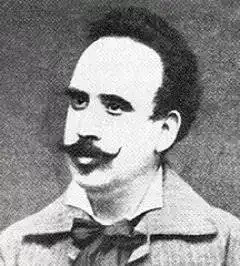
António Gomes Leal
1848–1921
· lived 72 years
 PT
PT
PT
António Gomes Leal was a Portuguese poet, a prominent figure in 19th-century poetry. His work is marked by intense lyricism, often egocentric and melancholic in nature, exploring themes such as love, death, and existential pain. Gomes Leal is known for his careful language and his exploration of traditional poetic forms, having left a collection of poems that establish him as one of the important names of late Romanticism in Portugal.
n. 1848-06-06, Lisboa · m. 1921-01-29, Lisboa
24
Views
Bio
Identification and Basic Context
António Gomes Leal (1849-1921) was a Portuguese poet. He was born and died in Lisbon. He was the son of a family of modest origins, which marked his youth and, to some extent, his work. His nationality was Portuguese, and he wrote in Portuguese. He lived through the second half of the 19th century and the first decades of the 20th century, a period of profound transformations in Portugal, marked by the end of the Monarchy and the establishment of the Republic.Childhood and Education
Of humble origin, Gomes Leal had a childhood marked by economic difficulties. He was self-taught, having attended the School of Fine Arts, where he studied Drawing. His readings, especially of French and Portuguese Romantic poets such as Victor Hugo and Almeida Garrett, were fundamental to his literary training. He absorbed the spirit of Romanticism, with its emphasis on the individual, emotion, and melancholy.Literary Career
António Gomes Leal began his literary activity early, publishing his first poems in newspapers and magazines of the time. His work evolved over time, maintaining a strong line of continuity in his egocentric and melancholic lyricism. He published several poetry books, with "As Primaveras" (1872) being his best-known and most emblematic work. He actively collaborated in various literary publications, and although not prominently known for critical or translation work, his poetic work consolidated his position in the literary landscape.Work, Style, and Literary Characteristics
António Gomes Leal's main works include "As Primaveras" (1872), "A Sombra" (1890), and "O Livro das Desilusões" (1919). The dominant themes in his poetry are love, death, loneliness, disillusionment, and existential pain. He frequently uses the sonnet and other traditional poetic forms, with characteristic rhythm and musicality. The tone of his poetic voice is markedly lyrical, elegiac, and sometimes confessional and egocentric, focused on his own pains and feelings. Gomes Leal's language is careful, with a rich vocabulary and strong imagistic density, exploring rhetorical devices to express his subjectivity. Although part of the late Romanticism context, his work presents a strong individuality, engaging with the anxieties of his time and anticipating, in some aspects, modern sensibility.Cultural and Historical Context
Gomes Leal lived in a period of transition in Portugal, with the decline of the Monarchy and the emergence of new ideologies. He was part of the literary circle of his time, being a contemporary of other Romantic poets and those transitioning to Symbolism. His philosophical stance tended towards a certain pessimism and melancholy, reflecting the existential anxieties of his generation. The society and culture of his time, with its rigidities and growing disenchantment, influenced his work.Personal Life
António Gomes Leal's personal life was marked by fragile health and an intense inner life. His affective and family relationships, although not widely detailed, seem to have been a source of inspiration for his lyricism of disillusionment. Literary friendships and rivalries are not a prominent focus in his public biography. Personal crises and existential pain profoundly shaped his work. It is not known if he lived exclusively from poetry, but his literary dedication was notable. His philosophical beliefs were marked by pessimism and melancholy.Recognition and Reception
António Gomes Leal is recognized as an important poet of Portuguese Romanticism, with a consolidated place in the history of national literature. "As Primaveras" was a commercial and critical success in his time, bringing him fame. His critical reception has been consistent over time, valuing his formal mastery and the depth of his lyrical expression, although sometimes criticized for his egocentrism.Influences and Legacy
Gomes Leal was influenced by European and Portuguese Romantic poets. His legacy lies in the persistence of his egocentric and melancholic lyricism, which influenced later poets in the exploration of subjectivity and existential pain. His work is part of the Portuguese literary canon and continues to be studied and appreciated for its aesthetic and expressive quality.Interpretation and Critical Analysis
Gomes Leal's work is often interpreted as a profound expression of existential anguish and Romantic melancholy. Critical analyses focus on his ability to transform personal pain into art, his poetic technique, and his contribution to the evolution of lyricism in Portugal.Curiosities and Lesser-Known Aspects
A curiosity about Gomes Leal is his connection with bohemian life and the literary circles of his time, despite his reserved and melancholic nature. His work, although focused on pain, reveals a formal beauty that contrasts with the suffering expressed. His dedication to writing, even in the face of adversity, is a striking aspect.Death and Memory
António Gomes Leal died in Lisbon in 1921. His death was not followed by posthumous publications of great relevance, but his work remained alive in Portuguese literary memory, ensuring its perpetuation.Poems
0No poems found
Comments (0)
Log in
to post a comment.
No comments yet. Be the first to comment.