
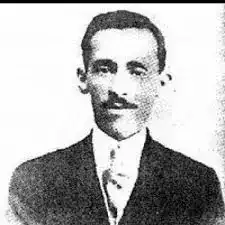
Augusto dos Anjos
 BR
BR
Augusto dos Anjos was a Brazilian poet, considered one of the greatest figures in Portuguese-language poetry. His work is marked by profound pessimism, with themes such as death, decomposition, and scientific materialism. He used rigorous language and an erudite vocabulary, often associated with the science of his time, which gave him a unique and innovative style for his era. Despite publishing only one book during his lifetime, "Eu" (I), his influence on Brazilian poetry is undeniable, anticipating many of the concerns and experiments that would mark modernism.
n. 1884-04-20, Sapé · m. 1914-11-12, Leopoldina
Bio
Identification and Basic Context
Full Name: Augusto César de Oliveira dos Anjos. Pseudonym: Augusto dos Anjos. Date and Place of Birth: April 20, 1884, in Sapé, Paraíba, Brazil. Date and Place of Death: November 28, 1914, in Resende, Rio de Janeiro, Brazil. Family background, social class, and cultural origin: Son of a primary school teacher, he had access to solid cultural and intellectual training. His family belonged to the petty intellectual bourgeoisie of Paraíba. Nationality and language(s) of writing: Brazilian, wrote in Portuguese. Historical context in which he lived: He lived through the late 19th and early 20th centuries, a period of transition in Brazil, marked by the end of the Old Republic and the consolidation of scientific thought that contrasted with traditional religious and philosophical views. The Brazilian Belle Époque and European influences were also part of the cultural landscape.Childhood and Education
From an early age, he showed great intelligence and aptitude for studies. He completed his secondary education at Colégio Pedro II, in Rio de Janeiro, where he excelled in subjects such as Latin and philosophy. He graduated in Law from the Law School of Rio de Janeiro in 1903. Initial influences (readings, culture, religion, politics): He was profoundly influenced by Auguste Comte's positivism, the scientific materialism of authors like Darwin and Haeckel, and the philosophy of Schopenhauer and Nietzsche. The reading of Parnassian poets, such as Olavo Bilac, also marked his initial style, although he developed his own path. Literary, philosophical, or artistic movements he absorbed: He absorbed the ideas of scientism and materialism that permeated the thought of the time, as well as the trends of Parnassianism in its form and rigor, but subverted the optimistic and aestheticist content of this movement with a dark and pessimistic vision. Significant events in his youth: The premature death of some of his children and his own fragile health profoundly marked his worldview and his work.Literary Career
Beginning of writing (when and how it started): He began writing poetry in adolescence, influenced by the literary and academic environment he frequented. His law degree and his interest in science were reflected in his poetry. Evolution over time (phases, style changes): His work is relatively homogeneous in terms of themes and style, focusing on the exploration of pessimism, death, and science. What is perceived is a consolidation of his unique style, which did not undergo drastic changes. Chronological evolution of his work: He published his main and only book during his lifetime, "Eu", in 1912. Most of his known poetic production was collected posthumously. Collaborations in magazines, newspapers, and anthologies: He collaborated in several newspapers and literary magazines of his time, such as "A Imprensa", "A Gazeta de Notícias", "O Malho", "Fon-Fon", among others. He participated in some anthologies, but his prominence came with the publication of his book. Activity as critic, translator, or editor: There is no record of significant activity as a critic, translator, or editor.Work, Style, and Literary Characteristics
Main works with dates and production context: "Eu" (1912). The book was published in his own edition and had little initial impact, but it consolidated his uncompromising and innovative style. Dominant themes — love, death, time, nature, identity, spirituality, etc.: Death, decomposition of matter, boredom, existential pessimism, human fragility, scientific determinism, the cosmos as a place of suffering and indifference. Form and structure — use of sonnet, free verse, fixed form, metric experimentation: He preferably used the sonnet, but with rigorous meter and rhyme, which gave a classical structure to his poetry. However, the content subverted this form with its dark and scientific themes. Poetic devices (metaphor, rhythm, musicality): He employed metaphors of a scientific and biological nature, with a grave and cadenced rhythm. The musicality is more cerebral than sensory, reflecting the nature of his poetry. Tone and poetic voice — lyrical, satirical, elegiac, epic, ironic, confessional: The predominant tone is elegiac and confessional, but tinged with radical pessimism and scientific objectivity. There is a bitter irony in the observation of human insignificance. Poetic voice (personal, universal, fragmented, etc.): The poetic voice is intensely personal in its suffering, but aims for universality by addressing profound existential questions. Language and style — vocabulary, imagery density, preferred rhetorical devices: Precise, erudite language, with scientific and technical vocabulary (physics, chemistry, biology, medicine). He used rhetorical devices such as hyperbole and antithesis to express the duality between spirit and matter, life and death. The density of imagery is marked by the rawness and grotesqueness of decomposition. Formal or thematic innovations introduced in literature: He introduced scientific and materialistic themes into Brazilian poetry with unprecedented rigor and originality. The fusion of scientific vocabulary with poetic form was a striking innovation. Relationship with tradition and modernity: He broke with romantic sentimentalism and Parnassian aestheticism, anticipating the search for more cerebral poetry engaged with scientific discoveries, aligning him with some concerns of Modernism. Literary movements associated (e.g., symbolism, modernism): Although not strictly affiliated with a movement, he is often associated with a transition between Parnassianism and Modernism, being considered a precursor of both. Lesser-known or unpublished works: "Psicologia de um Vencido" (Psychology of a Defeated Man) and "A Viagem" (The Journey), poems that are part of "Eu", but are often highlighted individually.Work, Style, and Literary Characteristics
Cultural and Historical Context Relationship with historical events (wars, revolutions, regimes): He lived in a period of great social and scientific transformations, but his work seems more focused on existential and philosophical issues than on direct engagement with specific historical events. Relationship with other writers or literary circles: He maintained contact with various intellectuals and writers of the time, but his style and themes somewhat isolated him from more conventional circles. He was admired by some, misunderstood by others. Generation or movement to which he belongs (e.g., Romanticism, Modernism, Surrealism): It is difficult to categorize him into a single generation or movement. His work dialogues with Parnassianism, but is darker and more scientific, anticipating elements of Modernism. Political or philosophical position: His philosophy is markedly materialistic and pessimistic, influenced by scientism and determinism. There is no record of explicit political engagement. Influence of society and culture on his work: The dissemination of scientific theories and the crisis of traditional values at the turn of the 19th to the 20th century directly influenced his worldview and, consequently, his work. Dialogues and tensions with contemporaries: His contemporaries reacted in a divided manner. Some admired him for his originality and rigor; others criticized him for his pessimism and language considered insufficiently lyrical. Critical reception during his lifetime vs. posthumous recognition: During his lifetime, his work had little impact. Recognition of his importance as a poet occurred mainly after his death, with the rediscovery and appreciation of his unique style and worldview.Work, Style, and Literary Characteristics
Personal Life Significant affective and family relationships and how they shaped his work: He married Cecília de Meireles (a namesake of the modernist poet) and had children. The loss of some of them at a young age contributed to the deepening of his pessimistic view and the exploration of the theme of death in his work. Friendships and literary rivalries: He maintained friendships with some intellectuals, but there is no record of major documented literary rivalries. Personal experiences and crises, illnesses, or conflicts: He suffered from tuberculosis, an illness that accompanied him in his final years and likely intensified his pessimism and obsession with death and the fragility of the body. Parallel professions (if he did not live solely from poetry): He was a literature professor at Ginásio Nilo Peçanha and, later, a Portuguese professor at Colégio Pedro II. He did not live exclusively from poetry. Religious, spiritual, or philosophical beliefs: His philosophy was strictly materialistic and scientific, which distanced him from traditional religious beliefs. Political positions and civic involvement: There is no record of civic involvement or explicit political positions.Work, Style, and Literary Characteristics
Recognition and Reception Place in national and international literature: He is considered one of the most original and important poets in Brazilian literature, holding a prominent place in 20th-century poetry. His work is also studied and recognized internationally. Awards, distinctions, and institutional recognition: He received no significant awards or distinctions during his lifetime. Recognition came posthumously. Critical reception at the time and over time: During his lifetime, reception was timid. From the second half of the 20th century onwards, his work began to be widely studied and admired by critics, who recognized his genius and his thematic and stylistic avant-garde. Popularity vs. academic recognition: His popularity among the general public may not be as significant as that of other poets, but his recognition in academic circles and among literature scholars is immense.Work, Style, and Literary Characteristics
Influences and Legacy Authors who influenced him: Auguste Comte, Charles Darwin, Ernst Haeckel, Arthur Schopenhauer, Friedrich Nietzsche, Olavo Bilac. Poets and movements he influenced: He influenced modern and contemporary poets with his scientific approach to poetry, his pessimism, and his rigorous language. He was a precursor in exploring existential themes from a materialistic perspective. Impact on national and world literature and subsequent generations of poets: His impact on Brazilian literature is profound, paving the way for experimentation and poetry that engages with scientific knowledge. His work continues to be a reference for poetry that seeks to confront human beings with their existential anxieties. Entry into the literary canon: He is a consolidated figure in the canon of Brazilian literature, present in anthologies and studies on national poetry. Translations and international dissemination: His work has been translated into several languages, expanding its international reach and allowing readers from other cultures to engage with his unique poetry. Adaptations (music, theater, cinema): There are few direct adaptations of his work for other media, but his influence can be perceived in various artistic creations. Academic studies dedicated to his work: Augusto dos Anjos's work is the subject of numerous academic studies, master's and doctoral theses, and critical articles that analyze his poetry from various perspectives.Work, Style, and Literary Characteristics
Interpretation and Critical Analysis Possible readings of his work: His work can be read as a manifesto of human despair in the face of finitude, pain, and cosmic indifference. Also as an attempt to reconcile poetry with science, exploring the limits of knowledge and existence. Philosophical and existential themes: Radical pessimism, nihilism, the nature of consciousness, the relationship between body and spirit, the insignificance of human beings in the universe, the inevitability of death and decomposition. Controversies or critical debates: One of the central debates revolves around his classification: would he be a Parnassian poet with dark themes, a precursor of Symbolism or Modernism, or an isolated and unique figure? His scientific language also generated discussions about whether poetry is a suitable vehicle for such terms.Work, Style, and Literary Characteristics
Curiosities and Lesser-Known Aspects Lesser-known aspects of his personality: Despite the apparent coldness and scientific rigor in his work, there are reports that he had a sharp sense of humor and sensitivity to social ills. Contradictions between life and work: The apparent contradiction lies in a poet so obsessed with death and decomposition having been a dedicated teacher and a man with a relatively stable family life, albeit marked by tragedy. Significant or anecdotal episodes that illuminate the author's profile: His insistence on self-publishing the book "Eu", given the initial lack of reception, demonstrates his conviction in his own work. Objects, places, or rituals associated with poetic creation: There are no records of specific objects or rituals, but his study environment and his extensive personal library were fundamental to his research and creation. Writing habits: He dedicated himself assiduously to scientific and philosophical studies, which underpinned his poetry. Writing was a rigorous, almost laboratory-like process. Curious episodes: The coincidence of his name with that of Cecília Meireles, the great modernist poet, is a curiosity that sometimes causes confusion. Manuscripts, diaries, or correspondence: Some manuscripts of his poems and part of his correspondence have been preserved, which help to trace his intellectual and personal journey.Work, Style, and Literary Characteristics
Death and Memory Circumstances of death: He died of tuberculosis in 1914, at the age of 30, in Resende, Rio de Janeiro, where he was undergoing treatment. Posthumous publications: After his death, other poems were collected and published, such as "Os Novos Poemas" (1920), "Poesias Completas" (1948), and editions that expanded the corpus of his work, consolidating his literary reputation.Poems
0No poems found
Comments (0)
No comments yet. Be the first to comment.