
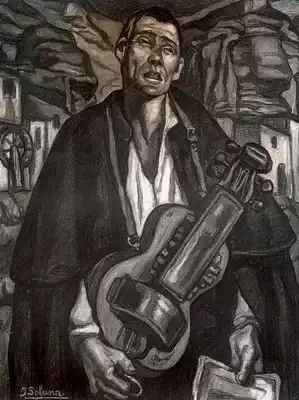
Baltazar Dias

Baltazar Dias is a playwright and poet, a prominent figure in Portuguese Renaissance theatre, known for his "farsas" and "tragicomédies" that combine humor, social satire, and a deep understanding of human nature. His work reflects the cultural and social context of the time, addressing themes such as love, honor, justice, and hypocrisy, with vivid characters and insightful dialogue, maintaining a relevance that transcends his time.
n. , Madeira · m. , Madeira
40
Views
Bio
Identification and Basic Context
Baltazar Dias, also known by his Hebrew name Ben-Rumi, was born in Trancoso, Portugal, around 1520, and died in Coimbra in 1599. He was a Portuguese Jewish playwright and poet, a transitional figure between the Renaissance and the Baroque.Childhood and Education
Although specific details of his childhood and education are scarce, it is known that he belonged to a family of Jewish origin. He likely had access to an education that allowed him to master several languages and the knowledge of the time, given his intellectual output and professional activity.Literary Career
Baltazar Dias began his literary activity as a poet, but his name is mostly associated with theatre. He wrote "farsas" and "tragicomédies" that were performed in Coimbra, where he lived for much of his life. His theatrical work developed during a period when Portuguese theatre was beginning to take shape and reflect the social and cultural concerns of the country.Work, Style, and Literary Characteristics
Baltazar Dias's best-known works are his "farsas" and "tragicomédies," such as "A Comédia de Dom Cristóvão de Chaves" and "O Triste de Querer Bem." His style is marked by social satire, humor, and insightful observation of human nature. He uses accessible language, but full of subtleties, and creates believable characters that reflect the different social strata of the time. He explores themes such as courtly love, honor, justice, madness, and hypocrisy.Cultural and Historical Context
Baltazar Dias lived in a period of great transformations in Portugal, marked by maritime expansion, the Inquisition, and the Iberian Union. As a Jew, his life was under constant scrutiny, which may have influenced his satirical work and his critical view of society. He was a contemporary of Camões and lived through the transition of literary movements such as the Renaissance to the Baroque.Personal Life
Baltazar Dias lived in Coimbra, where he practiced medicine and integrated into the city's academic and social life. His status as a Marrano Jew (New Christian) implied a life of caution, especially in the context of the Inquisition. His personal and family relationships are not known in detail, but his work shows a deep understanding of customs and social dynamics.Recognition and Reception
During his lifetime, Baltazar Dias enjoyed some recognition, especially in the theatrical and academic circles of Coimbra. His work was valued for its originality and social relevance. However, his broader recognition and entry into the Portuguese literary canon were consolidated later, with studies highlighting his importance for the development of theatre in Portugal.Influences and Legacy
Baltazar Dias was influenced by classical theatre and popular traditions. His legacy lies in his contribution to the foundation of Portuguese theatre and the creation of a satirical and socially observant style that influenced later authors. His work continues to be studied for its historical and literary relevance.Interpretation and Critical Analysis
Baltazar Dias's work has been interpreted as a mirror of 16th-century Portuguese society, with its virtues and vices. His social satire is often seen as a critique of the hypocrisy, ostentation, and injustices of the time. His characters, often archetypal, allow for an analysis of universal human dynamics.Curiosities and Lesser-Known Aspects
As a New Christian, Baltazar Dias may have used humor and satire as a way to express veiled criticisms of society without raising excessive suspicion from the Inquisition. His dual identity, as a doctor and as a playwright, reveals a multifaceted mind and a deep interest in human aspects.Death and Memory
Baltazar Dias died in Coimbra in 1599. Although some of his works were published during his lifetime, others were preserved in manuscripts, being recovered and studied later. His memory is associated with the foundation of Portuguese theatre and his insightful social observation.Poems
0No poems found
Comments (0)
Log in
to post a comment.
No comments yet. Be the first to comment.