
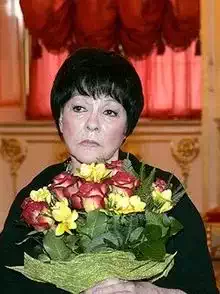
Bella Akhmadúlina
 RU
RU
Bella Akhmadulina was a prominent Russian poet, known for her refined lyricism and emotional expressiveness. Her poetic work is marked by formal beauty, the exploration of universal themes such as love, memory, and the passage of time, and a deep aesthetic sensibility. Akhmadulina emerged as an important voice in 20th-century Russian poetry, captivating readers with her elaborate language and her ability to evoke vivid imagery and profound feelings. Her legacy endures as a testament to the power of poetry in expressing the complexities of the human experience.
n. 1937-04-10, Moscovo · m. 2010-11-29, Peredelkino
Bio
Identification and basic context
Bella Akhmadulina, whose full name was Isabella Akhatovna Akhmadulina, was one of the most important Russian poets of the 20th century. She was born in Moscow, in the then Soviet Union. She was a central figure in Russian poetry, known for her high-quality lyricism and her resistance to political pressures that could compromise her artistic integrity. Akhmadulina wrote in Russian.Childhood and education
Bella Akhmadulina's parents came from distinct backgrounds: her father was Tatar and her mother, of Russian and Italian descent, was a translator. This ethnic and cultural diversity may have contributed to her eclectic worldview. From an early age, she showed an aptitude for literature and poetry, being influenced by readings and the cultural environment of her time. Her formal education included participation in literary circles and the absorption of various artistic and philosophical currents.Literary career
Bella Akhmadulina's writing began in her youth, when she started composing her first poems. Her work evolved over time, maintaining a consistent line in her pursuit of beauty and emotional depth, but also demonstrating growing maturity and sophistication. She published in various Russian literary journals, gaining notoriety for the unique quality of her poetry. Her activity as a writer was marked by exclusive dedication to poetry, without significant parallel activities such as criticism or large-scale translation.Work, style, and literary characteristics
Bella Akhmadulina's works, such as "A String" and "The Decembrists' Music," reflect a deep exploration of love, memory, nature, and the human condition. Her style is characterized by rich and ornate language, with a notable use of metaphors and vivid imagery. Akhmadulina frequently used more traditional poetic forms, but with a modern sensibility, employing a musical rhythm and cadence that give her poetry a unique sonority. Her poetic voice is often described as lyrical, confessional, and deeply feminine, but with a universal strength. Her vocabulary is erudite, and imagistic density is a trademark. She introduced thematic and formal innovations in Russian poetry, engaging with tradition but always with an original perspective. She is often associated with Russian post-Symbolism and Modernism.Work, style, and literary characteristics
Cultural and historical context Bella Akhmadulina lived most of her life under the Soviet regime, a period of strong restrictions on freedom of expression. Her poetry, although not overtly political, carried a deep humanity and a search for spiritual and aesthetic values that contrasted with the official ideology. She maintained relationships with other writers and intellectuals of the time, some of whom faced persecution. She belonged to a generation of poets who tried to preserve artistic integrity in difficult times. Her work sometimes reflected the tensions and dilemmas of her time, but always through a lyrical and personal lens.Work, style, and literary characteristics
Personal life Bella Akhmadulina's personal relationships, including her marriages to renowned poets like Yevgeny Yevtushenko, had an impact on her life and, indirectly, on her work. Her friendships and literary rivalries were part of the vibrant, yet sometimes tense, Soviet literary scene. Personal experiences and possible crises, although rarely explicitly stated in her poetry, contributed to the emotional depth that characterizes it. Although dedicated to poetry, like many artists in non-liberal regimes, she may have faced financial difficulties or pressure to conform.Work, style, and literary characteristics
Recognition and reception Bella Akhmadulina achieved a prominent place in Russian and, subsequently, international literature. She received several awards and distinctions in Russia, and her work was widely recognized for its literary quality. Critical reception of her work was generally very positive, both during her life and posthumously, being considered one of the most significant poetic voices of the 20th century in the Russian language. Her popularity among Russian readers was notable.Work, style, and literary characteristics
Influences and legacy Akhmadulina was influenced by classical and Symbolist Russian poets, but also absorbed elements of European poetry. Her legacy is immense, having influenced later generations of Russian poets with her lyrical style and artistic integrity. Her work is part of the Russian literary canon. Her poetry has been translated into various languages, allowing its international dissemination and recognition of its impact on world literature.Work, style, and literary characteristics
Interpretation and critical analysis Bella Akhmadulina's work is open to multiple interpretations, addressing universal themes such as mortality, the pursuit of beauty, and the fleeting nature of existence. Critical analysis often focuses on the complexity of her imagery, the musicality of her verses, and her ability to express deep emotions with elegance and precision. Critical debates may center on the relationship between her poetry and the political context in which it was written, as well as her position within the Russian literary tradition.Work, style, and literary characteristics
Curiosities and lesser-known aspects A curious aspect of her personality may be her apparent physical fragility contrasting with the strength and resilience of her work and character. Her dedication to artistic purity, even in the face of external pressures, is a testament to her integrity. Striking episodes in her life, such as her participation in human rights defense events or her relationship with prominent literary figures, contribute to a more complete profile of the author.Work, style, and literary characteristics
Death and memory Bella Akhmadulina passed away in Moscow. The circumstances of her death are not often highlighted as a central point of her biography; her literary legacy is more prominent. Posthumous publications continued to disseminate her work, ensuring her memory and her presence in Russian literature.Poems
0No poems found
Comments (0)
No comments yet. Be the first to comment.