
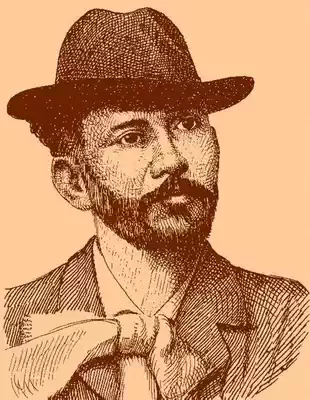
Bernardino Lopes
 BR
BR
Bernardino Lopes was a Portuguese poet associated with the Neorealist movement. His work, marked by a strong social and interventionist component, reflects the concerns and struggles of the working people. Lopes's poetry is characterized by direct language, expressive imagery, and a tone of denunciation and hope. He explored themes such as the condition of the worker, social injustice, resistance, and the search for a more dignified future, establishing himself as an authentic voice in Portuguese social poetry.
n. 1859-01-01, Rio de Janeiro · m. 1916-01-01, Rio de Janeiro
Bio
Identification and Basic Context
Bernardino Lopes was a Portuguese poet whose work is predominantly situated within the Neorealism context. Born in 1924 and passed away in 1994. His poetic identity is strongly linked to his origins and life experiences that shaped his worldview and artistic expression. He was a poet of intervention, whose writing became a vehicle for expressing the social and political concerns of his time, with a particular focus on the working classes.Childhood and Education
Bernardino Lopes's childhood and youth were marked by the social and economic conditions of Portugal during the first decades of the 20th century. Likely from a popular background, his upbringing was probably influenced by the realities of work and the struggle for survival. His formal education may have been limited, but his observational skills and sensitivity to social issues allowed him to develop a critical consciousness that was reflected in his poetry.Literary Career
Bernardino Lopes emerged as a poet at a time when Neorealism was gaining strength in Portugal, a movement characterized by its concern with social reality, denunciation of injustices, and defense of workers' rights. His poetry, marked by this context, focused on the representation of the life and struggles of the people. He published several works throughout his career, consolidating his voice as one of the important figures of Portuguese interventionist poetry. He collaborated in publications linked to the Neorealist movement and in social newspapers.Work, Style, and Literary Characteristics
Bernardino Lopes's work is essentially poetic and deeply rooted in social themes. His poems address the condition of the worker, the hardship of labor, oppression, hope for change, and solidarity among the oppressed. His style is direct and expressive, using language that evokes everyday reality and genuine emotions. He employs strong imagery and a tone that is often combative, but also lyrical and hopeful. His poetry seeks to give voice to the voiceless, denouncing inequalities and celebrating human resilience. One of his best-known books is "Poemas de Luta e Esperança" (Poems of Struggle and Hope). Lopes's meter and poetic form tend to be accessible, prioritizing message and emotional strength over complex formal experimentation, aligning with the Neorealist aesthetic that sought clear communication with the people.Cultural and Historical Context
Bernardino Lopes lived and produced his work during a period of great political and social instability in Portugal, marked by the Estado Novo dictatorship. Neorealism, to which he was associated, was a literary movement that sought to give form to cultural resistance against the regime, portraying the lives of the working classes and denouncing social injustices. His poetry reflects this atmosphere of struggle and yearning for freedom, dialoguing with other writers and artists who shared similar concerns. The regime's censorship, coupled with political repression, created a difficult environment for artists and intellectuals committed to social causes.Personal Life
Although details of Bernardino Lopes's personal life are less publicized compared to his work, it is reasonable to infer that his life experiences, connected to popular circles and work, were fundamental in shaping his social consciousness and poetic inspiration. His dedication to interventionist poetry suggests a strong sense of justice and a desire to contribute to improving the living conditions of the underprivileged. His life was likely marked by a passion for writing and a conviction in the causes he defended.Recognition and Reception
Bernardino Lopes is recognized as an important poet in the Portuguese Neorealism landscape. His work, although perhaps not reaching the same visibility as other more renowned authors, holds a secure place in interventionist and social literature. Critical reception of his work tends to value the authenticity of his voice, the strength of his messages, and his ability to express the aspirations of the people. His poetry continues to be studied and appreciated by those interested in social literature and the history of Portuguese literary movements.Influences and Legacy
Bernardino Lopes was influenced by the currents of Neorealism and by poets who, in Portugal and abroad, dedicated their work to the social cause. His legacy lies in his contribution to interventionist poetry, in his ability to portray the life and struggles of the working classes with authenticity and emotion. He inspired poets who came later, demonstrating the importance of poetry as a form of denunciation and hope. His work serves as a testament to a historical period and as an appeal for reflection on social justice.Interpretation and Critical Analysis
Bernardino Lopes's poetry is often interpreted as a mirror of the aspirations and difficulties of the Portuguese people in the mid-20th century. His social criticisms are direct and full of pathos. Critical analysis of his work focuses on his ability to transform concrete reality into poetic material, maintaining a balance between denunciation and hope. His strength lies in the simplicity and depth with which he addresses universal themes such as human dignity, the struggle for freedom, and the search for a better future.Curiosities and Lesser-Known Aspects
Although less known for specific anecdotes, Bernardino Lopes's journey as an interventionist poet within a dictatorial regime is, in itself, a relevant aspect. His resilience in continuing to produce and disseminate his work, even under censorship, demonstrates his strong conviction and commitment to his art and ideas.Death and Memory
Bernardino Lopes passed away in 1994, leaving behind a body of work that endures as a testament to Portuguese interventionist poetry. His memory is kept alive through the reprinting of his books and the study of his work in the context of Neorealist and social literature. He is remembered as a poet who knew how to give voice to the concerns of the people and who dedicated his art to the cause of social justice.Poems
0No poems found
Comments (0)
No comments yet. Be the first to comment.