
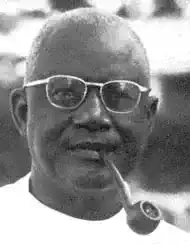
Birago Diop
1906–1989
· lived 82 years
 SN
SN
SN
Birago Diop was a Senegalese poet, writer, and diplomat, a central figure of Négritude. His poetic work, marked by musicality and the evocation of African culture, seeks to reclaim and celebrate the continent's roots and identity. His verses transpose the oral literature, myths, and traditions of African peoples into literature, giving a powerful voice to cultural heritage.
n. 1906-12-12, Dacar · m. 1989-11-25, Dacar
26
Views
Bio
Identification and basic context
Birago Diop was born in Senegal and is one of the most prominent figures of the Négritude literary and intellectual movement. His nationality is Senegalese and the predominant writing language was French, although his work is deeply rooted in African traditions and orality. He lived in a crucial period for the decolonization and cultural affirmation of Africa.Childhood and education
His childhood and education were influenced by the rich oral tradition of his homeland. The absorption of African stories, myths, and proverbs profoundly shaped his worldview and his future literary production. Formal education, combined with a deep knowledge of his people's culture, allowed him to transpose this heritage into literary writing.Literary career
Birago Diop's literary career is intrinsically linked to the Négritude movement, which aimed to revalue African culture in the face of colonial domination. He began his writing as a way to express African identity and combat imposed stereotypes. His work evolved, solidifying his position as one of the greatest poets of Francophone Africa.Work, style, and literary characteristics
Birago Diop's work is characterized by its deep connection to African orality, traditional tales, myths, and beliefs. His poems are marked by a unique musicality, a rhythm that evokes the cadence of oral narration. Themes such as ancestry, the land, African spirituality, and black identity are central to his poetry. He uses a language rich in imagery and symbolism, evoking ancestral wisdom. His writing dialogues with modernity, but without losing the essence of African traditions, being a representative of the Négritude movement.Cultural and historical context
Birago Diop was a key figure in the historical context of the anti-colonial struggle and the affirmation of African identity. As one of the proponents of Négritude, he sought to create a space for African cultural expression on the world stage. His work reflects the aspirations and struggles of his time, engaging with other intellectuals and artists who sought the cultural and political emancipation of Africa.Personal life
In addition to his literary career, Birago Diop had a career as a diplomat, which gave him a broader view of the international scene and the relations between African nations and the rest of the world. His personal life was intrinsically linked to his mission to give voice and dignity to African culture.Recognition and reception
Birago Diop received wide recognition for his contribution to African and Francophone literature. His work is studied and celebrated as a pillar of the Négritude movement, and he is considered one of the greatest African poets of the 20th century.Influences and legacy
Birago Diop was influenced by the rich African oral tradition. His legacy is immense, having inspired generations of African writers and those in the diaspora to explore and celebrate their cultural roots. He helped to place African poetry in the world literary canon, and his work continues to be a fundamental reference for understanding African identity and culture.Interpretation and critical analysis
Birago Diop's work is often analyzed from the perspective of Négritude, highlighting his ability to reclaim and revalue African culture. His poems are seen as a testament to cultural resistance and the search for an authentic identity.Curiosities and lesser-known aspects
Birago Diop is often associated with the oral tradition, having been one of the first to transcribe into literary writing many tales and myths that previously circulated only orally, thus preserving a valuable cultural heritage.Death and memory
Birago Diop passed away, leaving an invaluable literary and cultural legacy. His memory is celebrated as one of the fathers of modern African literature.Poems
0No poems found
Comments (0)
Log in
to post a comment.
No comments yet. Be the first to comment.