
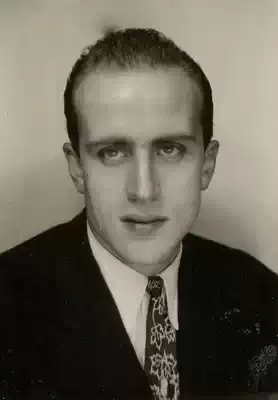
Boris Vian
 FR
FR
Boris Vian was a French writer, poet, playwright, jazz musician, composer, singer, lyricist, translator, critic, and inventor. Recognized for his multifaceted and transgressive literary work, he explored themes such as love, death, social criticism, and the absurdity of existence with a unique style, marked by humor, irony, and linguistic experimentation. His work, often underestimated during his lifetime, achieved enormous posthumous prestige, making him an unmissable figure in 20th-century literature.
n. 1920-03-10, Ville-d'Avray · m. 1959-06-23, 7.º arrondissement de Paris
Bio
Identification and Basic Context
Full name: Boris Paul Vian. Pseudonyms and heteronyms: Bison Ravi, Bis, Vania. Date and place of birth: March 10, 1920, Ville-d'Avray, France. Date and place of death: June 23, 1959, Paris, France. Family background, social class, and original cultural context: Coming from a bourgeois and cultured family, he was exposed from an early age to a stimulating intellectual and artistic environment. Nationality and language(s) of writing: French. Historical context in which he lived: He lived through the interwar period, World War II, and the beginning of the Cold War, periods that profoundly influenced his worldview and his work.Childhood and Education
Family background and social environment: Son of Yvonne and Paul Vian, he grew up in a family with means and a taste for the arts. Social environment: Upper-class family, with strong contact with the Parisian artistic scene. Formal education and self-education: He attended Lycée Carnot and later the École Centrale de Paris, where he studied engineering. However, his education was largely self-taught in the literary and musical fields. Early influences: Jazz music, particularly Louis Armstrong, was a primary influence. Surrealist literature and existentialist philosophy also marked his youth. Literary, philosophical, or artistic movements he absorbed: Surrealism, existentialism. Significant events in his youth: The pneumonia he contracted at age 12, which left him with lasting lung damage, as well as the outbreak of World War II.Literary Career
Beginning of writing: He began writing poetry and short stories in his adolescence. His first novel, "Trouble dans les chez-d'oeuvre," was written in 1943. Evolution over time: He went through various phases, from more surrealistic experimentation to more direct social criticism, always with an innovative tone. Chronological evolution of his work: He started with more experimental works and, over time, his writing became more focused on social criticism and denouncing the absurd, as in "L'Écume des jours." Collaborations in magazines, newspapers, and anthologies: He collaborated with various literary and jazz magazines, including "La Revue Littéraire" and "Jazz Hot." Activity as a critic, translator, or editor: He was a jazz critic, translator (of authors like Raymond Chandler), and wrote song lyrics.Work, Style, and Literary Characteristics
Major works: "L'Écume des jours" (The Froth of the Days, 1947), "La Chute des corps" (The Fall of the Bodies, 1950), "L'Automne à Pékin" (Autumn in Peking, 1956), "Le Goûter du général" (The General's Tea Party, 1950), "L'Arrache-cœur" (The Heartsnatcher, 1953). Dominant themes: Love, death, time, social criticism, absurdity of existence, war, alienation, sexuality. Form and structure: Great formal experimentation, with non-linear narratives, wordplay, neologisms, and genre mixing. Poetic devices: Profuse use of metaphors, wordplay, onomatopoeia, rhythms syncopated by jazz. Tone and poetic voice: Varies between the lyrical, the satirical, the grotesque, the absurd, and the confessional. Language and style: Rich, inventive language, full of neologisms and idiomatic expressions, with a vast vocabulary and impressive imagistic density. Formal or thematic innovations: Introduced a highly personal and innovative language into French prose, combining elements of high culture with popular culture. Relationship with tradition and modernity: Broke with French literary tradition, anticipating many trends of postmodern literature. Associated literary movements: Associated with existentialism and surrealism, although he developed his own unclassifiable style.Cultural and Historical Context
Relationship with historical events: The experience of war and political repression influenced his pessimistic view and criticism of power. Relationship with other writers or literary circles: He had contact with the Parisian existentialist scene, frequenting Café de Flore, and with the jazz world. Generation or movement to which he belongs: He does not strictly fit into a single generation or movement, but is often associated with the post-war generation. Political or philosophical position: Critical of institutions and social conformity. Influence of society and culture on his work: Consumer society, bureaucracy, and social hypocrisy are frequent targets of his satire. Dialogues and tensions with contemporaries: He had complex relationships with other writers, sometimes of admiration, sometimes of distance.Personal Life
Romantic and family relationships: He married Madeleine Ber Li, with whom he had two children. He had significant relationships with other women, such as the singer Juliette Gréco. Friendships and literary rivalries: He maintained friendships with figures from the artistic and intellectual scene. Personal experiences and crises: Fragile health, due to a lung disease, marked his life. Parallel professions: Engineer, jazz musician, composer, lyricist, singer. Religious, spiritual, or philosophical beliefs: Agnosticism, with a strong component of existential questioning. Political positions and civic engagement: Critical of militarism and war.Recognition and Reception
Place in national and international literature: A cult figure in French literature, with growing international recognition. Awards, distinctions, and institutional recognition: He received few distinctions during his lifetime, but his work was widely reissued and celebrated after his death. Critical reception during his lifetime vs. posthumous recognition: During his life, he was a marginalized author misunderstood by much of the official criticism, which saw him as a mere dilettante. Massive recognition only came after his death, with the re-evaluation of his work as a precursor to later literary trends.Influences and Legacy
Authors who influenced him: Lewis Carroll, Alfred Jarry, Raymond Roussel, the Surrealists, the Existentialists, and jazz musicians like Louis Armstrong. Poets and movements he influenced: He influenced generations of writers, especially those interested in linguistic experimentation, social criticism, and genre mixing. Impact on national and world literature: He marked 20th-century French literature and left a legacy in contemporary literature for his originality and audacity. Academic studies dedicated to his work: His work is the subject of study in universities around the world.Interpretation and Critical Analysis
Possible readings of his work: Vian's work can be read as a fierce critique of the social, political, and moral structures of his time, an exploration of love and loss, and a meditation on the absurdity of the human condition. Philosophical and existential themes: The ephemerality of life, the search for meaning in a chaotic world, the oppression of social conventions. Controversies or critical debates: The classification of his literary genre and his place in the history of French literature have been topics of debate, with some critics underestimating his depth.Curiosities and Lesser-Known Aspects
Lesser-known aspects of his personality: Behind his humor and irreverence, he hid great sensitivity and existential anguish. Contradictions between life and work: Although his work criticizes war, he himself was an engineer in the arms industry. Significant or anecdotal episodes: His ability for musical and literary improvisation. Places associated with his creation: Café de Flore, Parisian jazz clubs. Writing habits: He wrote quickly, with great fluidity and pleasure. Curious episodes: His invention of musical instruments.Death and Memory
Circumstances of death: He died of a heart attack, aggravated by the after-effects of his lung disease, while watching a film adaptation of one of his books, "J'irai cracher sur vos tombes" (I Will Spit on Your Graves). Posthumous publications: Many of his works, including plays and songs, were published posthumously and continue to be discovered and edited.Poems
0No poems found
Comments (0)
No comments yet. Be the first to comment.