
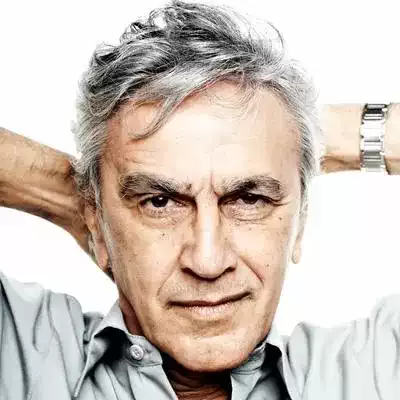
Caetano Veloso
b. 1942
 BR
BR
BR
Caetano Veloso is a Brazilian singer, songwriter, and writer, one of the most influential and innovative figures in Brazilian popular music. World-renowned for his work that spans various musical genres and for his poetic intelligence, Veloso was one of the creators of the Tropicalist movement in the 1960s, revolutionizing the country's cultural landscape. His career is marked by constant sonic experimentation, lyrical sophistication, and a sharp perception of Brazilian social and cultural reality, making him a timeless artist of great impact.
n. 1942-08-07, Santo Amaro
79
Views
Bio
Identification and basic context
Caetano Emanuel Viana Telles Veloso was born in Santo Amaro da Purificação, Bahia. He is a Brazilian singer, songwriter, arranger, writer, and filmmaker. Widely regarded as one of the greatest exponents of Brazilian popular music (MPB) and one of the most influential artists in Latin America. His work is marked by diversity of musical styles and poetic depth.Childhood and education
Caetano Veloso grew up in Santo Amaro da Purificação, Bahia, in a family environment that valued culture and the arts. His sister, Maria Bethânia, would also become a great singer. From an early age, he showed an interest in music, influenced by João Gilberto's samba, who introduced him to Bossa Nova. He studied at Colégio da Bahia and later at Colégio 2 de Julho in Salvador. His musical education was also self-taught, absorbing diverse influences.Literary career
In addition to his vast musical work, Caetano Veloso also developed a significant literary career. He has published books of chronicles, essays, and memoirs, where he explores reflections on music, culture, politics, and society. His writing is characterized by a personal, sharp, and sometimes ironic style, which directly dialogues with his musical and existential themes.Work, style, and literary characteristics
Caetano Veloso's work is vast and multifaceted, spanning over fifty years of career. Musically, he masterfully navigates genres such as samba, bossa nova, rock, reggae, electronic music, funk, and Brazilian regional rhythms. His lyrical poetry is complex, full of imagery, metaphors, and cultural references, addressing themes such as love, identity, Brazil, politics, the ephemerality of time, and the human condition. Constant reinvention is a hallmark of his style, always seeking new sounds and forms of expression.Cultural and historical context
Caetano Veloso emerged on the Brazilian cultural scene in the late 1960s, during a period of intense cultural and political effervescence, marked by the military dictatorship. Along with other artists such as Gilberto Gil, Gal Costa, and Tom Zé, he founded the Tropicalist movement (or Tropicália), which proposed a fusion of elements of Brazilian culture with international influences, challenging the aesthetic and behavioral canons of the time. Tropicalism was a milestone of cultural resistance and modernization of Brazilian art.Personal life
Caetano Veloso had significant relationships that influenced his life and work. He married Dedé Waddell and, later, Paula Lavigne, with whom he had two children. His sister, Maria Bethânia, is a central figure in his life and career. His relationship with Brazil, his homeland, is a recurring and profound theme in his work. He has always shown himself to be an artist engaged in social and political debates, never shying away from expressing his opinions.Recognition and reception
Caetano Veloso is one of the most acclaimed and internationally recognized Brazilian artists. He has received numerous awards throughout his career, including several Latin Grammys. His work is studied in universities and admired by critics and the public worldwide. He is considered an icon of Brazilian culture, an artist who managed to dialogue with tradition and modernity, maintaining an authorial and innovative voice.Influences and legacy
Caetano Veloso was deeply influenced by João Gilberto, his main reference in Bossa Nova. Other influences include The Beatles, Bob Dylan, Brazilian popular culture, concrete poetry, and Tropicalist artists. His legacy is immense: he reinvented Brazilian music, paved the way for experimentation, influenced generations of musicians and composers, and consolidated MPB as a genre of global reach. His ability to synthesize the national and the universal is one of the pillars of his importance.Interpretation and critical analysis
Caetano Veloso's work is rich in layers of interpretation. His critics highlight the complexity of his lyrics, the boldness of his musical experiments, and his ability to capture the spirit of his time. Critical analysis often addresses his role in Tropicalism, his views on Brazilian identity, the relationship between art and politics, and his continuous artistic evolution.Curiosities and lesser-known aspects
Caetano Veloso is known for his erudition and the way he incorporates literary, cinematic, and artistic references into his music. He is also an attentive observer of pop culture and global trends. A curious aspect is his ability to reinvent old songs, giving them new forms and meanings. His concern with words, form, and sound is constant.Death and memory
Caetano Veloso is alive and continues to actively produce and perform. His memory already constitutes one of the greatest legacies of Brazilian culture of the 20th and 21st centuries, an artist who has transcended generations and borders with his art.Poems
0No poems found
Comments (0)
Log in
to post a comment.
No comments yet. Be the first to comment.