
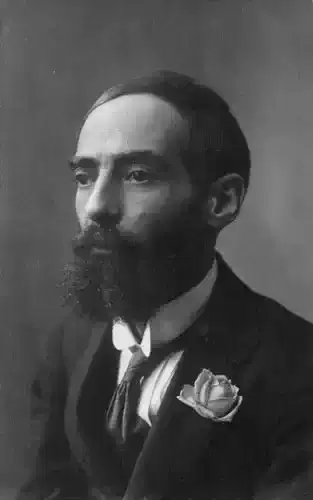
Camilo Pessanha
 PT
PT
Camilo Pessanha was a poet and Portuguese teacher, noted for his poetic work that marked the transition from Symbolism to Modernism in Portugal. His poetry, characterized by melancholy, exoticism, and unparalleled musicality, explores themes such as the ephemerality of time, saudade, love, and death, often through vivid and sensory images. Although his poetic output in volume is reduced, his influence on the Portuguese literary landscape is profound, being considered one of the most important poets in the Portuguese language.
n. 1867-09-07, Coimbra · m. 1926-03-01, Macau
Bio
Identification and basic context
Camilo de Almeida Pessanha, better known as Camilo Pessanha, was born in Coimbra, Portugal. He was a poet, translator, and Portuguese teacher. His poetic work is considered a bridge between Symbolism and Modernism in Portugal.Childhood and education
Camilo Pessanha was born into a wealthy family. He attended the University of Coimbra, where he studied Law, but did not complete the course. From an early age, he showed great interest in literature and Oriental languages. His intellectual formation was marked by diverse readings and a cosmopolitan spirit.Literary career
The beginning of his literary activity dates back to his youth, with contributions to various periodicals. His poetic work, although scarce in volume, is of remarkable richness and depth. He published a single book of poems during his lifetime, "Clepsidra", in 1920, which became a landmark in Portuguese poetry. He also dedicated himself to translation and teaching, lecturing in Macau.Work, style, and literary characteristics
Camilo Pessanha's work is dominated by themes such as the ephemerality of time, saudade, death, love, exoticism, and melancholy. His style is marked by great musicality, the subtlety of images, and the exploration of an erudite and sometimes archaic vocabulary. He frequently used the sonnet, but also explored free verse. His poetry is characterized by a lyrical and introspective tone, with a strong sensory charge.Work, style, and literary characteristics
Cultural and historical context Pessanha lived in a period of profound transformations in Portugal and Europe, including the fall of the Monarchy and the establishment of the Republic. His long period in Macau, a Portuguese colony in Asia, influenced his worldview and his work, bringing elements of exoticism and a broader cultural perspective. He is often associated with Symbolism, but his work anticipates many characteristics of Modernism.Work, style, and literary characteristics
Personal life Camilo Pessanha had a life marked by travels and a certain isolation. He spent much of his adult life in Macau, where he taught and held administrative positions. His personal relationships and his experiences in the East left an indelible mark on his sensibility and his poetry.Work, style, and literary characteristics
Recognition and reception Although his published work during his lifetime was limited, Camilo Pessanha gained increasing recognition over time. "Clepsidra" was acclaimed by critics and consolidated his position as one of the great Portuguese poets. His legacy is widely recognized, and his work continues to be studied and admired.Work, style, and literary characteristics
Influences and legacy Camilo Pessanha was influenced by French Symbolist poets, such as Baudelaire and Verlaine, and by classical poetry. His work, in turn, influenced later generations of Portuguese poets, particularly the modernists, who found in his poetry a model of formal refinement and exploration of subjectivity.Work, style, and literary characteristics
Interpretation and critical analysis Pessanha's poetry is often interpreted as a meditation on the transience of life, the fleeting nature of happiness, and the universality of pain and saudade. His work has been the subject of numerous critical studies exploring its thematic and stylistic complexity.Work, style, and literary characteristics
Curiosities and lesser-known aspects A curious aspect of his life is the fact that he lived for so long in Macau, where he developed a strong connection with Eastern culture. His poetry, although often associated with themes of melancholy, also reveals great sensuality and a deep appreciation for the beauty of the world.Work, style, and literary characteristics
Death and memory Camilo Pessanha died in Coimbra. After his death, his work continued to be disseminated and gained greater notoriety, solidifying his place in the canon of Portuguese literature. His memory endures through his poetic work, considered a treasure of the Portuguese language.Poems
0No poems found
Comments (0)
No comments yet. Be the first to comment.