
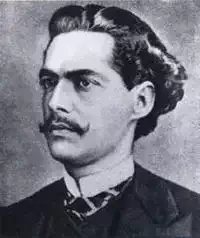
Castro Alves
1847–1871
· lived 24 years
 BR
BR
BR
Antônio Frederico de Castro Alves was one of the greatest poets in Brazilian literature, known as the "Poet of the Slaves". His work is marked by strong lyricism and social and political engagement, with emphasis on the defense of the abolition of slavery. His poetry, vigorous and passionate, thrilled crowds and served as an instrument of struggle against injustice, becoming a symbol of abolitionist romanticism and resistance against oppression.
n. 1847-03-14, Muritiba · m. 1871-07-06, Salvador
135
Views
Bio
Identification and Basic Context
Antônio Frederico de Castro Alves was born on March 14, 1847, in Salvador, Bahia, and died on September 25, 1871, in Rio de Janeiro. He is widely known as the "Poet of the Slaves" or "Social Poet," in recognition of his engagement in the abolitionist struggle. His work established him as one of the greatest representatives of the third generation of Brazilian Romanticism, also known as the "Condoreira Generation" or "Social Generation." The influence of the slave-owning society in which he lived profoundly shaped his writing.Childhood and Education
Castro Alves was the son of a nobleman and landowner, but his childhood was marked by his coexistence with the slave system, which he would later fight against. He studied in Salvador and later moved to Rio de Janeiro to pursue Law at the Faculty of São Francisco. During his youth, he absorbed the liberal and abolitionist ideas circulating at the time, influencing his thinking and literary production. Reading European romantic poets and directly observing social ills were important for his development.Literary Career
The beginning of his literary career occurred during college, with the publication of poems in newspapers and magazines. His work gained national prominence with the publication of "Espumas Flutuantes" (Floating Foams) (1870), which brought together poems from various phases of his production. Castro Alves was a transitional poet, blending the romantic lyricism of the second romantic generation with the social engagement of the third. Despite his relatively short life, his work left an indelible mark on Brazilian literature, especially for his ability to excite and mobilize the public around the abolitionist cause.Work, Style, and Literary Characteristics
Among his most important works are the novel "O Navio Negreiro" (The Slave Ship) (epic poem), "A Cachoeira de Paulo Afonso" (Paulo Afonso Waterfall), "O Adeus" (The Farewell), "O Grito do Ipiranga" (The Cry of Ipiranga), and "Espumas Flutuantes" (Floating Foams). His central themes address love, nature, and, primarily, the denunciation of slavery and the exaltation of freedom. Castro Alves used a grand and rhetorical language, with long and sonorous verses, in line with the condoreiro style. His poetic tone is fervent, epic, and with a strong emotional appeal, seeking to move the reader and incite action. He innovated by bringing social and political themes to Brazilian poetry with the same passion with which he treated love and nature, consolidating Romanticism as an engaged movement.Work, Style, and Literary Characteristics
Cultural and Historical Context Castro Alves lived in a crucial period of Brazilian history, the Second Empire, marked by the continuation of slavery and growing discussions about its abolition. He became the poetic voice of this movement, using his work as a weapon of combat. His generation, the Condoreira, was characterized by its social themes and formal grandeur. He interacted with other intellectuals and activists of the abolitionist cause, strengthening the movement through his poetry.Work, Style, and Literary Characteristics
Personal Life Castro Alves' personal life was intense, although marked by the illness that afflicted him early on. He was known for his bohemian temperament and his passionate love affairs, which were reflected in his lyrical poems. His dedication to the abolitionist cause was unquestionable, and he actively participated in debates and demonstrations. Although he lived off his inherited property, his life was relatively modest, entirely devoted to art and the fight for an ideal.Work, Style, and Literary Characteristics
Recognition and Reception Castro Alves achieved great fame during his lifetime, being acclaimed by the public as the "Poet of the Slaves." His poetry was recited in public, especially "O Navio Negreiro," which caused great commotion. After his death, his recognition was consolidated, and he became one of the most studied and revered poets in Brazil. His work is a fundamental pillar of the Brazilian literary canon, symbolizing the union between art and social engagement.Work, Style, and Literary Characteristics
Influences and Legacy Castro Alves was influenced by romantic poets such as Victor Hugo and Lord Byron. His legacy is immense, primarily for having elevated social poetry to a level of excellence and for having decisively contributed to abolitionist awareness in Brazil. He influenced generations of poets and writers who saw in his work an example of how art can be a transformative force. His poetry continues to be read and admired for its expressive power and profound humanism.Work, Style, and Literary Characteristics
Interpretation and Critical Analysis Castro Alves' work is frequently analyzed from the perspective of social Romanticism and engaged literature. Critics highlight the strength of his verses in denouncing slavery and the passion with which he defended freedom. His poetry is seen as a historical document and a literary manifesto, masterfully combining lyricism and protest.Work, Style, and Literary Characteristics
Curiosities and Lesser-Known Aspects A curiosity about Castro Alves is that, despite his fame as a poet, he was an impassioned orator and actively participated in abolitionist rallies. There are reports that he even fired a shot to defend a slave in a situation of abuse. His work "O Navio Negreiro" was written after he witnessed scenes of cruelty on a sea voyage, which deeply marked him.Work, Style, and Literary Characteristics
Death and Memory Castro Alves died as a result of pulmonary tuberculosis, which weakened him in the last years of his life. His premature death, at the age of 42, caused great national commotion. His memory is celebrated as that of a national hero and one of Brazil's greatest poets, whose abolitionist and literary legacy remains alive.Poems
0No poems found
Comments (0)
Log in
to post a comment.
No comments yet. Be the first to comment.