
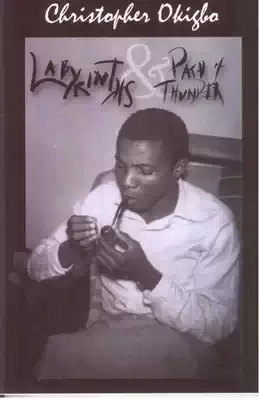
Christopher Okigbo
 NG
NG
Christopher Okigbo was a Nigerian poet, considered one of the most prominent figures in modern African English-language poetry. His work is marked by a deep lyrical sensibility, rich and imagistic language, and an exploration of themes such as African identity, the sacred, war, and the human condition. His influences are diverse, encompassing African oral traditions, classical and modern Western poetry, and a strong spirituality. Okigbo is remembered for his expressive force and his tragic death in combat during the Nigerian Civil War, which lent his work an aura of sacrifice and prophecy. His poetry continues to resonate for its formal beauty and its existential and political relevance.
n. 1930-08-16, Ojoto · m. 1967, Nsukka
Bio
Identification and basic context
Christopher Okigbo was born in 1932 and died in 1967. He was a Nigerian poet whose work is central to African English-language poetry. Pseudonyms or heteronyms are not prominent in his work. His family background belonged to an educated and Christian elite, with ties to Catholic missions, which provided him with a privileged education. He was Nigerian and wrote in English. He lived during a period of great political and cultural effervescence in Nigeria, marked by the struggle for independence and ethnic tensions that would culminate in the Nigerian Civil War (Biafran War).Childhood and education
Okigbo grew up in an environment influenced by both Igbo cultural traditions and missionary education. He attended primary school at the Catholic mission in his hometown and then Umuahia Government College, where he excelled academically. He later studied at University College Ibadan, where he graduated in Classical Literature in 1956. During this period, he was exposed to authors of classical and modern Western literature, as well as intellectual and artistic debates that shaped his worldview. His early readings included poets such as T.S. Eliot, Ezra Pound, and also African oral traditions and mythologies. The university context in Ibadan was a focal point for young Nigerian intellectuals and artists, where Okigbo absorbed and interacted with literary, philosophical, and political ideas.Literary career
Okigbo began writing poetry during his university years. His literary output, although relatively short, was intense and evolved rapidly. Initially, his early works reflected more direct influences from Western poetry, but he quickly developed a distinctive style. His major work is often divided into cycles, each exploring specific themes and using specific imagery, such as the poems in "Heavensgate", "Limits", "Distances", "Idoto", and "Lament of the Flowers", which culminate in his last work, "Come Thunder". He collaborated with important literary magazines of the time, such as "Black Orpheus", which became a fundamental vehicle for modern African poetry. Although his main activity was poetry, he also had an administrative and editorial career, working in publishing houses and as a librarian.Work, style, and literary characteristics
Okigbo's main works include "Heavensgate" (1962), "Limits" (1964), "Distances" (1965), "Idoto" (1960), and "Lament of the Flowers" (1962). Dominant themes in his poetry are African identity in search of itself, the exploration of the sacred, ancestral memory, guilt, redemption, and the inevitability of death and sacrifice, often linked to the context of war. Okigbo uses a variety of forms, experimenting with free verse and structures that evoke traditional African rhythms, as well as more conventional forms, but always with remarkable musicality. His poetic resources are abundant, with vivid metaphors, strong sensory images, alliterations, and assonances that create a rich sonic tapestry. The tone of his poetic voice is often elegiac, mystical, and at times prophetic, conveying a sense of urgency and transcendence. His language is dense, evocative, and erudite, combining English with terms and references from African languages and Yoruba and Igbo mythology. Okigbo is considered one of the pioneers of modern African poetry, integrating elements of African tradition with the techniques of Western modernist poetry. He belongs to a generation of writers who sought to redefine post-colonial African identity.Cultural and historical context
Okigbo lived during the period of decolonization in Africa and the subsequent Nigerian Civil War. His poetry reflects the social, political, and cultural tensions of that era, including the search for an authentic African identity and the conflicts arising from colonial borders. He was part of a vibrant intellectual circle in Ibadan, which included figures such as Wole Soyinka and Chinua Achebe, although their approaches and poetic styles were distinct. His generation, often called the "1960s generation", was committed to asserting an independent African literary voice. His philosophical position was complex, navigating between the Christian heritage and African spiritual traditions, which is reflected in his exploration of the sacred and sacrifice. Nigerian society and culture, with their ethnic and religious diversity, provided the backdrop for his work, while the Biafran war had a direct and tragic impact on his life and poetry.Personal life
Christopher Okigbo had significant family relationships that shaped his worldview, growing up in a family that combined Catholicism with Igbo cultural traditions. His friendships in the literary and academic circles in Ibadan were important, fostering an environment of intellectual exchange. Okigbo did not live solely from poetry; he worked as an administrator in publishing houses and as a librarian. His beliefs were syncretic, mixing elements of the Catholic faith with traditional African spirituality, which is manifested in his poetry as an exploration of the divine and the ancestral. His decision to join the Biafran army in 1967, despite being a poet, demonstrates his deep civic engagement and his conviction in the political causes of his time.Recognition and reception
Okigbo is widely recognized as one of the most important African poets of the 20th century. His work is studied in universities around the world and is an integral part of the canon of African and world literature. He received significant posthumous recognition, with many of his works being published and reissued after his death. His popularity among readers and academics lies in the formal beauty of his poetry, its thematic depth, and the tragedy of his life and death, which have become intrinsically linked to his work.Influences and legacy
Okigbo was influenced by a wide range of sources, including classical Greek and Latin poetry, English modernist poets such as T.S. Eliot and Ezra Pound, French Symbolist poetry, and African oral traditions and mythologies, particularly Igbo and Yoruba. His legacy is immense; he influenced generations of African and diaspora poets, who saw in him a model for integrating African heritage with modern and universal poetic techniques. His work is studied for its linguistic and thematic innovation, and his entry into the literary canon is undeniable. His works have been translated into several languages, disseminating his poetry internationally. Academic studies dedicated to his work are numerous, analyzing its complexity, its relationship with history, and its spiritual dimension.Interpretation and critical analysis
Okigbo's work allows for multiple readings, from the perspective of African post-colonial identity to the exploration of universal existential themes such as life, death, and the sacred. Philosophically and existentially, his poetry addresses the search for meaning in a world in transition, the relationship between the individual and the greater forces of history and destiny. His death in combat added a layer of interpretation to his work, seen by many as a prophetic sacrifice, in line with the themes of suffering and redemption he explored. Critical debates frequently focus on the tension between his Western and African influences, and his ability to create a genuinely African and universal poetic voice.Curiosities and lesser-known aspects
Okigbo was known for his distinctive appearance and his strong aesthetic sense. His poetry, though often complex, was written with remarkable discipline and focus. A curious aspect is how his life ended so dramatically, mirroring in a way the themes of sacrifice and destiny present in his work. His decision to join the Biafran army was an act of deep political and personal conviction, which had an undeniable impact on the perception of his work. Manuscripts and correspondence continue to be important sources for the study of his life and poetic creation.Death and memory
Christopher Okigbo died in 1967 during the Nigerian Civil War, in combat in the service of Biafra. His premature death shocked the literary world and solidified his image as a tragic hero and a martyr for his cause. After his death, several of his works were published posthumously, ensuring his permanence in the literary landscape. His memory is celebrated as one of Africa's greatest poets, whose life and work became a symbol of struggle, beauty, and sacrifice.Poems
0No poems found
Comments (0)
No comments yet. Be the first to comment.