
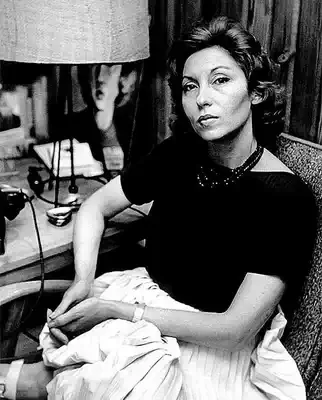
Clarice Lispector
 BR
BR
Clarice Lispector was a Brazilian writer, born in Ukraine, known for her introspective and innovative prose. Her work explores the human condition, identity, the mystery of existence, and the epiphanies of everyday life. With a unique style, marked by subjectivity and fragmentation, Clarice delved into the depths of consciousness, revealing the unspeakable and the uninterrupted flow of inner life. Her writing defies easy classification, moving between stream of consciousness, existentialism, and a profound lyrical sensitivity.
n. 1920-12-10, Chechelnyk · m. 1977-12-09, Rio de Janeiro
Bio
Identification and Basic Context
Clarice Lispector, whose birth name was Chaya Pinkhasivna Lispector, was one of the most important Brazilian writers of the 20th century. Born in Tchetchelnik, Ukraine, on December 10, 1920, she moved to Brazil with her family as a child, settling in Rio de Janeiro. She adopted the name Clarice and, later, the surname Lispector, which would become inseparable from her work. Her nationality was Brazilian. She lived most of her life in Rio de Janeiro and Recife, immersed in the cultural and social context of Brazil in the mid-20th century.Childhood and Education
Clarice's childhood was marked by antisemitic persecution in Ukraine, which led her family to emigrate to Brazil when she was only five years old. They arrived in Maceió, then Recife, where her father prospered, and finally settled in Rio de Janeiro. Despite having a relatively comfortable childhood in Brazil, the memory of tragedy and the Jewish diaspora permeated her sensitivity. Her formal education was interrupted by the tuberculosis that afflicted her mother, leading her to abandon her studies. It was largely at home that she developed her love for reading and writing, influenced by her mother, who read her excerpts from the Bible and novels. Reading authors such as Dostoevsky, Proust, and Virginia Woolf shaped her literary vision.Literary Career
Clarice Lispector began writing at a very young age. Her first novel, "Near to the Wild Heart," was published in 1943, when she was only 23 years old, and it made a great impact due to its originality and modernity. Throughout her career, she published novels, short stories, and chronicles, relentlessly exploring the complexities of human existence. Her work evolved from an early phase marked by more experimental and introspective language to an even deeper exploration of the feminine soul and existential anguish. She actively participated in Brazilian literary life, albeit discreetly, and her chronicles, published in newspapers, revealed a more accessible side of her prose.Work, Style, and Literary Characteristics
Among her most notable works are "The Passion According to G.H.," "Água Viva," "The Hour of the Star," and "Family Ties." Her central themes revolve around identity, solitude, love, death, epiphany, the search for the meaning of life, and the relationship between human beings and the transcendent and the world. Clarice frequently used stream of consciousness and narrative fragmentation to capture the complexity of thought and sensation. Her language is dense, imagistic, and sensory, often starting from the concrete to reach the abstract and metaphysical. The poetic voice in her work is often confessional and introspective, seeking to unravel the mystery of being. She innovated by bringing a radically subjective and philosophical approach to the human experience to Brazilian literature, engaging with existentialism and post-structuralism, but maintaining a singular and unmistakable voice, associated with late modernism and introspective prose.Work, Style, and Literary Characteristics
Cultural and Historical Context Clarice Lispector lived in a period of intense social and cultural transformation in Brazil, marked by democratic and dictatorial periods, urbanization, and modernization. Her work, although markedly personal and introspective, engages with the existential anxieties of her time. She was acquainted with great names in Brazilian literature such as Cecília Meireles and Vinicius de Moraes, although she maintained a reserved stance regarding literary circles. Her writing, at times hermetic and challenging, reflected the tensions between tradition and modernity in Brazilian art.Work, Style, and Literary Characteristics
Personal Life Clarice Lispector's personal life was marked by a marriage to diplomat Maury Gurgel Valente, which led her to live in various countries, including Italy, England, and the United States. This experience abroad, while enriching, also made her deeply homesick for Brazil. She had two sons, Pedro and Antônio. Writing was her refuge and her main form of expression, a constant quest to unravel the mysteries of the soul. She suffered from her mother's illness and from social and familial pressures, which at times distanced her from writing. Her dedication to poetry and prose was almost a private religion, an exploration of the most intimate truths.Work, Style, and Literary Characteristics
Recognition and Reception Clarice Lispector gained national and international recognition during her lifetime, especially after the publication of "The Passion According to G.H." Her work was praised for its originality and depth, but also generated debates due to its complexity and hermeticism. Over time, her prestige only grew, consolidating her as an icon of Brazilian literature and a reference point in world literature. Her unique style and her ability to penetrate the human psyche have earned her a prominent place both in academia and among readers eager for literature that transcends the ordinary.Work, Style, and Literary Characteristics
Influences and Legacy Clarice Lispector was influenced by authors such as Virginia Woolf, James Joyce, Franz Kafka, and Marcel Proust, whose stream-of-consciousness techniques and psychological exploration she masterfully adapted. Her legacy is immense: she influenced generations of Brazilian and Latin American writers, opening new paths for introspective prose and the exploration of subjectivity. Her work is studied in universities worldwide, translated into numerous languages, and continues to challenge and enchant readers with its depth and originality. Clarice's entry into the literary canon is undeniable, being considered one of the greatest writers in the Portuguese language.Work, Style, and Literary Characteristics
Interpretation and Critical Analysis Clarice Lispector's work has been the subject of numerous critical interpretations, exploring its philosophical, psychological, and existential layers. Readings associate her with existentialism, phenomenology, and psychoanalysis, seeking to understand her quest for "being" and her way of representing the experience of time and consciousness. Critical discussions often revolve around the difficulty of classifying her work and the genius of her language, which defies literary conventions.Work, Style, and Literary Characteristics
Curiosities and Lesser-Known Aspects Clarice had a fascination with animals, especially dogs, who appear in her work and her life. She was known for her discretion and a certain shyness at social events. Her writing routine was rigorous, and she valued silence and solitude for creation. It is said that she wrote on old typewriters and that her manuscripts were meticulously organized. A curious episode involves her participation in television programs, where her slow speech and deep thoughts caused bewilderment and admiration among the audience.Work, Style, and Literary Characteristics
Death and Memory Clarice Lispector died in Rio de Janeiro on December 9, 1977, one day before her 57th birthday, from ovarian cancer. Her death, though sad, did not diminish the impact of her work. Posthumous publications continued to reveal facets of her thought and writing, solidifying her memory as one of the most unique and powerful voices of modern literature.Poems
0No poems found
Comments (0)
No comments yet. Be the first to comment.