
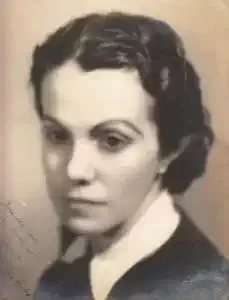
Dulce María Loynaz
1902–1997
· lived 94 years
 --
--
--
Dulce María Loynaz was a Cuban poet and novelist, a key figure in the literature of the 20th century in her country. Her work, marked by deep introspection, exquisite sensitivity, and a refined style, explores themes such as solitude, love, death, and the fleetingness of time. Despite later recognition, her legacy is fundamental to understanding the evolution of modern Cuban poetry, standing out for its originality and mastery of language.
n. 1902-12-10, Havana · m. 1997-04-27, Havana
56
Views
Bio
Identification and basic context
Dulce María Loynaz del Castillo was a Cuban poet and novelist, born on December 25, 1902, in Havana and died on April 25, 1997, in the same city. She is considered one of the most important voices of 20th-century Cuban lyric poetry. Coming from a family of prestigious military men and politicians, her life was marked by deep sensitivity and an inclination towards introspection and solitude.Childhood and education
Her childhood was spent in an atmosphere of relative comfort, surrounded by a cultured and influential family. She was educated at home and received a solid humanistic education, becoming interested in literature, music, and the arts from a very young age. Her father, Enrique Loynaz, was a general in the Liberation Army and a writer, which undoubtedly influenced her early literary vocation. The family environment and her own introspective nature led her to develop a rich and complex inner world.Literary career
She began writing poetry at a very young age, publishing her first verses in the magazine "La Novela Semanal" in 1920. However, her literary career gained significant momentum in the 1930s with the publication of "Versos" (1938), a work that brought her recognition in Cuban literary circles. Throughout her life, her literary output was rather scarce in quantity but of exceptional quality, characterized by deep meditation and a refined style. In 1958, she published her novel "Jardín," which later became a cult classic. After the Cuban Revolution, Loynaz withdrew from public and literary life, dedicating herself to a life of reclusion and reflection, which was reflected in the maturity and depth of her later work.Work, style, and literary characteristics
Dulce María Loynaz's work is distinguished by its intimate lyricism, its deep meditation on existence, and its mastery of language. Her recurring themes include solitude, unrequited or idealized love, death, the fleetingness of time, nature, and the search for identity. Her style is sober, elegant, and precise, characterized by an apparent simplicity that hides great semantic and emotional complexity. She masterfully uses free verse, although her poetry often possesses an internal musicality and rhythm that evoke classical forms. In "Jardín" (1958), her only novel, she explores existential solitude through characters who inhabit a timeless and dreamlike space. Nature, especially the sea and flowers, is a recurring and symbolic element in her work. Her poetry is often considered an expression of modern sensibility, marked by introspection and the search for meaning.Cultural and historical context
Loynaz's work is framed within a period of profound social and political changes in Cuba. She lived through the era of the Republic, the Cuban Revolution, and the years that followed. Her decision to withdraw from public life after the Revolution isolated her from official literary circles, but it did not diminish the quality of her output. Her work relates to currents of introspective and existentialist poetry and is often associated with a post-symbolist and modernist sensibility. Despite her seclusion, her figure was recognized and valued by subsequent generations of Cuban writers.Personal life
Dulce María Loynaz led a relatively private life, marked by her introspective nature and her deep connection with her inner world. No publicly known significant romantic or family relationships influenced her work directly, beyond the family environment of her childhood. Her voluntary reclusion after the Cuban Revolution accentuates the image of a woman dedicated to contemplation and literary creation in privacy. Her personal or philosophical beliefs, though not explicitly stated, seem to lean towards an existentialist vision and a deep appreciation for beauty and spirituality.Recognition and reception
The full recognition of Dulce María Loynaz's work came posthumously. Although appreciated during her lifetime by a circle of connoisseurs, it was in the last decades of the 20th century and the early 21st century that her work began to be revalued and widely disseminated. In 1992, she received the Cervantes Prize, the highest award in Spanish-language literature, a recognition that consolidated her place in the history of Hispanic American literature. Her poetry is today studied and admired for its originality, depth, and aesthetic beauty.Influences and legacy
While Loynaz possessed a very personal voice, echoes of poets like Juan Ramón Jiménez or Gabriela Mistral, who also explored intimacy and nature with great mastery, can be perceived in her work. Her legacy is immense for Cuban and Latin American poetry, having contributed a work of profound originality, marked by introspection, aesthetic quality, and the exploration of the human condition. Her influence is felt in contemporary poets who seek an authentic and transcendent lyrical expression.Interpretation and critical analysis
Loynaz's work is the subject of analysis that highlights her ability to express the complexities of human existence through a refined and evocative poetic language. Her work has been interpreted as a search for transcendence in solitude, a meditation on the fleetingness of life, and a deep exploration of the self. Critics agree on the universality of her themes and the aesthetic beauty of her poetry.Childhood and education
After the Cuban Revolution, Loynaz self-exiled herself in her own home, cultivating a garden that became her refuge and source of inspiration. This voluntary reclusion, which lasted for decades, contributed to weaving an aura of mystery and mysticism around her figure. Her writing was meticulous and selective, reflecting her constant search for formal and expressive perfection.Death and memory
Dulce María Loynaz died in Havana in 1997. Her death marked the end of a life dedicated to contemplation and literary creation. Her memory endures through the vitality of her work, which continues to be read, studied, and admired, ensuring her permanent place in the canon of Spanish-language literature. Her home and legacy are preserved as a space for literary and cultural reflection.Poems
0No poems found
Comments (0)
Log in
to post a comment.
No comments yet. Be the first to comment.