Poems List

Thanksgiving

Thanksgiving


Gettin' together to smile an' rejoice,
An' eatin' an' laughin' with folks of your choice;
An' kissin' the girls an' declarin' that they
Are growin' more beautiful day after day;
Chattin' an' braggin' a bit with the men,
Buildin' the old family circle again;
Livin' the wholesome an' old-fashioned cheer,
Just for awhile at the end of the year.
Greetings fly fast as we crowd through the door

And under the old roof we gather once more
Just as we did when the youngsters were small;
Mother's a little bit grayer, that's all.
Father's a little bit older, but still
Ready to romp an' to laugh with a will.
Here we are back at the table again
Tellin' our stories as women an' men.


Bowed are our heads for a moment in prayer;
Oh, but we're grateful an' glad to be there.
Home from the east land an' home from the west,
Home with the folks that are dearest an' best.
Out of the sham of the cities afar
We've come for a time to be just what we are.
Here we can talk of ourselves an' be frank,
Forgettin' position an' station an' rank.


Give me the end of the year an' its fun
When most of the plannin' an' toilin' is done;
Bring all the wanderers home to the nest,
Let me sit down with the ones I love best,
Hear the old voices still ringin' with song,
See the old faces unblemished by wrong,
See the old table with all of its chairs
An' I'll put soul in my Thanksgivin' prayers.
621

The Bachelor's Soliloquy

The Bachelor's Soliloquy

To wed, or not to wed; that is the question;
Whether 'tis nobler in the mind to suffer
The bills and house rent of a wedded fortune,
Or to say "nit" when she proposes,
And by declining cut her. To wed; to smoke
No more; And have a wife at home to mend
The holes in socks and shirts
And underwear and so forth. 'Tis a consummation
Devoutly to be wished. To wed for life;

To wed; perchance to fight; ay, there's the rub;
For in that married life what fights may come,
When we have honeymooning ceased
Must give us pause; there's the respect
That makes the joy of single life.
For who would bear her mother's scornful tongue,
Canned goods for tea, the dying furnace fire;
The pangs of sleepless nights when baby cries;
The pain of barking shins upon a chair and
Closing waists that button down the back,
When he himself might all these troubles shirk
With a bare refusal? Who would bundles bear,
And grunt and sweat under a shopping load?
Who would samples match; buy rats for hair,
Cart cheese and crackers home to serve at night
For lunch to feed your friends; play pedro
After tea; sing rag time songs, amusing
Friendly neighbors. Buy garden tools
To lend unto the same. Stay home at nights
In smoking coat and slippers and slink to bed
At ten o'clock to save the light bills?
Thus duty does make cowards of us all,
And thus the native hue of matrimony
Is sicklied o'er with the pale cast of chores;
And thus the gloss of marriage fades away,
And loses its attraction.
579

Selfishness

Selfishness


Search history, my boy, and see
What petty selfishness has done.
Find if you can one victory
That little minds have ever won.
There is no record there to read
Of men who fought for self alone,
No instance of a single deed
Splendor they may proudly own.


Through all life's story you will find
The miser—with his hoarded gold—
A hermit, dreary and unkind,
An outcast from the human fold.
Men hold him up to view with scorn,
A creature by his wealth enslaved,
A spirit craven and forlorn,
Doomed by the money he has saved.


No man was ever truly great
Who sought to serve himself alone,
Who put himself above the state,
Above the friends about him thrown.
No man was ever truly glad
Who risked his joy on hoarded pelf,
And gave of nothing that he had
Through fear of needing it himself.


For selfishness is wintry cold,
And bitter are its joys at last,
The very charms it tries to hold,
With woes are quickly overcast.
And only he shall gladly live,
And bravely die when God shall call,
Who gathers but that he may give,
And with his fellows shares his all.
840

Reflection

Reflection


You have given me riches and ease,
You have given me joys through the years,
I have sat in the shade of your trees,
With the song of your birds in my ears.
I have drunk of your bountiful wine
And done as I've chosen to do,
But, oh wonderful country of mine,
'How little have I done for you!


You have given me safe harbor from harm,
Untroubled I've slept through the nights
And have waked to the new morning's charm
And claimed as my own its delights.
I have taken the finest of fine
From your orchards and fields where it grew,
But, oh wonderful country of mine,
How little I've given to you!


You have given me a home and a place
Where in safety my babies may play;
Health blooms on each bright dimpled face
And laughter is theirs every day.
You have guarded from danger the shrine
Where I worship when toiling is through,
But, oh wonderful country of mine,
How little have I done for you!


I have taken your gifts without thought,
I have revelled in joys that you gave,
That I see now with blood had been bought,
The blood of your earlier braves.
I have lived without making one sign
That the source of my riches I knew,
Now, oh wonderful country of mine,
I'm here to do something for you!
653

On Quitting

On Quitting

How much grit do you think you've got?
Can you quit a thing that you like a lot?
You may talk of pluck; it's an easy word,
And where'er you go it is often heard;
But can you tell to a jot or guess
Just how much courage you now possess?
You may stand to trouble and keep your grin,
But have you tackled self-discipline?
Have you ever issued commands to you

To quit the things that you like to do,
And then, when tempted and sorely swayed,
Those rigid orders have you obeyed?


Don't boast of your grit till you've tried it out,
Nor prate to men of your courage stout,
For it's easy enough to retain a grin
In the face of a fight there's a chance to win,
But the sort of grit that is good to own
Is the stuff you need when you're all alone.
How much grit do you think you've got?
Can you turn from joys that you like a lot?
Have you ever tested yourself to know
How far with yourself your will can go?
If you want to know if you have grit,
Just pick out a joy that you like, and quit.


It's bully sport and it's open fight;
It will keep you busy both day and night;
For the toughest kind of a game you'll find
Is to make your body obey your mind.
And you never will know what is meant by grit
Unless there's something you've tried to quit.
1,112

Life's Slacker

Life's Slacker

The saddest sort of death to die
Would be to quit the game called life
And know, beneath the gentle sky,
You'd lived a slacker in the strife.
That nothing men on earth would find
To mark the spot that you had filled;
That you must go and leave behind
No patch of soil your hands had tilled.


I know no greater shame than this:
To feel that yours were empty years;
That after death no man would miss
Your presence in this vale of tears;
That you had breathed the fragrant air
And sat by kindly fires that burn,
And in earth's riches had a share
But gave no labor in return.


Yet some men die this way, nor care:
They enter and they leave life's door
And at the end, their record's bare—
The world's no better than before.
A few false tears are shed, and then,
In busy service, they're forgot.
We have no time to mourn for men
Who lived on earth but served it not.


A man in perfect peace to die
Must leave some mark of toil behind,
Some building towering to the sky,
Some symbol that his heart was kind,
Some roadway where strange feet may tread
That out of gratitude he made;
He cannot bravely look ahead
Unless his debt to life is paid.
669

He Who Serves

He Who Serves

He has not served who gathers gold,
Nor has he served, whose life is told
In selfish battles he has won,
Or deeds of skill that he has done;
But he has served who now and then
Has helped along his fellow men.


The world needs many men today;
Red-blooded men along life's way,
With cheerful smiles and helping hands,
And with the faith that understands
The beauty of the simple deed
Which serves another's hour of need.


Strong men to stand beside the weak,
Kind men to hear what others speak;
True men to keep our country's laws
And guard its honor and its cause;
Men who will bravely play life's game
Nor ask rewards of gold and fame.


Teach me to do the best I can
To help and cheer our fellow man;
Teach me to lose my selfish need
And glory in the larger deed
Which smoothes the road, and lights the day
For all who chance to come my way.
690

Ideals

Ideals


Better than land or gold or trade
Are a high ideal and a purpose true;
Better than all of the wealth we've made
Is the work for others that now we do.
For Rome grew rich and she turned to song
And danced to music and drank her wine,
But she sapped the strength of her fibres strong
And a gilded shroud was her splendor fine.


The Rome of old with its wealth and wine
Was the handiwork of a sturdy race;
They builded well and they made it fine
And they dreamed of it as their children's place.
They thought the joys they had won to give,
And which seemed so certain and fixed and sure,
To the end of time in the world would live
And the Rome they'd fashioned would long endure.


They passed to their children the hoarded gold,
Their marble halls and their fertile fields!
But not the spirit of Rome of old,
Nor the Roman courage that never yields.
They left them the wealth that their hands had won,
But they failed to leave them a purpose true.
They left them thinking life's work all done,
And Rome went down and was lost to view.


We must guard ourselves lest we follow Rome.
We must leave our children the finer things.
We must teach them love of the spot called home
And the lasting joy that a purpose brings.
For vain are our Flag and our battles won,
And vain are our lands and our stores of gold,
If our children feel that life's work is done.
We must give them a high ideal to hold.
721

Father

Father


My father knows the proper way
The nation should be run;
He tells us children every day
Just what should now be done.
He knows the way to fix the trusts,
He has a simple plan;
But if the furnace needs repairs,
We have to hire a man.
My father, in a day or two
Could land big thieves in jail;
There's nothing that he cannot do,
He knows no word like "fail."
"Our confidence" he would restore,
Of that there is no doubt;
But if there is a chair to mend,
We have to send it out.

All public questions that arise,
He settles on the spot;
He waits not till the tumult dies,


But grabs it while it's hot.
In matters of finance he can
Tell Congress what to do;


But, O, he finds it hard to meet
His bills as they fall due.


It almost makes him sick to read
The things law-makers say;
Why, father's just the man they need,
He never goes astray.
All wars he'd very quickly end,
As fast as I can write it;
But when a neighbor starts a fuss,
'Tis mother has to fight it.

In conversation father can
Do many wondrous things;
He's built upon a wiser plan
Than presidents or kings.
He knows the ins and outs of each
And every deep transaction;
We look to him for theories,
But look to ma for action.
827

Grace At Evening

Grace At Evening

For all the beauties of the day,
The innocence of childhood’s play,
For health and strength and laughter sweet,
Dear Lord, our thanks we now repeat.


For this our daily gift of food
We offer now our gratitude,
For all the blessings we have known
Our debt of gratefulness we own.


Here at the table now we pray,
Keep us together down the way;
May this, our family circle, be
Held fast by love and unity.


Grant, when the shades of night shall fall,
Sweet be the dreams of one and all;
And when another day shall break
Unto Thy service may we wake.
542

Comments (1)

Log in to post a comment.
Duane Gevert
Duane Gevert

Brilliantly written and a poem that we, OLDER FOLKS, can related to!

Identification and basic context

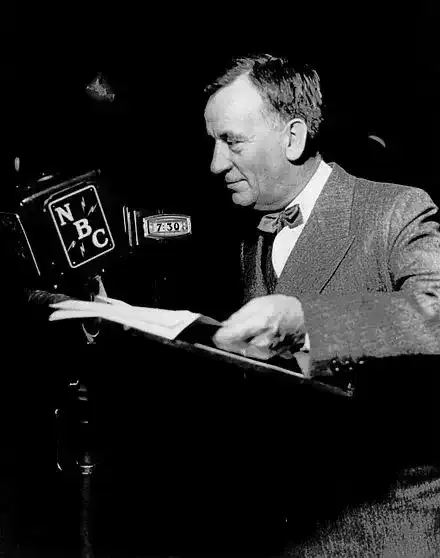
Edgar Albert Guest was a British-born American poet, best known for his sentimental and optimistic verse that focused on everyday life and common experiences. He often wrote under his own name, Edgar Albert Guest.

Childhood and education

Born in Birmingham, England, Guest's family emigrated to the United States when he was ten years old, settling in Detroit, Michigan. His formal education was limited, but he possessed a natural talent for writing from a young age. He began his career in journalism at a young age, which honed his literary skills.

Literary trajectory

Guest began his writing career as a journalist, working for various Detroit newspapers. His poetry, initially published in these papers, quickly gained popularity. He was later hired by the Detroit Free Press, where his poems became a regular feature. His work was syndicated nationally, reaching a vast readership.

Works, style, and literary characteristics

Guest's major works include "A Heap o' Livin'" (1916), "Peacock Feathers" (1920), and "Father wasn't There" (1918). His dominant themes revolved around family, patriotism, optimism, the struggles and joys of ordinary people, and the importance of simple virtues. His style was characterized by its simplicity, clarity, and accessible language, often employing rhyme and regular meter. His poetic voice was warm, familiar, and empathetic, aiming to connect with the reader on a personal level. He aimed for a conversational tone, making his poems feel like direct addresses to the reader.

Cultural and historical context

Guest's poetry flourished during a period of significant social and cultural change in the United States, including World War I and the Roaring Twenties. His work resonated with a public seeking comfort and reassurance during times of upheaval and rapid modernization. He belonged to no specific literary movement but rather represented a strand of popular, accessible verse that was widely embraced by the mass media of the time.

Personal life

Guest's personal life, marked by strong family values and a commitment to community, was reflected in his poetry. He was married and had children, and his poems often drew inspiration from his own domestic experiences and observations of family life. He was also known for his active involvement in civic life and his patriotic sentiments.

Recognition and reception

Edgar Albert Guest achieved immense popularity during his lifetime, becoming one of the most widely read poets in America. His poems were frequently quoted, recited, and published, earning him the moniker "America's People's Poet." While critically, his work was often seen as sentimental, its widespread public appeal and its ability to capture the spirit of the times were undeniable.

Influences and legacy

While Guest did not identify strong literary influences in the academic sense, his work was influenced by the tradition of popular verse and the journalistic style of his era. He, in turn, influenced a generation of readers and writers who appreciated his directness and emotional resonance. His legacy lies in his ability to connect with a broad audience through accessible and heartfelt poetry.

Interpretation and critical analysis

Guest's work is often interpreted as a reflection of the values and aspirations of the American middle class during the early to mid-20th century. Critics sometimes point to its lack of complex literary devices or profound philosophical inquiry, but its strength lies in its emotional authenticity and its ability to articulate common human experiences.

Curiosities and lesser-known aspects

Guest's prolific output and consistent popularity made him a household name. He was also known for his public readings and his ability to engage directly with his audience. His seemingly simple approach to poetry masked a keen understanding of human sentiment and a knack for creating relatable narratives.

Death and memory

Edgar Albert Guest passed away, leaving behind a vast body of work that continues to be remembered for its warmth and its portrayal of an era. His poems are still occasionally read and appreciated for their nostalgic value and their simple, heartfelt messages.