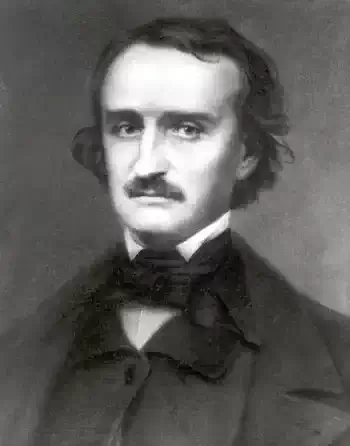
Identification and basic context
Edgar Allan Poe was an American writer, poet, editor, and literary critic, celebrated for his masterful contributions to the genres of mystery, the macabre, and Gothic literature. He is also credited with pioneering detective fiction and crafting early examples of science fiction. Poe's writing is deeply imbued with the spirit of American Romanticism, often exploring themes of death, loss, the supernatural, and the darker aspects of the human psyche. His unique narrative style and thematic preoccupations have left an indelible mark on literature worldwide. He wrote exclusively in English.
Childhood and education
Poe's childhood was marked by tragedy and instability. Orphaned at a young age, he was taken in by the Allan family in Richmond, Virginia, though he never formally adopted their surname. His upbringing, while providing him with education, was often strained by complex familial relationships and financial difficulties. He attended the University of Virginia and later West Point, but his academic pursuits were often cut short by his personal struggles and a developing literary ambition. His early readings exposed him to the Gothic literature and Romantic poetry that would profoundly influence his own creative output.
Literary trajectory
Poe's literary career began with poetry, but he soon found his greatest success in short stories. His early works often graved with themes of loss and melancholy, reflecting his personal experiences. He worked as an editor for various literary magazines, where he not only published his own works but also developed a reputation as a sharp and influential critic. His contributions to periodicals were instrumental in shaping American literary tastes and in advancing the development of the short story as a literary form. His trajectory saw him move from romantic lyricism to the darker, more psychologically complex narratives for which he is now most famous.
Works, style, and literary characteristics
Poe's most famous works include the poems "The Raven," "Annabel Lee," and "Lenore," and the short stories "The Tell-Tale Heart," "The Fall of the House of Usher," "The Murders in the Rue Morgue," and "The Pit and the Pendulum." His dominant themes are death, decay, madness, guilt, the supernatural, and the human capacity for both extreme beauty and terror. Poe's style is characterized by its meticulous craftsmanship, its intense atmosphere, and its psychological realism, even when dealing with fantastical elements. He was a master of creating suspense and dread, employing vivid imagery and a carefully controlled rhythm. His poetic devices often emphasize musicality and rhyme, contributing to the hypnotic quality of his verse. The tone of his work is frequently melancholic, terrifying, or elegiac. Poe's poetic voice is often deeply personal, exploring profound emotional states and existential anxieties. His language is precise and evocative, with a rich vocabulary that enhances the unsettling mood. He is renowned for his innovations in narrative structure and his creation of unforgettable, often tormented, protagonists. His association with the Gothic and Romantic movements is clear, but his work also presaged elements of symbolism and modernism.
Cultural and historical context
Poe lived during a period of significant cultural and intellectual ferment in the United States, known as the American Romantic period. He was part of a literary scene that included contemporaries like Nathaniel Hawthorne and Ralph Waldo Emerson, though his work often stood apart in its darker inclinations. Poe engaged with the intellectual debates of his time, particularly concerning the nature of genius, the role of art, and the exploration of the subconscious. His often-unconventional views and critical stance sometimes placed him at odds with the literary establishment, yet his influence grew steadily.
Personal life
Poe's personal life was profoundly shaped by loss and hardship. The death of his young wife, Virginia Clemm, had a particularly devastating impact on him and is often seen as a direct influence on his preoccupation with themes of death and mourning. His relationships were often marked by intensity and tragedy. He struggled with financial instability and issues with alcohol throughout his life, which contributed to his personal crises. Despite these challenges, he maintained a fierce dedication to his literary craft.
Recognition and reception
Poe gained a degree of recognition during his lifetime, particularly for his critical essays and his more accessible poems. However, it was posthumously that his work achieved its true and lasting fame. "The Raven," in particular, became an instant sensation and cemented his place in literary history. Critical reception of his work has evolved over time, with initial skepticism giving way to profound appreciation for his originality, his psychological depth, and his influence on subsequent literary movements. He is now considered a foundational figure in American literature.
Influences and legacy
Poe was influenced by European Gothic literature, the works of Samuel Taylor Coleridge, and the broader Romantic movement. His legacy is immense and far-reaching. He is considered the inventor of the detective story, with "The Murders in the Rue Morgue" serving as a blueprint for the genre. His influence extends to horror, science fiction, and symbolist poetry. Countless writers, including Arthur Conan Doyle, H.P. Lovecraft, and Charles Baudelaire, have acknowledged Poe's impact on their work. His stories and poems continue to be translated, adapted, and studied globally, solidifying his position as one of the most important figures in world literature.
Interpretation and critical analysis
Poe's work is ripe for interpretation, often analyzed for its exploration of psychological states, the subconscious, and the nature of beauty and terror. His stories are frequently examined for their narrative techniques and their uncanny ability to evoke dread and suspense. Critical debates often center on the biographical elements that may have informed his writing and the extent to which his work represents a dark romanticism or a proto-modernist sensibility.
Curiosities and lesser-known aspects
Poe was known for his sharp critical intellect and his often controversial reviews, which he delivered with unsparing honesty. He was also a man of intense emotions and profound sensitivity. Anecdotes about his life reveal a passionate artist struggling against the constraints of his time and his own personal demons. His writing habits were often characterized by intense periods of creation, fueled by strong coffee and a meticulous attention to detail.
Death and memory
Edgar Allan Poe died under mysterious circumstances in Baltimore, Maryland. The exact cause of his death remains a subject of speculation and debate among historians and literary scholars. His posthumous fame has far surpassed any recognition he received during his life, and his memory is celebrated through the enduring power of his literary creations, which continue to captivate and disturb readers around the world.