
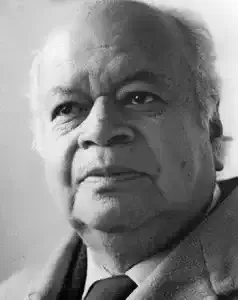
Eduardo Carranza
1913–1985
· lived 71 years
 CO
CO
CO
Eduardo Carranza was a Colombian poet, a prominent figure in 20th-century Hispanic American poetry. His work is marked by deep lyricism and a strong connection to the land, nature, and the traditions of his region. Carranza explored themes such as love, melancholy, the passage of time, and the search for identity, using language rich in imagery and musicality. He is considered one of the great poets of Latin America, whose work resonates for its authenticity and sensitivity.
n. 1913-07-23, Villavicencio · m. 1985-02-13, Bogotá
31
Views
Bio
Identification and basic context
Eduardo Carranza Fernández was born in Apiay, Meta, Colombia, on June 26, 1915, and died in Bogotá on February 14, 1985. Son of Julio Carranza and Clementina Fernández. He was of Colombian nationality and wrote in Spanish. His family origin was linked to the Llanos Orientales region of Colombia, a cultural context marked by the landscape, traditions, and frontier spirit. He lived in a period of intense social and political transformations in Colombia and Latin America.Childhood and education
Eduardo Carranza spent his childhood and youth in the Llanos Orientales region, where the natural environment and local traditions strongly influenced his development. He received a formal education, but his contact with the land, customs, and people of the Llanos profoundly shaped his sensitivity and worldview. Readings of classical and contemporary poets, as well as music and oral stories from the region, were his initial influences. He absorbed the lyrical tradition in Spanish, adapting it to his own voice.Literary journey
Carranza's writing began in his youth, when he started to express the landscapes and feelings of his homeland. His work evolved over time, consolidating a lyrical and evocative style, with phases that deepened his exploration of the human condition and time. He published several books, with "Seis Poemas de Amor" (1934) being one of the early milestones. He contributed to various literary magazines and newspapers in Colombia. His work as a literary critic and his active participation in intellectual circles enriched his journey.Work, style, and literary characteristics
Eduardo Carranza's main works include "Seis Poemas de Amor" (1934), "Canciones de Tierra" (1942), "El Corazón Sangrante" (1947), "Lasieves" (1954), and "Viento" (1962). The dominant themes are love in its various facets, melancholy, longing, the inexorable passage of time, nature (especially the Llanos landscape), death, and the search for identity. Carranza predominantly uses free verse and more traditional poetic forms, with great attention to musicality and rhythm, creating an engaging sound. His poetic resources are abundant in metaphors and comparisons that evoke nature and human emotions. The poetic voice is lyrical, confessional, and deeply emotional, exploring the subjectivity and universality of feelings. His language is rich, evocative, with a vocabulary that ranges from popular to erudite, imbued with sensory images and colors. He introduced a new lyrical sensibility to Colombian poetry, rooted in the landscape and culture of his land, engaging with the Spanish lyrical tradition and seeking an authentic voice in modernity. He is often associated with poetry of a lyrical and intimate tone, with roots in the land.Work, style, and literary characteristics
Cultural and historical context Eduardo Carranza lived in a period of significant social and political changes in Colombia. His poetry, although focused on the intimate and the landscape, reflects a sense of belonging and regional identities in a country searching for its own voice. He was a contemporary of important Colombian and Hispanic American writers, with whom he maintained intellectual relationships. His work is seen as a bridge between the lyrical tradition and poetic modernity in Latin America.Work, style, and literary characteristics
Personal life Eduardo Carranza led a life dedicated to poetry and culture. His affective and family relationships, although not publicly detailed, appear to have been a source of inspiration for his poems of love and melancholy. He maintained friendships with other writers and intellectuals, actively participating in Colombian cultural life. He dedicated himself to diplomacy, holding consular positions in New York, which provided him with contact with other cultures and realities, but his main passion remained literature.Work, style, and literary characteristics
Recognition and reception Eduardo Carranza is widely recognized as one of the most important poets in Colombia and Latin America. He received several awards and distinctions throughout his career. His work has been the subject of study and admiration, consolidating his place in the Latin American literary canon.Work, style, and literary characteristics
Influences and legacy Carranza's influences include poets from the Spanish lyrical tradition. His legacy is immense for Colombian and Latin American poetry, inspiring generations of poets with his ability to unite landscape and emotion in verses of great beauty and depth. His work continues to be studied and celebrated.Work, style, and literary characteristics
Interpretation and critical analysis Carranza's work is often analyzed from the perspective of lyricism, landscape evocation, and the exploration of universal human feelings. His poetry invites reflection on identity, memory, and the passage of time, themes that deeply resonate with readers.Work, style, and literary characteristics
Curiosities and lesser-known aspects A curious aspect of his life is his diplomatic career, parallel to his literary work. The deep connection with the land of the Llanos Orientales is a striking feature that is indelibly reflected in his poetry, making him a poet intrinsically linked to his origins.Work, style, and literary characteristics
Death and memory Eduardo Carranza died in Bogotá in 1985. His memory is celebrated through his published works and the continuous study and appreciation of his poetry, which remains alive in Colombian and Latin American literature.Poems
0No poems found
Comments (0)
Log in
to post a comment.
No comments yet. Be the first to comment.