Poems List

I felt a cleaving in my mind

I felt a cleaving in my mind

I felt a cleaving in my mind
As if my brain had split;

I tried to match it, seam by seam,
But could not make them fit.

The thought behind I strove to join
Unto the thought before,

But sequence ravelled out of reach
Like balls upon a floor.
249

I envy Seas, whereon He rides

I envy Seas, whereon He rides

498

I envy Seas, whereon He rides-
I envy Spokes of Wheels
Of Chariots, that Him convey-
I envy Crooked Hills

That gaze upon His journey-
How easy All can see
What is forbidden utterly
As Heaven-unto me!

I envy Nests of Sparrows-
That dot His distant Eaves-
The wealthy Fly, upon His Pane-
The happy-happy Leaves-

That just abroad His Window
Have Summer's leave to play-
The Ear Rings of Pizarro
Could not obtain for me-

I envy Light-that wakes Him-
And Bells-that boldly ring
To tell Him it is Noon, abroadMyself-
be Noon to Him-

Yet interdict-my Blossom-
And abrogate-my Bee-
Lest Noon in Everlasting Night-
Drop Gabriel-and Me-
411

I Died For Beauty

I Died For Beauty

I died for beauty, but was scarce
Adjusted in the tomb,
When one who died for truth was lain
In an adjoining room.


He questioned softly why I failed?
"For beauty," I replied.
"And I for truth - the two are one;
We brethren are," he said.


And so, as kinsmen met a-night,
We talked between the rooms,
Until the moss had reached our lips,
And covered up our names.
362

I dreaded that first Robin, so

I dreaded that first Robin, so

348

I dreaded that first Robin, so,
But He is mastered, now,
I'm accustomed to Him grown,
He hurts a little, though-


I thought If I could only live
Till that first Shout got by-
Not all Pianos in the Woods
Had power to mangle me-


I dared not meet the Daffodils-
For fear their Yellow Gown
Would pierce me with a fashion
So foreign to my own-


I wished the Grass would hurrySo-
when 'twas time to seeHe'd
be too tall, the tallest one
Could stretch-to look at me-


I could not bear the Bees should come,
I wished they'd stay away
In those dim countries where they go,
What word had they, for me?


They're here, though; not a creature failed-
No Blossom stayed away
In gentle deference to me-
The Queen of Calvary-


Each one salutes me, as he goes,
And I, my childish Plumes,
Lift, in bereaved acknowledgment
Of their unthinking Drums-
351

I could not prove the Years had feet

I could not prove the Years had feet

563

I could not prove the Years had feet-
Yet confident they run
Am I, from symptoms that are past
And Series that are done-

I find my feet have further Goals-
I smile upon the Aims
That felt so ample-YesterdayToday's-
have vaster claims-

I do not doubt the self I was
Was competent to me-
But something awkward in the fit-
Proves that-outgrown-I see-
251

I cried at Pity—not at Pain

I cried at Pity—not at Pain

588

I cried at Pity—not at Pain—
I heard a Woman say
"Poor Child"—and something in her voice
Convicted me—of me—


So long I fainted, to myself
It seemed the common way,
And Health, and Laughter, Curious things—
To look at, like a Toy—


To sometimes hear "Rich people" buy
And see the Parcel rolled—
And carried, I supposed—to Heaven,
For children, made of Gold—


But not to touch, or wish for,
Or think of, with a sigh—
And so and so—had been to me,
Had God willed differently.


I wish I knew that Woman's name—
So when she comes this way,
To hold my life, and hold my ears
For fear I hear her say


She's "sorry I am dead"—again—
Just when the Grave and I—
Have sobbed ourselves almost to sleep,
Our only Lullaby—
254

I could die—to know

I could die—to know

570

I could die—to know—
'Tis a trifling knowledge—
News-Boys salute the Door—
Carts—joggle by—
Morning's bold face—stares in the window—
Were but mine—the Charter of the least Fly—


Houses hunch the House
With their Brick Shoulders—
Coals—from a Rolling Load—rattle—how—near—
To the very Square—His foot is passing—
Possibly, this moment—
While I—dream—Here—
269

I cautious, scanned my little life

I cautious, scanned my little life

178

I cautious, scanned my little life-
I winnowed what would fade
From what would last till Heads like mine
Should be a-dreaming laid.


I put the latter in a Barn-
The former, blew away.
I went one winter morning
And lo - my priceless Hay


Was not upon the "Scaffold"-
Was not upon the "Beam"-
And from a thriving Farmer-
A Cynic, I became.


Whether a Thief did it-
Whether it was the wind-
Whether Deity's guiltless-
My business is, to find!


So I begin to ransack!
How is it Hearts, with Thee?
Art thou within the little Barn
Love provided Thee?
279

I cannot live with You (No. 640)

I cannot live with You (No. 640)

I cannot live with You--
It would be Life--
And Life is over there--
Behind the Shelf

The Sexton keeps the Key to--
Putting up
Our Life--His Porcelain--
Like a Cup--

Discarded of the Housewife-Quaint--
or Broke--
A newer Sevres pleases--
Old Ones crack--

I could not die--with You--
For One must wait
To shut the Other's Gaze down-You--
could not--

And I--could I stand by
And see You--freeze--
Without my Right of Frost-Death's
privilege?

Nor could I rise--with You--
Because Your Face
Would put out Jesus'--
That New Grace

Glow plain--and foreign
On my homesick Eye--
Except that You than He
Shone closer by-


They'd judge Us--How--
For You--served Heaven--You know,
Or sought to--
I could not--

Because You saturated Sight--
And I had no more Eyes
For sordid excellence
As Paradise

And were You lost, I would be--
Though My Name
Rang loudest
On the Heavenly fame--

And were You--saved--
And I--condemned to be


Where You were not--
That self--were Hell to Me--

So We must meet apart--
You there--I--here--
With just the Door ajar
That Oceans are--and Prayer--
And that White Sustenance--
Despair--
353

I cannot buy it—'tis not sold

I cannot buy it—'tis not sold

840

I cannot buy it—'tis not sold—
There is no other in the World—
Mine was the only one


I was so happy I forgot
To shut the Door And it went out
And I am all alone—


If I could find it Anywhere
I would not mind the journey there
Though it took all my store


But just to look it in the Eye—
"Did'st thou?" "Thou did'st not mean," to say,
Then, turn my Face away.
271

Comments (0)

Log in to post a comment.

NoComments

Identification and basic context

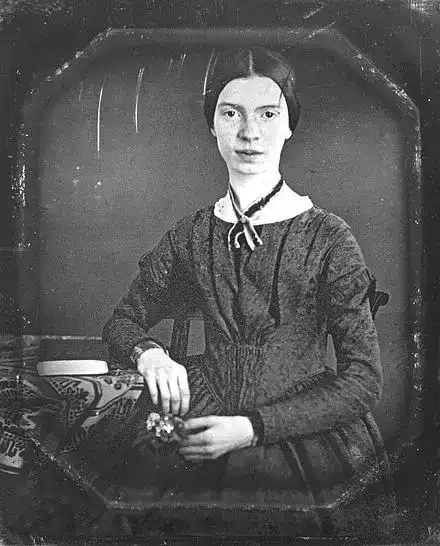
Emily Dickinson is one of America's most celebrated poets. She often wrote under her own name. She was born in Amherst, Massachusetts, and died there. Her family was prominent in Amherst society, and she came from a lineage of lawyers and politicians. She was an American national and wrote in English.

Childhood and education

Dickinson grew up in a devoutly religious household, which likely influenced her later theological explorations. She attended Amherst Academy and Mount Holyoke Female Seminary, receiving a rigorous education for the time. Her early readings included the Bible, works by Ralph Waldo Emerson, and classical literature, which undoubtedly shaped her intellectual and poetic development. Significant events in her youth included periods of intense religious engagement and growing introspection.

Literary trajectory

Dickinson began writing poetry at a young age, with her output increasing significantly in the 1860s. Her style evolved, becoming increasingly concise, introspective, and experimental. While she shared her poems with friends and family, she did not actively seek publication. A few poems were published anonymously during her lifetime, often altered by editors. She did not engage with literary magazines or anthologies in a conventional manner.

Works, style, and literary characteristics

Dickinson's major works are her nearly 1,800 poems, most of which were published posthumously. Dominant themes include nature, death, immortality, faith, doubt, love, and the self. Her poems are known for their radical compression, slant rhyme, unconventional capitalization, and use of dashes. Her poetic devices are striking, creating vivid imagery and a unique rhythm. The tone can range from ecstatic to despairing, often employing irony and a deeply personal voice that transcends to the universal. Her language is precise, often using domestic imagery to explore profound philosophical ideas. She is associated with no specific literary movement but is a precursor to modernism.

Cultural and historical context

Dickinson lived during a period of significant social and intellectual change in the United States, including the abolitionist movement and the Civil War, though these are not overt subjects in her poetry. She engaged intellectually with Transcendentalism, particularly through Emerson's writings, and her work reflects a broader cultural questioning of religious and social norms. Her isolation in Amherst created a unique space for her creative development, setting her apart from established literary circles.

Personal life

Dickinson's personal life was largely private and centered in Amherst. Her relationships with family, particularly her brother Austin and his wife Susan Gilbert, were complex and deeply influential. Friendships, such as with Thomas Wentworth Higginson, provided intellectual companionship and some encouragement. Her intense inner life, marked by periods of profound introspection and perhaps illness, is reflected in the depth and originality of her poetry. She did not pursue a parallel profession, dedicating herself to her inner world and writing.

Recognition and reception

During her lifetime, Dickinson received very little recognition, with only a handful of poems published in altered forms. Her major posthumous publication in 1890 by Mabel Loomis Todd and Thomas Wentworth Higginson marked the beginning of her rise to prominence. Over time, her work has achieved immense critical acclaim and immense academic recognition, establishing her as a central figure in American literature.

Influences and legacy

Dickinson was influenced by the Bible, hymnology, and writers like Ralph Waldo Emerson. Her legacy is immense; she profoundly influenced modern poetry with her innovative use of language, form, and thematic exploration. She is a cornerstone of the American literary canon, and her poems are widely translated, studied, and adapted into music and other art forms. Her work continues to inspire poets and readers worldwide.

Interpretation and critical analysis

Dickinson's poetry invites multiple interpretations, often focusing on her exploration of consciousness, spirituality, and the human condition. Critical analysis has delved into her complex relationship with faith and doubt, her unique perspective on death, and the psychological dimensions of her work. Debates often surround the dating and ordering of her poems and the extent of her engagement with social issues.

Curiosities and lesser-known aspects

Dickinson was known for her reclusive habits in her later years, often dressing in white. There is a fascinating tension between her seemingly quiet life and the radical, often explosive, nature of her poetry. Anecdotal evidence suggests her intense observational skills and a profound, sometimes unsettling, wit. She was known to bake and engage in household activities, which stood in contrast to her abstract poetic explorations.

Death and memory

Emily Dickinson died in Amherst, Massachusetts. Her memory is preserved through her extraordinary body of work, the preservation of her home as a museum, and ongoing critical and scholarly engagement with her life and poetry. Numerous posthumous collections and scholarly editions have ensured her enduring presence in literary history.