
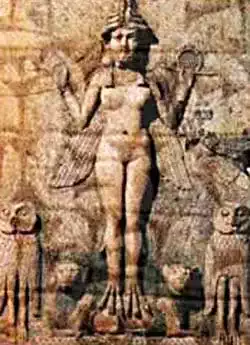
En Hedu'anna

In Hedu'anna is recognized as the first known author in human history, a Sumerian priestess who lived in ancient Mesopotamia. Her poetic work, mainly composed of religious hymns dedicated to the goddess Inanna, reveals a deep spirituality and a remarkable mastery of language. Her writings not only express devotion but also explore universal themes such as power, justice, and compassion, establishing a literary and religious legacy that endures through millennia.
n. 2285ac, Acádia (Mesopotâmia) · m. 2300-01-01
20
Views
Bio
Identification and Basic Context
En Hedu'anna (or Enheduanna) was an Akkadian high priestess and princess, daughter of King Sargon of Akkad. She lived in Sumer, in the city of Ur. She is widely recognized as the first named author in the history of writing, having lived approximately between 2285 and 2250 BC. Her nationality was Akkadian, but she wrote in Sumerian, the liturgical and cultural language of the time in Mesopotamia. She served as En (high priestess) to the moon god Nanna in Ur, a position of immense religious and political power.Childhood and Education
As the daughter of King Sargon of Akkad, En Hedu'anna likely received a privileged education, typical of the elites of the time. The training of an En involved a deep knowledge of religious traditions, rituals, sacred texts, and cuneiform writing. She was likely exposed early to the complex Sumerian and Akkadian mythologies and cosmogonies. Her ascent to the position of En in Ur indicates rigorous religious and intellectual training.Literary Career
En Hedu'anna's literary career is intrinsically linked to her religious role. She is credited with the authorship of numerous hymns and poems, the most famous being those dedicated to the goddess Inanna (Ishtar to the Akkadians). Her best-known work is the "Exaltation of Inanna," a collection of hymns that reveals a complex theology and an intense, personal poetic voice. Her writing is one of the earliest examples of individual authorship and personal expression in religious texts.Work, Style, and Literary Characteristics
En Hedu'anna's main works include the "Hymns to Inanna" and the "Exaltation of Inanna." These poems explore themes such as divine power, justice, love, war, and compassion, through the central figure of the goddess Inanna. En Hedu'anna's style is characterized by its emotional depth, rich imagery, and ability to articulate complex theological concepts. She uses lyrical and powerful language, with an often confessional and exalted tone. She innovated by introducing her own perspective and feelings into religious compositions, a significant step in the evolution of literature.Work, Style, and Literary Characteristics
Cultural and Historical Context En Hedu'anna lived during the Akkadian Empire, a period of expansion and unification under her father Sargon. Her role as En in Ur, a Sumerian city, reflects the cultural intersection between Akkadians and Sumerians. She operated in a context of strong religiosity and the development of cuneiform writing. Her position of power and her literary work demonstrate the importance of women in the religious and cultural spheres of ancient Mesopotamia.Work, Style, and Literary Characteristics
Personal Life As a high priestess and a member of the royal family, En Hedu'anna's personal life was deeply intertwined with her religious and political responsibilities. She was exiled from Ur during a period of conflict, an experience that seems to have influenced her work, particularly the "Exaltation of Inanna," where she recounts her suffering and the goddess's intervention to restore her position. Her spiritual beliefs were central, focused on the worship of Inanna.Work, Style, and Literary Characteristics
Recognition and Reception En Hedu'anna was revered in life and after death. Her name was preserved in copies of her texts that survived for centuries, and her figure was worshipped. She is widely recognized by modern historiography as the first known author, a fundamental milestone in the development of literature and individual expression.Work, Style, and Literary Characteristics
Influences and Legacy En Hedu'anna profoundly influenced the Mesopotamian religious and literary tradition. Her hymns and the way she articulated the relationship between the divine and the human established models for later religious poetry. Her legacy lies in her pioneering status as an author, paving the way for other individuals to express their experiences and thoughts in literary texts. Her impact is felt in the study of the history of literature and religion.Work, Style, and Literary Characteristics
Interpretation and Critical Analysis En Hedu'anna's work has been analyzed from various perspectives, including theological, literary, and feminist. Her "Exaltation of Inanna" is seen as a testament to the complexity of the human experience, the search for justice and redemption, and the strength of the individual spirit in the face of adversity. Her authorship is a crucial point for understanding the evolution of individual consciousness and artistic expression.Work, Style, and Literary Characteristics
Curiosities and Lesser-Known Aspects Despite her historical importance, specific details about her personal life outside of her religious and political role are scarce. The fact that she was exiled from Ur and returned with divine support is a striking episode that reveals the dangers and political complexities of her time. Her ability to transcend mere worship to express personal suffering and hope in her hymns is a remarkable aspect of her genius.Work, Style, and Literary Characteristics
Death and Memory The exact circumstances of En Hedu'anna's death are unknown. However, her memory was preserved through copies of her writings, which were rediscovered and studied centuries later, consolidating her place as the first author in history. There are no records of posthumous publications in the modern sense, but the continuous copying and reading of her texts ensured her survival.Poems
0No poems found
Comments (0)
Log in
to post a comment.
No comments yet. Be the first to comment.