
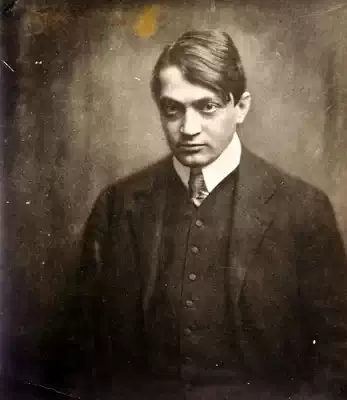
Endre Ady
 HU
HU
Endre Ady was one of the most influential and innovative poets in Hungarian literature. His work is marked by an overwhelming emotional intensity, exploring themes such as love, death, homeland, and spirituality in a deeply personal and, at the same time, universal way. Ady revolutionized Hungarian poetry with his modern language, bold imagery, and raw approach to the human condition. His poetry reflects the complexities of his time and his own soul, with a strong sense of urgency and an incessant search for meaning. He is considered one of the pillars of Hungarian modernism, whose impact on the country's literature endures to this day.
n. 1877-11-22, Ady Endre · m. 1919-01-27, Budapeste
Bio
Identification and basic context
Endre Ady was born in Érmindszent (now Cămin, Romania) in 1877 and died in Budapest, Hungary, in 1919. He used his baptismal name as his primary pseudonym. His family background was of minor rural nobility, but in a context of financial difficulties. His early education took place in a transforming Hungary, under the Austro-Hungarian Empire, a period of strong social, political, and cultural tensions, with growing nationalism and debates about Hungarian identity.Childhood and education
Ady spent his childhood in a modest but aspiring family. He attended secondary school in Debrecen and Zilah, where he began to show an interest in literature and journalism. He studied law in Budapest, but his true passion was writing. His early readings were influenced by classical Hungarian and European literature, as well as the social and political ideas of his time. He absorbed influences from French symbolism and other European modernist currents.Literary career
The beginning of his literary career was in journalism, where he worked as a reporter and editor. His poetry began to gain prominence with the publication of "Új versek" (New Poems) in 1906, a milestone in modern Hungarian poetry. His work evolved through several phases, reflecting his personal experiences, his crises, and his worldview. He actively collaborated with various literary and cultural magazines, becoming a central figure in the modernist circle.Work, style, and literary characteristics
Ady's main works include "Új versek" (1906), "Vér és arany" (Blood and Gold, 1907), "Az Illés szekerén" (On Elijah's Chariot, 1908), "Szeretném, ha szeretnének" (I Would Like to Be Loved, 1909), "A Minden-Titkok Verselője" (The Poet of All Secrets, 1910), and "A halottak élén" (At the Head of the Dead, 1918). The dominant themes in his poetry are love (often tormented and passionate), death (seen as a constant and inexorable presence), homeland (with a complex feeling of love and criticism), spirituality (a tormented search for God and the meaning of life), decay, loneliness, and the lyrical self. In terms of form, Ady radically innovated Hungarian poetry. He abandoned many traditional metrical forms in favor of free verse, exploring his own musicality and intense rhythm. His poetic devices include bold and often shocking metaphors, powerful imagery, and expressive use of symbolism. The tone of his poetic voice is often confessional, passionate, elegiac, but also prophetic and sometimes ironic. The language is dense, imagistic, and laden with strong emotional charge. He introduced thematic and formal innovations that broke with tradition, paving the way for modernism. Ady is often associated with Hungarian symbolism and modernism, being considered one of its greatest exponents. His lesser-known works include scattered poems and manuscripts published posthumously.Work, style, and literary characteristics
Cultural and historical context Ady lived and wrote during a period of great cultural and political effervescence in Hungary, marked by nationalism, the issue of minorities, and the social tensions preceding World War I. His work engaged intensely with these events, reflecting the anguish and contradictions of his time. He was a central figure in the intellectual circle known as "Nyugat" (West), a fundamental modernist literary movement. His political stance was complex, leaning towards liberalism and criticizing the rigidity of the aristocratic and conservative system. His poetry captured the soul of a nation in an identity crisis, confronting it with its own contradictions.Work, style, and literary characteristics
Personal life Ady's personal life was marked by intense passions, existential crises, and health problems. His romantic relationships, particularly with his muse and companion Léda (Adél Brüll), were a crucial source of inspiration and torment for his poetry. His friendships within the "Nyugat" circle were important, although rivalries also existed. He suffered from syphilis, an illness that contributed to his physical and mental deterioration and is also reflected in his work. He did not live solely from poetry, having also had a journalistic career.Work, style, and literary characteristics
Recognition and reception During his lifetime, Ady was a controversial figure, admired by some and criticized by others for his modernity and boldness. After his death, his place as one of the greatest Hungarian poets was solidified. He received some recognition, but it was posthumous recognition that established him as a pillar of modern Hungarian literature.Work, style, and literary characteristics
Influences and legacy Ady was influenced by French symbolist poets such as Baudelaire and Verlaine, and by German poetry. In turn, he profoundly influenced subsequent generations of Hungarian poets, opening new paths for poetic expression and the exploration of subjectivity. His entry into the Hungarian literary canon is unquestionable. His work has been translated into several languages, contributing to its international dissemination.Work, style, and literary characteristics
Interpretation and critical analysis Ady's work has been the subject of numerous studies and interpretations, addressing its thematic complexity, formal innovation, and psychological depth. His reflections on Hungarian identity and the human condition continue to be subjects of debate and critical analysis.Work, style, and literary characteristics
Curiosities and lesser-known aspects Ady was known for his impulsive and passionate temperament. His relationship with Léda was one of the most intense and dramatic in his life. His writing habits involved long hours of work, often at night. His manuscripts and correspondence are valuable for the study of his work and life.Work, style, and literary characteristics
Death and memory Endre Ady died in Budapest in 1919, at the age of 42, from pneumonia, aggravated by syphilis. His publications continued after his death, with the collection and editing of his poems and writings. His memory is celebrated as that of a revolutionary poet who transformed Hungarian literature.Poems
0No poems found
Comments (0)
No comments yet. Be the first to comment.