
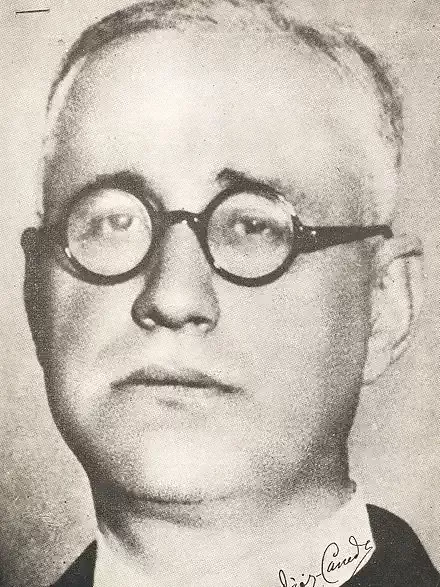
Enrique Díez Canedo
 --
--
Enrique Díez Canedo was a prominent Spanish poet and literary critic, a key figure in the renewal of lyric poetry in the early 20th century. His work is characterized by a deep aesthetic sensibility, a masterful command of language, and a constant exploration of themes such as love, melancholy, and the transience of time. His work as a critic and introducer of avant-garde poetry in Spain was fundamental to the development of the literature of his time, leaving an important legacy in contemporary criticism and poetry.
n. 1879-01-07, Badajoz · m. 1944-06-07, Cidade do México
Bio
Identification and Basic Context
Enrique Díez Canedo y Ruiz de la Luz was a Spanish poet, literary critic, and translator. He was born on July 24, 1879, and died on April 22, 1944. His family background and social class belonged to the bourgeoisie. He was Spanish, and his writing language was Castilian. He lived in a historical context marked by the crisis of the Restoration, the dictatorship of Primo de Rivera, and the beginnings of the Second Republic.Childhood and Education
Born in Madrid, his childhood took place in an environment of relative comfort. He completed his studies in Madrid, where he graduated in Law. He was an avid reader from a young age, which allowed him to be self-taught in literature. His initial influences ranged from Spanish classics to French symbolist poetry.Literary Career
His beginnings in poetic writing date back to the late 19th century, publishing his first verses in youth magazines. His literary career can be divided into several stages, from an initial influence of modernism to the assimilation of avant-garde currents. He actively collaborated in literary magazines of the time such as "La Lectura" and "Revista de Occidente," and participated in important anthologies. His work as a critic and translator was very prolific.Work, Style, and Literary Characteristics
Among his main works are "Versos de amor" (1910), "Las armas de la luz" (1913), and "Sonetos a la sombra" (1930). The dominant themes in his poetry are love, death, the transience of time, nature, and melancholic introspection. Formally, he showed great mastery of classical metrics, especially the sonnet, but he also experimented with free verse. His style is characterized by elegance, musicality, and a careful expression of feelings, with a lyrical and often elegiac tone. His language is refined and rich in subtle imagery. He sought formal and thematic renewal, engaging in dialogue with tradition and modernity. He is associated with the Novecentismo movement.Cultural and Historical Context
His work developed during a period of profound social and political changes in Spain. He was a contemporary of figures such as Juan Ramón Jiménez, Antonio Machado, and Manuel de Falla. He belonged to the Generation of '98 and the Generation of '14, or Novecentismo. Although he did not have active political militancy, his work reflects the concerns of his time. The society and culture of the era, with its tensions and its search for modernity, notably influenced his production.Personal Life
His personal life was marked by his dedication to literature. He maintained significant relationships with other intellectuals of the time. He was a friend of poets and critics, and also had some literary rivalries. His personal experiences and reflections were reflected in his poetic work.Recognition and Reception
Díez Canedo held an important place in Spanish literature of his time. He received recognition for his work as a poet and critic. His work was valued by specialized critics, although perhaps it did not achieve the massive popularity of other authors. The critical reception of his poetry has been generally positive, highlighting its formal and expressive quality.Influences and Legacy
He was influenced by French symbolist poets and the Spanish poetic tradition. In turn, he influenced later poets, especially in the consolidation of modern literary criticism and in the appreciation of avant-garde poetry. His work has been the subject of academic study and continues to be valued for its literary quality.Interpretation and Critical Analysis
Díez Canedo's work has been interpreted as an expression of melancholy and the search for beauty in a changing world. His philosophical and existential themes, as well as his ability to combine tradition and modernity, have been analyzed.Childhood and Education
In addition to his poetic and critical work, Díez Canedo also dedicated himself to translation, introducing foreign authors to the Spanish public. His writing habits were rigorous, seeking formal perfection in every verse.Death and Memory
He died in Madrid in 1944. After his death, some of his works have been reissued, and his memory as one of the most relevant poets and critics of 20th-century Spanish literature has been kept alive.Poems
0No poems found
Comments (0)
No comments yet. Be the first to comment.