
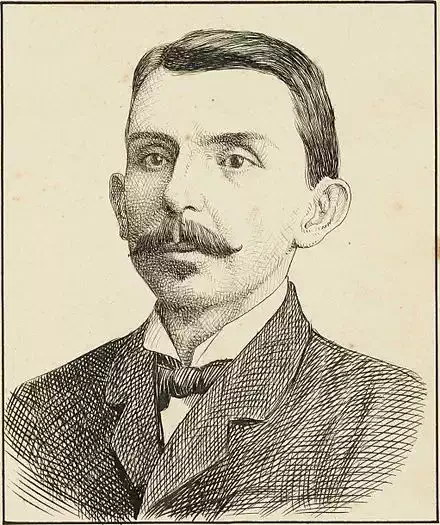
Euclides da Cunha
 BR
BR
Euclides da Cunha was a notable Brazilian writer, journalist, and engineer, widely recognized for his masterpiece "Os Sertões." This seminal book is a detailed and multifaceted account of the War of Canudos, combining sociological, geographical, and historical analysis with powerful and engaging prose. His work transcends the mere description of a conflict, becoming a profound study of Brazilian national identity, social tensions, and the complex relationship between the coast and the backlands, man and land. Euclides da Cunha left a lasting legacy in Brazilian literature and social thought.
n. 1866-01-20, Cantagalo · m. 1909-08-15, Rio de Janeiro
Bio
Identification and basic context
Euclides Rodrigues Pimenta da Cunha, known as Euclides da Cunha, was a Brazilian writer, journalist, engineer, and sociologist. He was born on January 4, 1866, in Cantagalo, Rio de Janeiro, and died on August 15, 1917, in Petrópolis, Rio de Janeiro. His family background was upper middle class, with roots in military and intellectual traditions. He was of Brazilian nationality and wrote in Portuguese. He lived in a period of profound transformations in Brazil, such as the Proclamation of the Republic and the establishment of new political and social regimes.Childhood and education
Euclides da Cunha's childhood was marked by his family's move to Rio de Janeiro in search of better opportunities. He was a brilliant student from an early age. He graduated in military engineering from the Military School of Praia Vermelha, in Rio de Janeiro, where he also studied law and philosophy. He was influenced by positivist and scientific readings of the time, absorbing movements such as determinism and scientism. The War of Canudos, which he witnessed as a war correspondent, was a significant event that profoundly shaped his worldview and his work.Literary career
Euclides da Cunha began writing as a journalist during his studies, publishing articles in newspapers. His literary notoriety was consolidated with the publication of "Os Sertões" in 1902. The work represents a milestone in his literary evolution, characterized by profound analysis and a dense style. He was intensely involved as a journalist, covering the War of Canudos for the newspaper "O Estado de S. Paulo."Work, style, and literary characteristics
Euclides da Cunha's main work is "Os Sertões" (1902), an epic and analytical account of the War of Canudos. The dominant themes in his work include Brazilian national identity, the conflict between civilization and barbarism, the man-land relationship, social poverty, and messianism. His style is characterized by erudition, lexical density, long and complex sentence construction, and the use of resources such as metaphor and hyperbole, lending an epic and tragic tone to the narrative. The work is associated with Brazilian pre-modernism, albeit with unique characteristics that dialogue with the scientism and determinism of the era.Work, style, and literary characteristics
Context of culture and history Euclides da Cunha lived in a period of great political and social effervescence in Brazil, including the Proclamation of the Republic, the consolidation of the republican regime, and events such as the War of Canudos. He belonged to a generation that sought to understand Brazil through the lens of the new social sciences. His work "Os Sertões" engages with the tensions between urban and rural Brazil and reflects the scientific and philosophical ideas of his time, such as positivism and determinism.Work, style, and literary characteristics
Personal life Euclides da Cunha was married to Ana Emília Ribeiro da Cunha, with whom he had children. His experience in the War of Canudos marked him profoundly, influencing both his work and his health. Besides being a writer, he worked as an engineer and journalist, not living solely from poetry. His philosophical convictions were influenced by positivism.Work, style, and literary characteristics
Recognition and reception "Os Sertões" received significant recognition, both during his lifetime and posthumously, becoming a classic of Brazilian literature. The work is considered fundamental for understanding Brazil and its social and cultural formation. Critical reception was generally very positive, highlighting the originality and depth of the analysis.Work, style, and literary characteristics
Influences and legacy Euclides da Cunha was influenced by thinkers such as Auguste Comte and Herbert Spencer. His legacy is immense, having influenced generations of Brazilian writers, sociologists, and historians, such as Gilberto Freyre and Sérgio Buarque de Holanda. "Os Sertões" is a central work in the Brazilian literary canon, and its international dissemination, though late in some aspects, is undeniable. His studies on the backlands and the Brazilian people continue to inspire debates and research.Work, style, and literary characteristics
Interpretation and critical analysis Euclides da Cunha's work, especially "Os Sertões," has been the subject of numerous interpretations, ranging from critical analysis of racial and geographical determinism to the understanding of a profound portrait of the Brazilian soul. Philosophically, the work addresses themes such as the human condition, conflict, and the search for identity.Work, style, and literary characteristics
Curiosities and lesser-known aspects A curious aspect is the contradiction between the man of science and engineer and the writer of profound sensitivity and lyricism who emerges in "Os Sertões." Euclides da Cunha died as a result of a gunshot, after an argument with his son, a tragic event that ended his life.Work, style, and literary characteristics
Death and memory Euclides da Cunha died on August 15, 1917, in Petrópolis, victim of a firearm discharge in tragic circumstances involving his son. His memory is celebrated as one of the greatest Brazilian intellectuals. The publication of "Os Sertões" occurred in 1902, with posthumous editions consolidating his work.Poems
0No poems found
Comments (0)
No comments yet. Be the first to comment.