
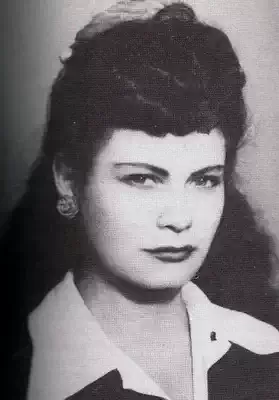
Eunice Odio
1919–1974
· lived 54 years
 --
--
--
Costa Rican poet, Eunice Odio is an essential voice in 20th-century Spanish-language poetry. Her work is distinguished by a profound exploration of the human condition, spirituality, death, and the search for identity, often through language charged with symbolism and powerful imagery. Her poetry transcends geographical and temporal boundaries, inviting existential and transcendent reflection.
n. 1919-10-18, San José · m. 1974-03-23, Cidade do México
24
Views
Bio
Identification and Basic Context
Eunice Odio (full name Eunice Odio 1918-1974) was a prominent Costa Rican poet, although she is also associated with Central American and Latin American literature. Born in Cartago, Costa Rica, her work is set in the second half of the 20th century, a period of great literary effervescence and profound social and political changes in the region.Childhood and Education
From a young age, she showed an inclination for reading and writing. Her childhood and youth were marked by a particular sensitivity to life and art. Although exhaustive details about her specific academic training in literature are not available, her work reveals great erudition and a deep connection with the poetic tradition.Literary Career
Eunice Odio began publishing poetry in literary magazines in Costa Rica in the 1940s. Her first book, "Las memorias de mamá Blanca" (The Memories of Mama Blanca), published in 1951, introduced her to the literary world. Throughout her career, she published several poetry collections that consolidated her unique voice and unmistakable style. She lived and worked in different countries, which enriched her perspective and her work.Work, Style, and Literary Characteristics
Odio's work is characterized by its lyrical intensity, profound introspection, and constant questioning of universal themes: life, death, love, solitude, spirituality, and the search for transcendent meaning. Her language is rich in metaphors, symbols, and archetypes, creating vivid and evocative images. Free verse is her preferred form, allowing her greater expressive freedom. Her poetry is often described as existential, metaphysical, and of great formal beauty. Some of her most important poetry collections are "Las memorias de mamá Blanca", "Canto rodado" (Rolling Stone), "El tránsito de la pena" (The Passage of Sorrow), and "Territorio Sonoro" (Sound Territory).Cultural and Historical Context
Her work was created in a post-war context and amidst important literary movements in Latin America, such as the so-called 'Generation of the 40s' and later the avant-garde movements. Although her style is personal and inimitable, it engages with the existential concerns of her time and the renewal of Spanish lyric poetry.Personal Life
Eunice Odio's personal life was private, but it is known that her artistic sensitivity and spiritual depth marked her profoundly. She lived in Costa Rica, Mexico, and the United States, experiences that undoubtedly nurtured her worldview and her poetic creation.Recognition and Reception
While perhaps not achieving the mass fame of some contemporaries, Eunice Odio is recognized by critics and scholars as one of the most important and original poetic voices of the 20th century in the Spanish language. Her work has been the subject of analysis and study, highlighting its uniqueness and depth.Influences and Legacy
Her poetry has influenced subsequent generations of poets, especially those interested in exploring the inner self, spirituality, and the human condition. Her ability to unite the personal with the universal makes her an enduring figure.Interpretation and Critical Analysis
Odio's work invites multiple readings. Her profound religiosity, her reflection on time and memory, and her confrontation with finitude have been analyzed. Her poetry is a space for wonder and meditation on existence.Childhood and Education
It is said that Eunice Odio possessed great intuition and a deep connection with the spiritual world, aspects that are powerfully reflected in her poetry.Death and Memory
She passed away in Mexico City in 1974. Her literary legacy endures through the dissemination and study of her work, which continues to move readers and critics with its beauty and depth.Poems
0No poems found
Comments (0)
Log in
to post a comment.
No comments yet. Be the first to comment.