
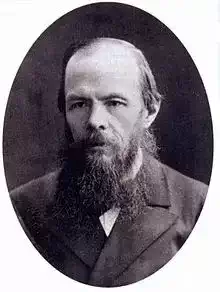
Fyodor Mikhailovich Dostoevsky was born on November 11, 1821, in Moscow, Russia. His father was a doctor, and his mother came from a family of merchants. Dostoevsky showed an early talent for reading and writing.
After his mother's death, he studied at the Imperial Military Academy of Engineering in Saint Petersburg but soon abandoned a military career to devote himself to literature. His first novel, "Poor Folk" (1846), was met with critical acclaim.
However, in 1849, Dostoevsky was arrested for his involvement with a radical intellectual circle and sentenced to death. The sentence was commuted at the last moment to hard labor in Siberia. This traumatic experience had a profound impact on his work, which began to explore themes of redemption, faith, and the nature of evil.
After serving his sentence, Dostoevsky returned to Russia and produced some of his most celebrated works, including "Notes from Underground" (1864), "Crime and Punishment" (1866), "The Gambler" (1867), "The Idiot" (1869), "Demons" (1872), and "The Brothers Karamazov" (1880). His novels are praised for their complex character portrayals, psychological insight, and profound exploration of moral and philosophical issues.
Dostoevsky was known for his emotional intensity and for frequently struggling with addictions, such as gambling. He married twice and had children. Fyodor Dostoevsky died on February 9, 1881, in Saint Petersburg, leaving an immeasurable literary legacy that continues to influence writers and thinkers worldwide.
Poems List
To crush, to annihilate a man utterly, to inflict on him the most terrible of punishments so that the most ferocious murderer would shudder at it and dread it beforehand, one need only give him work of an absolutely, completely useless and irrational character.
10
If you happen to have a wart on your nose or forehead, you cannot help imagining that no one in the world has anything else to do but stare at your wart, laugh at it, and condemn you for it, even though you have discovered America.
6
Sarcasm: the last refuge of modest and chaste- souled people when the privacy of their soul is coarsely and intrusively invaded.
6
Man has such a predilection for systems and abstract deductions that he is ready to distort the truth intentionally, he is ready to deny the evidence of his senses only to justify his logic.
9
Money is coined liberty, and so it is ten times dearer to a man who is deprived of freedom. If money is jingling in his pocket, he is half consoled, even though he cannot spend it.
6
Comments (0)
Log in
to post a comment.
NoComments