
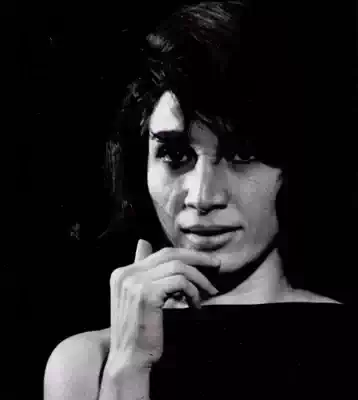
Forough Farrokhzad
 IR
IR
Forough Farrokhzad was an Iranian poet, filmmaker, and intellectual, considered one of the most influential voices in modern Persian poetry. Her work is characterized by boldness, exploration of the female condition, social criticism, and lyrical intensity. Through a personal and transgressive language, she addressed themes such as love, freedom, religion, and alienation, challenging the social and literary conventions of her time. Her short but impactful life and work left a lasting legacy in Iran's literature and cinema.
n. 1935-01-05, Teerão · m. 1967-02-13, Tafresh
Bio
Identification and basic context
Forough Farrokhzad was an Iranian poet, screenwriter, and filmmaker. Born on January 5, 1935, and passed away on February 13, 1967. She is widely regarded as one of the most important and innovative figures in modern Persian poetry, as well as a pioneer in Iranian documentary cinema. She was known for her bold and transgressive approach to themes of love, sexuality, freedom, and the condition of women in 20th-century Iranian society. Her nationality was Iranian, and her writing language was Persian.Childhood and education
Forough Farrokhzad was born into an upper-middle-class family in Tehran. Her father was a military officer who was reportedly quite strict. Her childhood and youth were marked by a conservative environment, but also by a growing desire for independence and artistic expression. She attended high school in Tehran and later a vocational school for sewing and painting. From an early age, she showed an inclination for poetry and writing, influenced by classical Persian literature and readings of modern poets. Her formal education was interrupted by early marriages and the need to adapt to the social expectations of the time.Literary career
Forough Farrokhzad's writing began in her adolescence. She started publishing her poems in literary magazines in the 1950s. Her work evolved significantly over time, moving from an early, more lyrical and confessional phase to a more mature, critical, and existential expression. Her poetry is known for its strong and authentic female voice, which addresses taboo subjects with unprecedented frankness in Persian literature. She published four collections of poetry during her lifetime: 'The Captive' (1955), 'The Wall' (1957), 'Rebellion' (1958), and 'Let Us Believe in the Beginning of the Cold Season' (1961). She was also an active figure in Tehran's literary and artistic circles, collaborating with other cultural figures.Work, style, and literary characteristics
Forough Farrokhzad's works, notably her poetry collections, explore themes such as forbidden love, social and religious oppression, the quest for individual freedom, loneliness, mortality, and the beauty of everyday life, often through a lens of strong lyrical and confessional intensity. Her language is direct, raw, and imagistic, moving away from more traditional poetic forms to embrace a freer and more modern expression, although she often maintained a rhythmic and metrical structure with classical influences. Her poetic voice is unmistakably feminine, personal, and challenging, breaking with the tradition of portraying women through a male gaze. She innovated by giving voice to the aspirations, frustrations, and desires of Iranian women, addressing sexuality and independence in a way that was revolutionary for its time. In addition to poetry, Forough Farrokhzad also ventured into cinema, directing the acclaimed documentary 'Khaneh Siah Ast' (A House Is Black) in 1962, which addresses life in a leper colony and is considered a milestone in Iranian cinema.Cultural and historical context
Forough Farrokhzad lived and produced her work during a period of significant social and political changes in Iran. Post-World War II Iran saw increased modernization and Western influence, but also strong conservative resistance. Her poetry reflected the tensions between tradition and modernity, and her bold explorations of femininity and sexuality shocked many in conservative society. She was part of a circle of progressive intellectuals and artists in Tehran, but her work often brought her into conflict with established values. Her life and work were influenced by the context of growing nationalism, as well as the political upheavals that would culminate in the Islamic Revolution decades later.Personal life
Forough Farrokhrokhzad's personal life was marked by early and troubled marriages. Her first marriage, at age 16, to her cousin Parviz Shapour, lasted until 1957 and resulted in the birth of her son Kamyar. Her second marriage, to director Ebrahim Golestan, was also complex and unconventional. Her personal relationships, especially with Golestan, were a source of inspiration and, at times, anguish, reflected in her poetry. She was known for her intelligence, emotional intensity, and a strong determination to live life on her own terms, which set her apart from the expected feminine norms of the time.Recognition and reception
During her lifetime, Forough Farrokhzad enjoyed recognition within literary and intellectual circles, but her work also attracted criticism and controversy due to its explicit and challenging nature. After her death, her prestige grew exponentially. She is now celebrated as an iconic literary figure in Iran and internationally, seen as a proponent of freedom of expression and female emancipation. Her poems are taught in schools, studied in universities, and translated into various languages.Influences and legacy
Forough Farrokhzad was influenced by classical Persian poetry, but also by Western literary currents. Her legacy is immense; she paved the way for a new generation of Iranian poetesses, encouraging them to express their own experiences and perspectives. Her work continues to inspire artists, writers, and filmmakers, and her figure is a symbol of resistance and the pursuit of freedom. Her innovative approach to poetry and cinema has profoundly influenced Iranian culture.Interpretation and critical analysis
Forough Farrokhzad's work is often analyzed from the perspectives of feminism, post-colonial criticism, and existentialism. Her interpretations focus on her exploration of female identity in a patriarchal context, her search for authenticity, and her confrontation with mortality. Some critical debates revolve around her relationship with Persian literary tradition and how radically she subverted it.Curiosities and lesser-known aspects
A little-known aspect is her work as a translator and her passion for painting. She was also a chain smoker, a habit that contrasted with the expected image of a woman in Iranian society. Her short life, marked by creative and emotional intensity, and her premature death in a car accident, contribute to her almost legendary status.Death and remembrance
Forough Farrokhzad tragically passed away on February 13, 1967, at the age of 32, following a car accident in Tehran. Her premature death shocked Iran and the art world. Posthumous publications continued to expand the knowledge of her work, with editions of her letters and other writings being released. Her memory is celebrated through academic studies, exhibitions, films, and the continued popularity of her poetry.Poems
0No poems found
Comments (0)
No comments yet. Be the first to comment.