
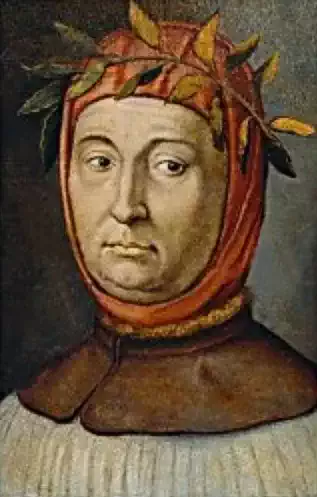
Francesco Petrarca
 IT
IT
Francesco Petrarca was an Italian scholar and poet, considered one of the founders of Humanism and one of the greatest lyric poets in Western literature. His work "Il Canzoniere" is a collection of poems, predominantly sonnets, dedicated to Laura, his inspirational muse, and explores themes such as platonic love, female beauty, the transience of time, and the pursuit of glory and salvation. Petrarca is revered for his formal mastery, especially in the use of the sonnet, which he perfected and popularized, influencing poets for centuries. His work marked a transition between the Middle Ages and the Renaissance, emphasizing the value of the individual, classical culture, and the expression of human feelings with unprecedented depth.
n. 1304-07-19, Arezzo · m. 1374-07-18, Arquà Petrarca
Bio
Identification and basic context
Francesco Petrarca (in Italian: Francesco Petrarca) was an influential scholar, poet, and one of the earliest humanists of the pre-Renaissance period. Born in Arezzo, Tuscany, he wrote in both Latin and Italian (Tuscan). He is widely regarded as a seminal figure in the transition from the Middle Ages to the Renaissance.Childhood and education
Due to his father's political exile, Petrarca spent part of his childhood in Avignon, France, and other cities. He studied Law in Montpellier and Bologna, but his true passion lay in classical literature. He dedicated himself to the intensive study of Greco-Roman authors like Cicero and Virgil, and was a pioneer in the rediscovery and appreciation of ancient texts.Literary career
Petrarca's literary career is marked by the duality between his Latin production, focused on scholarship and philosophy, and his poetry in the Italian vernacular, which made him famous. His most celebrated Italian work is "Il Canzoniere" (The Songbook), a vast collection of poems composed over many years, narrating his love for Laura and his reflections on life, death, and faith. In Latin, he wrote works such as "De viris illustribus" (On Famous Men), "Africa" (an epic poem about Scipio Africanus), and "Epistolae" (letters).Work, style, and literary characteristics
"Il Canzoniere" is Petrarca's vernacular masterpiece, comprising 366 poems (mostly sonnets) dedicated to his muse, Laura. Central themes include intense and tormented love, Laura's idealized beauty, the passage of time, the ephemerality of life, the pursuit of earthly glory, and the hope of divine salvation. His poetry is characterized by deep lyricism, introspection, and psychological analysis. Petrarca perfected the sonnet form, establishing the model that would become known as the "Petrarchan sonnet," with its octave and sestet structure and the way themes are developed and resolved. His language is elegant, precise, and rich in rhetorical devices, conveying a unique expressiveness to his feelings. The tone of his poetry is predominantly lyrical, confessional, and elegiac, with moments of exaltation and profound melancholy. He explored the duality between earthly desires and spiritual aspirations, a conflict that became central to his work and influenced later poetry.Work, style, and literary characteristics
Cultural and historical context Petrarca lived in a crucial transitional period, where medieval thought was giving way to the new ideas of Humanism. He was one of the main drivers of this movement, advocating for the revival of the values and knowledge of Classical Antiquity. His era was marked by political instability in Italy, with the papacy in Avignon, and by a growing interest in arts and letters.Work, style, and literary characteristics
Personal life Petrarca's life was marked by an idealized and lasting love for Laura, whose real identity is still debated, but who became the focus of his poetic output. He was a tireless traveler and maintained contact with many important figures of his time, including popes and kings. His life was also marked by spiritual crises and the search for reconciliation between his earthly desires and his faith.Work, style, and literary characteristics
Recognition and reception Petrarca achieved great renown during his lifetime, being crowned a poet laureate in Rome. His Latin works were admired for their scholarship, while "Il Canzoniere" established him as the greatest lyric poet of his generation. His influence on European poetry was immense, setting the standard for courtly love and lyrical poetry for centuries.Work, style, and literary characteristics
Influences and legacy Petrarca was profoundly influenced by Latin poets such as Virgil, Ovid, and Horace, and by philosophers like Cicero. He, in turn, influenced generations of poets in the Renaissance and later periods, including Boccaccio, Shakespeare, Camões, and many others. "Petrarchism" became a dominant style in lyrical poetry for centuries.Work, style, and literary characteristics
Interpretation and critical analysis Petrarca's work is analyzed from various perspectives: as the expression of an idealized and platonic love, as a profound study of the human condition and the duality of desires, and as a landmark in the consolidation of individual identity and subjectivity in literature.Work, style, and literary characteristics
Curiosities and lesser-known aspects A curiosity is that Petrarca, despite having studied Law, did not practice the profession, dedicating himself entirely to studies and writing. He also had a particular fascination with the figure of Cicero, whom he considered a master.Work, style, and literary characteristics
Death and memory Francesco Petrarca died in Arquà, near Padua. His death was felt as the loss of one of the greatest intellectuals of his time. His memory is celebrated as that of a pioneer of Humanism and a master of lyric poetry, whose legacy continues to inspire and be studied.Poems
0No poems found
Comments (0)
No comments yet. Be the first to comment.