
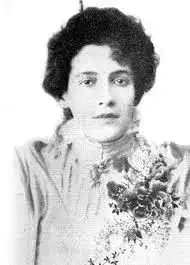
Francisca Júlia
1871–1920
· lived 49 years
 BR
BR
BR
Francisca Júlia da Silva was a Brazilian poet who stood out in the second half of the 19th century, being considered one of the few female voices to achieve recognition in a male-dominated period. Her work, marked by lyricism and romantic themes, contributed to the renewal of Parnassian poetry, introducing a more personal and sentimental tone.
n. 1871-08-31, Eldorado · m. 1920-11-01, São Paulo
39
Views
Bio
Identification and Basic Context
Francisca Júlia da Silva, known as Francisca Júlia, was a notable Brazilian poet, born in 1834 in Santa Catarina, and passed away in 1907. Her work, though not extensive, left an important mark on 19th-century Brazilian poetry, especially for the feminine perspective she brought to a predominantly male literary scene.Childhood and Education
Little is known about Francisca Júlia's childhood and education. It is believed that she received a thorough education for the time, which allowed her access to reading and writing. In a patriarchal society, the path of a literate woman and writer was, in itself, a remarkable feat.Literary Career
Francisca Júlia's literary career began later in her life but gained prominence in the second half of the 19th century. Her work consists mainly of poems that explore love, longing, and the female condition. She published her poetry in newspapers and magazines of the time, earning the respect of critics and readers, and was even praised by figures such as Machado de Assis.Work, Style, and Literary Characteristics
Francisca Júlia's best-known work is the book "Espinhos e Flores" (Thorns and Flowers) (1886). Her poems are characterized by delicate lyricism, with strong Parnassian influence, but also with a personal and sentimental touch that set her apart. The central themes of her poetry revolve around romantic love, introspection, and the expression of feminine emotions, which was innovative for the time. She used traditional poetic forms, such as the sonnet, with great metric and rhyme skill.Work, Style, and Literary Characteristics
Cultural and Historical Context Francisca Júlia lived during a period of great transformations in Brazil, such as the end of slavery and the Proclamation of the Republic. In the literary sphere, Parnassianism was the dominant movement, with its emphasis on form and objectivity. However, Francisca Júlia's poetry, by introducing subjectivity and a more personal expression, pointed towards a path that would be explored more vigorously by Symbolism and Modernism.Work, Style, and Literary Characteristics
Personal Life Francisca Júlia's personal life is poorly documented, which reinforces the idea that she maintained a reserved posture. It is believed that her marriage and family life were marked by discretion, which did not prevent her from expressing her emotions and reflections in her poetry.Work, Style, and Literary Characteristics
Recognition and Reception Francisca Júlia achieved significant recognition during her lifetime, which was rare for female writers of the time. Her work was praised by important literary critics, and she is often cited as one of the few women to achieve prominence in the 19th-century literary scene. The reception of "Espinhos e Flores" was positive, consolidating her name as a poet.Work, Style, and Literary Characteristics
Influences and Legacy Francisca Júlia was influenced by the romantic and Parnassian poetry of her time. Her legacy lies in her ability to introduce an authentic and lyrical female voice into Brazilian literature, paving the way for future writers. Her work is a testament to the strength and sensitivity of women in a period of great social and cultural restrictions.Work, Style, and Literary Characteristics
Interpretation and Critical Analysis Francisca Júlia's poetry is often analyzed from the perspective of female representation in literature, highlighting how she subverted gender expectations by expressing her feelings so openly and lyrically. Her work is seen as an important counterpoint to dominant male poetry.Work, Style, and Literary Characteristics
Curiosities and Lesser-Known Aspects An interesting aspect about Francisca Júlia is that, despite her shyness and discretion in her personal life, her poetry showed great emotional depth and an expressive capacity that made her remarkable.Work, Style, and Literary Characteristics
Death and Memory Francisca Júlia passed away in 1907, leaving a poetic legacy that, although not vast, is of great historical and literary importance for the feminine perspective it represented.Poems
0No poems found
Comments (0)
Log in
to post a comment.
No comments yet. Be the first to comment.