
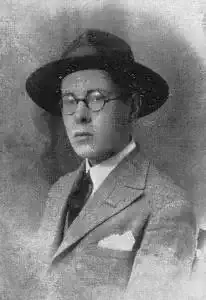
Francisco Luis Bernárdez
 --
--
Francisco Luis Bernárdez was an Argentine poet whose work is characterized by a deep, spiritual, and reflective lyricism, often marked by the influence of philosophy and theology. His poetry explores themes such as faith, doubt, the mystery of existence, transcendence, and the search for God. With a refined style and language rich in symbolism, Bernárdez managed to create a poetic work of great spiritual depth. His figure is relevant within 20th-century Argentine poetry, standing out for his originality and his inquiry into the fundamental questions of the human being.
n. 1900-10-05, Buenos Aires · m. 1978-10-24, Buenos Aires
Bio
Identification and Basic Context
**Full Name:** Francisco Luis Bernárdez **Nationality:** Argentine **Language of Writing:** Spanish **Historical Context:** His life and work take place in the first half of the 20th century, a period of profound social, political, and cultural changes in Argentina and the world.Childhood and Education
Information about his childhood and education is more limited in public sources. However, his work suggests a solid education and a deep inclination towards philosophical and theological reflection, elements that marked his intellectual development.Literary Career
Francisco Luis Bernárdez became known as a poet in the 20th-century Argentine literary scene. His career is characterized by a poetic production focused on spiritual and existential inquiry. His work is valued for its originality and thematic depth.Work, Style, and Literary Characteristics
**Main Works:** * "El libro de la noche" (1929) * "Dos poemas" (1931) * "Poemas" (1933) * "El ruiseñor y la rosa" (1936) * "Canto a mí mismo" (1942) * "La edad del hombre" (1943) * "El camino de la cruz" (1947) * "El milagro" (1949) **Dominant Themes:** Faith, doubt, the search for God, the mystery of existence, transcendence, death, solitude, the beauty of the universe, the relationship between the human and the divine. **Form and Structure:** His poetry often uses classical forms and refined language, but its strength lies in the intensity of his thought and the depth of his imagery. **Poetic Resources:** He employs rich metaphors, symbolism, and introspective musicality to express his complex ideas. **Tone and Poetic Voice:** A reflective tone predominates, sometimes elegiac or one of wonder at the mystery, with a poetic voice that seeks to question and contemplate. **Language and Style:** His language is dense, elaborate, and full of philosophical and spiritual resonances. **Associated Literary Movements:** Although his work is unique, he is associated with poetry of a more traditional and metaphysical nature, distancing himself from more disruptive avant-garde movements.Cultural and Historical Context
Bernárdez is part of the Argentine poetic tradition of the first half of the 20th century, engaging with the spiritual and philosophical concerns of his time. His work, though markedly personal and existential in nature, is inscribed in a cultural landscape where the search for meaning was a constant.Personal Life
Detailed information about his personal life is scarce in general sources. It is known that his work is deeply marked by an intense inner life and a constant spiritual quest.Recognition and Reception
Francisco Luis Bernárdez is a recognized poet in Argentine literature for the originality and depth of his poetic proposal. His work has been valued by critics and readers interested in metaphysical and spiritual poetry.Influences and Legacy
His poetry engages with universal literary tradition, exploring philosophical and theological themes. His legacy lies in his ability to articulate doubt and faith, the finite and the infinite, in a work of great coherence and beauty.Interpretation and Critical Analysis
Bernárdez's work invites reflection on the great questions of human existence, faith, and man's relationship with the transcendent. His poetry is a testament to the incessant search for meaning.Childhood and Education
His poetry often reflects an intimate dialogue with the fundamental questions of life, exploring the boundaries between reason and faith, light and darkness.Death and Memory
Information about his death and specific memory is limited in the consulted sources, but his work endures as a benchmark of Argentine spiritual poetry.Poems
0No poems found
Comments (0)
No comments yet. Be the first to comment.