
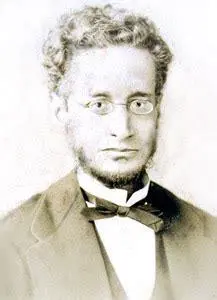
Francisco Otaviano
 BR
BR
Francisco Otaviano de Almeida Rosa was a Brazilian writer, journalist, and politician, a prominent figure of Romanticism in Brazil, especially linked to the second romantic generation, Ultra-Romanticism. His poetic work, although not vast, is marked by a melancholic tone, the exaltation of feelings, the escape from reality, and the search for an unattainable ideal, distinctive characteristics of the "mal du siècle". Besides his literary production, Otaviano had an active career in politics and journalism, demonstrating a multifaceted intervention in 19th-century Brazilian public life. His poetry is a reflection of the anxieties and aspirations of a generation that sought to express subjectivity and idealism in a context of great social and political transformations.
n. 1825-06-26, Rio de Janeiro · m. 1889-06-28, Rio de Janeiro
Bio
Identification and basic context
Francisco Otaviano de Almeida Rosa was a prominent Brazilian writer, journalist, and politician. He was born in Rio de Janeiro on March 10, 1811, and died in the same city on February 27, 1851. Pseudonyms or heteronyms are not widely known. He belonged to a wealthy family, which provided him with a privileged education. He was an influential figure in Brazilian Romanticism.Childhood and education
Francisco Otaviano had a childhood and youth marked by access to a good education, typical of affluent families in Imperial Brazil. He attended the Faculty of Law of São Paulo, graduating in 1831. This legal education offered him a solid foundation for his future professional and political career. During his studies, he absorbed the literary and philosophical influences of the time, including the romantic fervor that swept Europe and began to gain strength in Brazil.Literary career
Francisco Otaviano's literary career began during the flourishing of Romanticism in Brazil. His poetic work, although relatively scarce, is a landmark of Ultra-Romanticism or the "mal du siècle" in the country. He published his poems in newspapers and literary magazines of the time, actively participating in the cultural life of Rio de Janeiro. His literary evolution was marked by sentimental intensity and a search for the ideal, characteristics of his generation.Work, style, and literary characteristics
Francisco Otaviano's main work consists of poems that reflect Ultra-Romanticism. Dominant themes include melancholy, boredom, idealized and unattainable love, death, loneliness, and escape from reality through dreams and imagination. His poetic form favored verse, often with a structure that allowed for the effusive expression of feelings. His style is characterized by subjectivity, emotional intensity, sometimes bombastic vocabulary, and the pursuit of purified lyricism, albeit permeated by an elegiac and confessional tone. The poetic voice is markedly personal and melancholic. He clearly belongs to the second generation of Brazilian Romanticism, the ultra-romantic generation.Cultural and historical context
Francisco Otaviano lived during a crucial period in Brazilian history: the Regency and the Second Empire. Romanticism in Brazil, with its various phases, mirrored the tensions between the search for a national identity and European influences. Otaviano was immersed in this cultural context, participating in literary and political debates. His work engages with the atmosphere of idealism and, at the same time, disillusionment that characterized many intellectuals of the time, who struggled between the need to build the country and their own existential anxieties.Personal life
Francisco Otaviano's life was marked by intellectual and political activity. His affective relationships, although not extensively documented, are often transfigured in his poetry in search of an ideal love. In addition to being a poet, he was an active journalist, founding and directing several periodicals, and held political office, having been a deputy and senator. His health, however, was fragile, contributing to a melancholic temperament.Recognition and reception
During his lifetime, Francisco Otaviano was recognized as one of the most important voices of Brazilian Ultra-Romanticism. His poetry, while admired for its intensity and musicality, was also subject to criticism for its excessive subjectivity and pessimistic tone. His legacy endures as a fundamental representative of the second romantic generation, whose characteristics he helped to define.Influences and legacy
Francisco Otaviano was influenced by European romantic poets such as Lord Byron, Alfred de Musset, and Alphonse de Lamartine, who were precursors of Ultra-Romanticism. His work, in turn, contributed to shaping the lyrical landscape of Brazilian Romanticism, inspiring poets who explored similar themes of melancholy and idealism. His inclusion in the Brazilian literary canon is unquestionable as one of the exponents of the "mal du siècle" in Brazil.Interpretation and critical analysis
Otaviano's work is often interpreted as a mirror of the contradictions and aspirations of romantic youth, torn between idealism and disillusionment. Critical analyses highlight the expressive power of his language and his ability to translate complex feelings, while also pointing to a certain unidimensionality of themes and sentiments.Curiosities and lesser-known aspects
A curiosity about Francisco Otaviano is his role as a journalist, having founded and directed several newspapers that served as a vehicle for disseminating romantic ideas and for his own literary production. His relatively short life and debilitated health accentuate the aura of disillusionment and suffering that permeates his work.Death and memory
Francisco Otaviano died in Rio de Janeiro on February 27, 1851, at the age of 39, from tuberculosis. His premature death left a void in the Brazilian literature of the time. His memory is preserved as that of one of the most faithful representatives of Ultra-Romanticism in Brazil, with his poetry continuing to be studied and appreciated for its aesthetic and historical value.Poems
0No poems found
Comments (0)
No comments yet. Be the first to comment.