
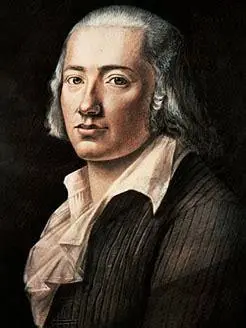
Friedrich Hölderlin
 DE
DE
Friedrich Hölderlin was one of the most important poets of German Romanticism. His work, profoundly marked by the influence of Ancient Greece and the search for an aesthetic and spiritual ideal, is characterized by an elevated and musical language. His reflections on nature, homeland, and human destiny, often expressed in odes and hymns, reveal a deep melancholy and an incessant search for lost harmony. His life was marked by a mental collapse that distanced him from literary activity in the last decades of his existence.
n. 1770-03-20, Lauffen · m. 1843-06-07, Tubinga
Bio
Identification and Basic Context
Friedrich Hölderlin (full name: Johann Christian Friedrich Hölderlin) was a German poet and philosopher, considered one of the central figures of Romanticism and a precursor of modern poetry. He was born in Lauffen am Neckar, in the Duchy of Württemberg, and died in Tübingen. His poetic work, although recognized late, exerted a profound influence on German and Western literature, exploring themes such as beauty, nature, divinity, human destiny, and the search for harmony in times of fragmentation.Childhood and Education
Born into an upper-middle-class family, Hölderlin's childhood was marked by the premature death of his father. He received an excellent education, first at the Latin school in Denkendorf and later at the Protestant seminary in Maulbronn, where he studied theology and philosophy. It was during this period that he developed a deep interest in Classical Antiquity, especially Greek poetry, and in the philosophical ideas of Kant and Fichte. His friendship with the future thinkers Hegel and Schelling was fundamental to his intellectual formation, with whom he shared ideals about reason, art, and the search for a new spiritual order.Literary Career
He began his literary activity during his studies, composing lyrical poems and translating classical works. His work evolved from more traditional forms, inspired by Greek and Latin models, to greater formal and expressive freedom, especially in his odes and hymns. He published his first important works, such as "Hyperions Schicksalslied" and the novel "Hyperion", which reflect his existential and political concerns. He unsuccessfully attempted an academic career, working briefly as a tutor.Work, Style, and Literary Characteristics
Hölderlin's main works include "Hyperion's Pages", "Hyperion's Song of Fate", and a vast collection of poems, odes, and hymns, such as "The River", "The Old Time", and "Metanoeite". The dominant themes are the idealized beauty of Ancient Greece, nature as a manifestation of the divine, the duality between the sacred and the profane, the search for lost harmony, and meditation on the destiny of Germany and Europe. In terms of form, Hölderlin experimented with free verse, but also masterfully used more classical forms, such as the sonnet. His style is characterized by an elevated language, intense musicality, rich imagery, and a deep symbolic charge. His poetic voice is often elegiac, melancholic, and sometimes prophetic, expressing the pain of fragmentation and the longing for totality.Work, Style, and Literary Characteristics
Cultural and Historical Context Hölderlin lived in a period of intense transformations in Europe, marked by the French Revolution and the Napoleonic Wars, which had a significant impact on his reflections on freedom, politics, and the destiny of peoples. He belonged to the "Jena generation" of German Romanticism, a movement that sought to reconcile reason with emotion, science with art, and tradition with modernity. He maintained relationships with important intellectual figures of the time, such as Goethe, Schiller, and his friends Hegel and Schelling. His work reflects the tensions between philosophical idealism and harsh historical reality.Work, Style, and Literary Characteristics
Personal Life Hölderlin's personal life was marked by exacerbated sensitivity and intense emotional relationships, but also by financial difficulties and emotional instability. His passion for Susette Gontard, the wife of his employer in Frankfurt, inspired many of his love poems and is considered an important influence on his work. His mental health gradually deteriorated, culminating in a nervous breakdown that led him to live the last thirty-six years of his life in a tower in Tübingen, under the care of a family.Work, Style, and Literary Characteristics
Recognition and Reception Hölderlin's work was largely recognized posthumously. During his lifetime, his poetry, considered by many to be excessively abstract and hermetic, had limited reception. It was only at the end of the 19th and beginning of the 20th centuries that his work was rediscovered and valued, influencing subsequent generations of poets and thinkers, such as Rilke, Heidegger, and the poets of the Tübingen School. Today, he is universally recognized as one of the greatest poets in the German language.Work, Style, and Literary Characteristics
Influences and Legacy Hölderlin was profoundly influenced by ancient Greek poetry, by the philosophers Plato and Kant, and by classical literature. His legacy is immense, having influenced poets of various nationalities and literary movements. His exploration of the relationship between man, nature, and the divine, his search for beauty and harmony, and his ability to express existential anguish with sublime language continue to resonate in contemporary poetry. His philosophical thought, especially his reflection on language and the experience of the sacred, has also been the subject of study by philosophers such as Martin Heidegger.Work, Style, and Literary Characteristics
Interpretation and Critical Analysis Hölderlin's work has been the subject of numerous critical interpretations, ranging from deeply philosophical readings, focused on his metaphysics of beauty and being, to analyses of his relationship with politics and history. His "vision of Greece" is often analyzed as a lost ideal and a source of inspiration for the search for a lost unity in the modern world. The tension between the ideal and the real, the sacred and the profane, heaven and earth, are central themes in the critical analysis of his poetry.Work, Style, and Literary Characteristics
Curiosities and Lesser-Known Aspects Despite living his last years in a state of dementia, Hölderlin continued to write verses and recite poems until the end. His guardians allowed him paper and pen, and he continued to write with a peculiar, often illegible, handwriting. A curious aspect is his fixation with the word "heil" (sacred, holy, healed), which appears repeatedly in his later writings, suggesting a persistent spiritual quest.Work, Style, and Literary Characteristics
Death and Memory Friedrich Hölderlin died in Tübingen on June 7, 1843, at the age of 73. His complete works were published in various editions, both during his lifetime and posthumously, contributing to his growing influence and recognition. His house in Lauffen am Neckar and his room in the tower in Tübingen have become pilgrimage sites for lovers of his work and literature students.Poems
0No poems found
Quotes
3Comments (0)
No comments yet. Be the first to comment.