
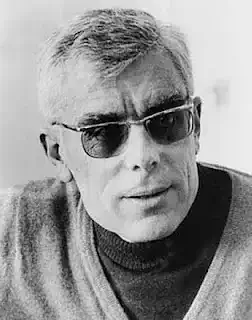
Gabriel Ferrater
1922–1972
· lived 49 years
 ES
ES
ES
Gabriel Ferrater was a Catalan poet, literary critic, and linguist, a prominent figure of social poetry and cultural resistance in Francoist Spain. His work, marked by raw realism and a profound reflection on the human condition, language, and social reality, is in continuity with avant-garde poetry but strongly anchored in everyday life. He is recognized for his direct language, his irony, and his ability to transform the prosaic into the poetic.
n. 1922-05-20, Reus · m. 1972-04-27, Sant Cugat del Vallès
29
Views
Bio
Identification and basic context
Gabriel Ferrater i Soler was a Catalan poet, literary critic, linguist, and professor. He was born in Reus, Catalonia, in 1922, and died in Sant Cugat del Vallès in 1972. He was the son of a family of rural origin with strong ties to the land and work. His nationality was Catalan, and he wrote in Catalan. He lived during the dictatorial regime of Francisco Franco, a period of strong political and cultural repression in Spain.Childhood and education
He grew up in Reus in a family of small farmers. His childhood was marked by the Spanish Civil War and its consequences. He was a voracious autodidact, taking an early interest in literature, philosophy, and linguistics. His formal academic education included studies in Philosophy and Letters at the University of Barcelona, where he graduated in Romance Philology. He absorbed influences from European avant-garde poetry, as well as classical and contemporary literature.Literary career
Ferrater began writing poetry in his youth, but his work only began to be published later, in a context of great difficulty for publishing in Catalan. His literary evolution can be divided into phases, with a transition from early lyricism to more incisive and reflective realism. His complete poetic works were collected in "Les dones i els dies" (1968), considered his magnum opus. He was also an important literary critic, with articles published in various magazines, and a linguist dedicated to the study of Catalan phonetics and phonology.Work, style, and literary characteristics
Gabriel Ferrater's work is marked by profound realism, irony, and a reflection on the human condition, time, memory, and language. "Les dones i els dies" is his central work, where he explores themes such as love, death, the passage of time, the city, and everyday experience. His style is characterized by colloquial language, conciseness, the absence of excessive ornamentation, and the ability to transform the mundane into poetry. He uses free verse and irregular meter, with a rhythm that reflects natural speech. His poetic voice is personal but resonates with existential universality. Ferrater's work engages with the tradition of Catalan and European poetry but introduces a new sensibility, closer to the social and existential reality of his time. He is associated with the poetry of the "1950s Generation" or "Generation of Masters," which sought to renew Catalan poetry.Work, style, and literary characteristics
Cultural and historical context Ferrater lived and produced his work under the Francoist dictatorship, a period of great censorship and repression for Catalan culture. His poetry is seen as an act of cultural resistance, a way of keeping the Catalan language and identity alive. He was friends with other important writers of the time, such as Salvador Espriu and Vicent Andrés Estellés, with whom he shared aesthetic and political concerns. His political stance was antifascist, and his work reflects a deep concern for social justice and freedom.Work, style, and literary characteristics
Personal life Gabriel Ferrater married Mercè Fernández and had two daughters. His personal life was marked by intense intellectual and professional activity. In addition to poetry, he dedicated himself to teaching Catalan philology, working as a university professor. His literary friendships were important to his career, but he also faced some critical rivalries. His premature death at the age of 50, due to cancer, was a great loss to Catalan literature.Work, style, and literary characteristics
Recognition and reception Although Ferrater had limited recognition during his lifetime, his work gained great prestige after his death. Today, he is considered one of the most important poets in 20th-century Catalan literature. He received some literary awards, but his main recognition comes from his inclusion in the literary canon and his influence on later poets.Work, style, and literary characteristics
Influences and legacy Ferrater was influenced by poets such as T.S. Eliot, Ezra Pound, Walt Whitman, and by social and existential poetry. His legacy is immense: he renewed Catalan poetry with his direct language, his realism, and his reflective depth. He influenced generations of poets who saw him as a model of artistic and ethical integrity. His work is studied in schools and universities and continues to be read and admired for its relevance and power.Work, style, and literary characteristics
Interpretation and critical analysis Ferrater's work is often analyzed from the perspective of existentialism, phenomenology, and social criticism. His poetry invites reflection on the human condition, the passage of time, and the search for meaning in a complex world. His analyses of language and its ability to create and destroy realities are recurring themes in criticism.Work, style, and literary characteristics
Curiosities and lesser-known aspects A curiosity about Ferrater is his interest in photography, which he considered a way of capturing reality similarly to poetry. His figure as a committed intellectual and a poet who knew how to translate everyday life into art fascinates his readers. His writing habits were rigorous, dedicating time to reflection and the refinement of verse.Work, style, and literary characteristics
Death and memory Gabriel Ferrater died in 1972 from cancer, leaving an invaluable poetic legacy. His complete works were published posthumously, consolidating his position as one of the great names in contemporary Catalan poetry. His memory is kept alive through the reading of his work, academic studies, and the homage of poets and critics.Poems
0No poems found
Comments (0)
Log in
to post a comment.
No comments yet. Be the first to comment.