
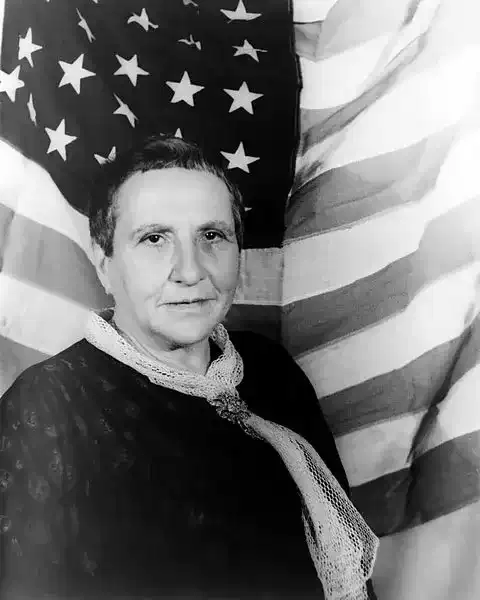
Gertrude Stein
1874–1946
· lived 72 years
 US
US
US
Gertrude Stein was an American modernist writer, known for her experimental prose and her influence on the development of 20th-century literature. Her work challenged narrative and stylistic conventions, exploring language in new ways. She was also an important figure in the Parisian artistic and intellectual scene, collecting artworks and promoting young artists and writers.
n. 1874-02-03, Allegheny · m. 1946-07-27, Neuilly-sur-Seine
2,958
Views
Bio
Identification and Basic Context
Gertrude Stein was an American modernist writer, poet, and playwright. Pseudonym: Gertrude Stein. Date and place of birth: February 3, 1874, Allegheny (now a neighborhood of Pittsburgh), Pennsylvania, USA. Date and place of death: July 13, 1946, Neuilly-sur-Seine, France. Family background: Upper-class Jewish family, German emigrants. Nationality: American. Language of writing: English. Historical context: Lived through the transition from the 19th to the 20th century, witnessing and actively participating in the artistic and intellectual movements that marked modernism, especially in Paris, during the two World Wars.Childhood and Education
Gertrude Stein spent her childhood between Vienna, France, and Oakland, California. She was educated at home and attended Radcliffe College, where she studied psychology under the guidance of William James. This scientific and philosophical training profoundly influenced her experimental approach to writing. She absorbed the ideas of pragmatism and the psychology of the time, which are reflected in her exploration of consciousness and perception in language.Literary Career
Stein began writing seriously during her years at Radcliffe. Her literary career is marked by constant experimentation with language, structure, and form. She published her first book, "Three Lives," in 1909, and her most influential work, "The Autobiography of Alice B. Toklas," in 1933. She collaborated with various artistic and literary publications and was a central figure in the circle of American expatriates in Paris.Work, Style, and Literary Characteristics
Major works include "The Making of Americans" (published in 1925), "Tender Buttons" (1914), and "The Autobiography of Alice B. Toklas" (1933). Dominant themes in her work are the nature of identity, the perception of time, daily life, and the exploration of language itself. Stein is known for her automatic writing, repetition of words and phrases, fragmentation, and deconstruction of traditional syntax. Her style is dense, imagistic, and often hermetic, challenging the reader to rethink the relationship between word and meaning. Associated with modernism, she introduced significant formal innovations, breaking with linear narrative and exploring the subjectivity and simultaneity of experience.Work, Style, and Literary Characteristics
Cultural and Historical Context Stein lived in Paris during a vibrant period for the arts, interacting with figures such as Pablo Picasso, Henri Matisse, Ernest Hemingway, and F. Scott Fitzgerald. Her home became a meeting point for artists and writers, and her collection of modern art was fundamental to the development and recognition of many of these artists. World War I and World War II affected her life and work, with periods of uncertainty and the need for adaptation.Work, Style, and Literary Characteristics
Personal Life Gertrude Stein maintained a long and deep relationship with Alice B. Toklas, who was her companion, secretary, and editor. Her family, although Jewish, was not particularly religious, but Jewish culture and the experience of being a minority in different contexts shaped her perspective. She did not live solely from poetry, relying on family support and, later, on the success of her publications.Work, Style, and Literary Characteristics
Recognition and Reception During her lifetime, Stein received considerable recognition, especially in artistic and intellectual circles, but her experimental work was not always widely understood or accepted by the general public. "The Autobiography of Alice B. Toklas" brought her fame and commercial success. Her legacy is undeniable in the development of modernist and postmodernist literature.Work, Style, and Literary Characteristics
Influences and Legacy Influenced by William James, Charles Darwin, and the European artistic avant-garde, Stein, in turn, influenced generations of writers, including those of the Lost Generation. Her exploration of language opened new paths for literary experimentation, and her work continues to be studied and debated in academic circles.Work, Style, and Literary Characteristics
Interpretation and Critical Analysis Stein's work is often analyzed from the perspectives of psychoanalysis, the philosophy of language, and gender studies. Her exploration of identity and subjectivity, as well as her radical approach to language, generate ongoing debates about the meaning and function of art.Work, Style, and Literary Characteristics
Curiosities and Lesser-Known Aspects Stein was an avid collector of modern art, and her Paris home was a living museum. She had a fondness for dogs, especially her poodle, Basket. Her writing often resembled a stream of consciousness, capturing the changing nature of perception and thought.Work, Style, and Literary Characteristics
Death and Memory Gertrude Stein passed away in 1946 in Neuilly-sur-Seine, France, due to stomach cancer. She was buried in the Père Lachaise cemetery in Paris. Her work continues to be published and studied, keeping alive her memory as one of the most innovative figures in 20th-century literature.Poems
0No poems found
Quotes
25No poems found
Comments (0)
Log in
to post a comment.
No comments yet. Be the first to comment.