
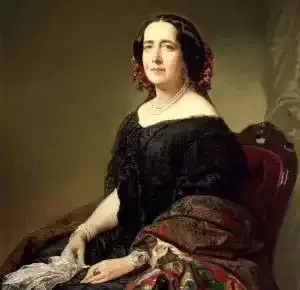
Gertrudis Gómez de Avellaneda
 --
--
Gertrudis Gómez de Avellaneda was a prominent Cuban writer, recognized for her romantic poetry and theatrical work. Her writing is characterized by passion, emotional intensity, and the exploration of themes such as love, freedom, and justice. Despite facing the social limitations imposed on women of her time, she managed to publish and gain recognition in the literary circles of Spain and America. Her legacy endures as a symbol of the struggle for female artistic expression and a fundamental exponent of Hispanic American Romanticism.
n. 1814-03-23, Camagüey · m. 1873-02-01, Madrid
Bio
Identification and basic context
Gertrudis Gómez de Avellaneda y de la Concepción, known as "La Peregrina", was a Cuban writer, considered one of the towering figures of Hispanic American Romanticism. She was born in Puerto Príncipe (now Camagüey), Cuba, and died in Madrid, Spain. She was one of the first female voices to stand out in Spanish and Latin American literature.Childhood and education
Born into an affluent family, her childhood was marked by the early death of her father and subsequent family instability. She received a meticulous education for the time, which included learning languages and self-taught literary training. Early reading of classical and romantic authors significantly influenced her literary vocation.Literary career
Her literary career began in Cuba, but she soon moved to Spain, where she developed most of her career. She published her first book of poems in 1841. Her work encompasses poetry, novels, and theater. She was a prolific writer and recognized in the literary circles of her time, although she often had to fight against gender prejudice.Work, style, and literary characteristics
Her poetic work is characterized by lyrical intensity, the expression of deep feelings, and themes of love, often tinged with melancholy and disillusionment. Notable works include "Sab" (novel), "Egilona" (historical drama), "La hija del rey" (drama), and poetry collections such as "Poesías". Her style is passionate, musical, and with a rich and evocative language, typical of Romanticism.Cultural and historical context
She lived in a time of profound social and political changes, marked by independence struggles in Latin America and the consolidation of Romanticism in Europe. She was a contemporary of figures such as Espronceda, Larra, and Zorrilla in Spain.Personal life
Her life was marked by intense and often tragic loves. Her marriage to Pedro de Aranda was brief, and her life was characterized by illness and loss. Despite the difficulties, she maintained a strong will and deep intellectual independence.Recognition and reception
She was one of the few women of the 19th century to achieve such broad literary recognition during her lifetime, both in Spain and America. She was admired for her talent and courage, and is considered a pioneer of literary feminism in the Hispanic sphere.Influences and legacy
Influenced by Spanish and French romantic poets, her work in turn influenced later generations of Latin American writers and poets. She is remembered as a key figure of Romanticism and a symbol of women's creative capacity.Interpretation and critical analysis
Her work has been interpreted from the perspectives of feminism, postcolonialism, and romantic literary studies, highlighting her subversive voice and profound sensitivity.Childhood and education
She was known as "La Peregrina" for her restless spirit and constant travels. Despite her success, she never stopped fighting against the limitations imposed on women of her time.Death and memory
She died in Madrid in 1873. Her work has been reissued and studied, ensuring her place in the history of the Spanish language literature.Poems
0No poems found
Comments (0)
No comments yet. Be the first to comment.