
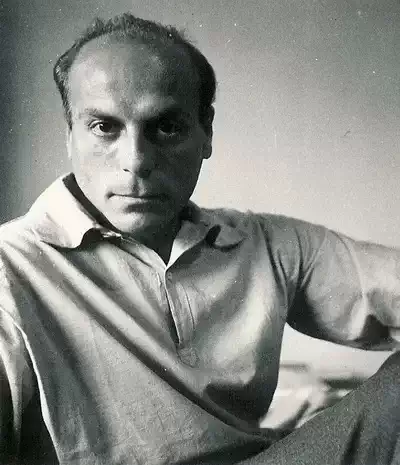
Ghérasim Luca
1913–1994
· lived 80 years
 RO
RO
RO
Ghérasim Luca was a Romanian poet, naturalized French, known for his radical exploration of language and poetry. His profoundly innovative work challenged literary conventions, delving into sonority, fragmentation, and the exploration of the absurd and the dreamlike. He maintained a strong connection with surrealism and explored other art forms, such as cinema and visual arts, leaving a legacy of experimentation and linguistic subversion.
n. 1913-07-23, Bucareste · m. 1994-02-09, Boulogne-Billancourt
39
Views
Bio
Identification and Basic Context
Ghérasim Luca, born on July 26, 1913, in Bucharest, Romania, and died on December 10, 1994, in Paris, France, was a poet, essayist, and visual artist of Romanian origin who became a naturalized French citizen. He used his own name throughout his literary career. His family background was middle-class, and the cultural context of Bucharest at the time was vibrant and effervescent, with a strong European influence. His primary writing language was French, although he initially wrote in Romanian. He lived through a period of great political and social instability in Europe, marked by two World Wars and the Cold War.Childhood and Education
Luca grew up in Bucharest in a middle-class family. His education involved studies in Bucharest, where he encountered an intellectually stimulating atmosphere. From an early age, he showed an interest in literature and experimentation, absorbing influences from artistic and philosophical movements that were beginning to emerge in Europe. His youth was marked by the cultural effervescence of the Romanian capital and the social and political transformations of the interwar period.Literary Career
Ghérasim Luca's writing began in Romanian, but it was in Paris, from 1945 onwards, that his work gained a new dimension, predominantly in French. His writing evolved continuously, always marked by experimentation and a break from traditional forms. He collaborated with various literary and artistic magazines, particularly those linked to Surrealism. In addition to poetry, he dedicated himself to writing essays and exploring other artistic languages.Work, Style, and Literary Characteristics
Ghérasim Luca's work is vast and heterogeneous, including poetry collections such as "Un-serviteur" (1961), "Sens-débords" (1970), "Le vampire passif" (1971), among others. The central themes of his work revolve around identity, the body, sexuality, the absurdity of existence, language, and its capacity for subversion. Luca explored free verse and poetic prose, with a style characterized by fragmentation, sonority, wordplay, and the creation of neologisms. His poetic voice is often visceral, interrogative, and provocative, challenging the reader to question reality and language. He introduced innovations in the way language was explored, deconstructing syntax and semantics. His work is strongly associated with Surrealism, a movement he absorbed and revitalized with his originality. Lesser-known works include his forays into visual arts and cinema.Cultural and Historical Context
Ghérasim Luca lived in a time of profound historical upheavals, including World War II and the communist regime in Romania, which led him to exile. His connection with Surrealism, especially with André Breton, was an important milestone. He maintained relationships with various artists and intellectuals of his time, actively participating in the Parisian art scene. His work reflects existential anguish and the search for creative freedom in a constantly changing world.Personal Life
Luca had a life marked by instability and the search for refuge and freedom. His personal relationships and his experience of exile and marginality within the literary milieu profoundly influenced his worldview and his work. His dedication to art was total, and he was a multifaceted artist.Recognition and Reception
Although Ghérasim Luca did not achieve widespread recognition during his lifetime, his work was admired by select circles of artists and intellectuals, especially those connected to Surrealism. The importance of his work has been increasingly recognized, with academic studies and reissues of his work, consolidating his place as one of the most relevant experimental poets of the 20th century.Influences and Legacy
Luca was influenced by Surrealist authors and by an experimental approach to language. His legacy lies in how he expanded the boundaries of poetry, in his radical exploration of the word, and in his ability to create a transgressive and profoundly original body of work. He influenced subsequent generations of poets seeking new forms of expression and linguistic subversion. His work continues to be a subject of study and admiration for its audacity and originality.Interpretation and Critical Analysis
Ghérasim Luca's work has been the subject of various interpretations, focusing on his exploration of language as a means of deconstructing reality and his approach to existential questions and the human condition. His poetry is often analyzed from the perspective of Surrealism, but also as a unique voice that transcends movements.Curiosities and Lesser-Known Aspects
Luca experimented with various writing techniques, including the innovative use of sounds and phonemes. He was also a practitioner of visual arts, with ventures into cinema and painting, demonstrating remarkable creative breadth.Death and Memory
Ghérasim Luca passed away in Paris, leaving behind a body of work that continues to challenge and inspire. His posthumous publications and the ongoing critical re-evaluation of his work ensure his persistence in literary and artistic memory.Poems
0No poems found
Comments (0)
Log in
to post a comment.
No comments yet. Be the first to comment.