
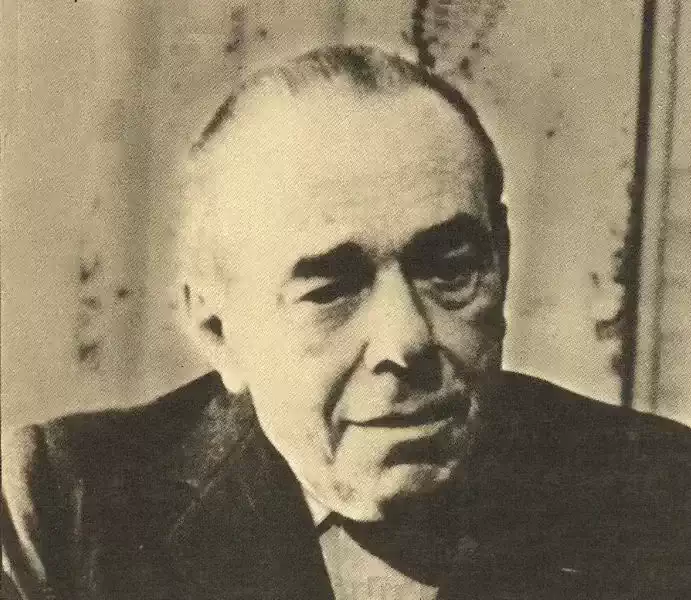
Guilherme de Almeida
1890–1969
· lived 78 years
 BR
BR
BR
Guilherme de Almeida was a Brazilian poet, journalist, and lawyer, a central figure of Parnasianism and Modernism in Brazil. His poetic work, marked by musicality, formal rigor, and nationalist themes, celebrates the Brazilian landscape, history, and culture. Almeida also stood out as an important translator and promoter of foreign literature in Brazil.
n. 1890-07-24, Campinas · m. 1969-07-11, São Paulo
55
Views
Bio
Identification and basic context
Guilherme de Almeida, full name Guilherme Francisco de Almeida, was born in Campinas, São Paulo, and passed away in the city of São Paulo. He was a Brazilian poet, journalist, translator, and lawyer, one of the most important figures of Parnasianism and the early days of Modernism in Brazil. His work is written in Portuguese.Childhood and education
Son of a wealthy family, Guilherme de Almeida studied Law at the Faculty of Law of São Paulo, where he graduated. From an early age, he showed great interest in literature, cultivating friendships with other young intellectuals who would form the São Paulo literary avant-garde.Literary career
His literary career began with poems of a Parnassian nature, characterized by formal perfection and erudite vocabulary. With the advent of Modernism, Almeida knew how to engage with new aesthetic proposals, incorporating elements of colloquial language and Brazilian themes into his work, without, however, abandoning the musicality and formal rigor that characterized him. He was an active participant in São Paulo's cultural life, collaborating in newspapers and magazines.Work, style, and literary characteristics
Guilherme de Almeida's works include "Misérere" (1910), "Sua" (1911), "Guirlanda de Versos" (1912), "O Livro das Horas" (1915), and "A Dança das Horas" (1917). His poems explore themes such as love, Brazilian nature, history, and national identity, with restrained lyricism and a pursuit of formal beauty. Musicality, rhythm, and rich vocabulary are hallmarks of his style, which transitions between Parnasianism and early modernist experiments. Although linked to Parnasianism, his sensibility and themes also bring him closer to Symbolism and the trends of Pre-Modernism and Modernism.Cultural and historical context
Guilherme de Almeida lived through a period of great social and cultural transformations in Brazil, including the Week of Modern Art of 1922, to which he was linked, albeit with reservations about some of its excesses. His work reflects the desire to build a genuinely Brazilian literary identity, engaging with European tradition while adapting it to the national reality.Personal life
In addition to being a poet, Guilherme de Almeida was a lawyer and journalist. He maintained close relationships with many intellectuals of his generation, such as Oswald de Andrade and Mário de Andrade, with whom he discussed the direction of Brazilian literature. His life was dedicated to art and the defense of an aesthetic ideal.Recognition and reception
Guilherme de Almeida was a recognized poet in his time, with work appreciated by critics for its formal and thematic quality. His importance lies in his ability to navigate between different aesthetics, contributing to the renewal of Brazilian poetry.Influences and legacy
Influenced by French Parnassian and Symbolist poets, Guilherme de Almeida, in turn, left a legacy of poetry that values form, musicality, and national themes. His work served as a bridge between Parnasianism and Modernism, opening paths for Brazilian poetry.Interpretation and critical analysis
Almeida's work is seen as a testament to the search for a national poetic expression that reconciles formal tradition with the exploration of Brazilian themes. His poetry is valued for its formal beauty and the lyrical depth with which it addresses the Brazilian soul.Curiosities and lesser-known aspects
Guilherme de Almeida also stood out as an excellent translator, bringing works by authors such as Shakespeare, Goethe, and Baudelaire into Portuguese. His artistic versatility is one of the most notable aspects of his career.Death and memory
Guilherme de Almeida passed away in 1969. His poetic work continues to be studied and admired as a fundamental part of Brazilian literature, representing an important link between different phases of the country's poetry.Poems
0No poems found
Comments (0)
Log in
to post a comment.
No comments yet. Be the first to comment.