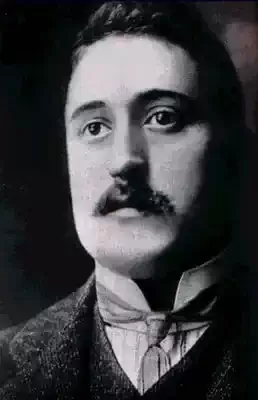
Guillaume Apollinaire

Guillaume Apollinaire

1880–1918 · lived 38 years FR FR

Guillaume Apollinaire was a highly influential French poet, playwright, short story writer, novelist, and art critic. He is considered one of the most important figures of early 20th-century European literature, particularly associated with the Symbolist movement and the development of Surrealism. Apollinaire is credited with coining the term 'Surrealism' and is renowned for his innovative use of language, experimental typography, and exploration of modern themes. His poetry often blends lyricism with everyday experiences, reflecting the vibrant, often chaotic, spirit of his time.

n. 1880-08-26, Roma · m. 1918-11-09, Paris

21,449 Views

Shadow

Shadow


Here you are beside me again
Memories of my companions killed in the war
The olive-branch of time
Memories that make only a single memory
As a hundred skins make only a single coat
As these thousands of wounds make only a single
newspaper article
Impalpable and ark presence who have assumed
the changing shape of my shadow
an Indian on the watch through all Eternity
shadow you creep beside me
but you do not hear me any more
you will not know any more the divine poems I sing
but I hear you still and see you still
Destinies
Multiple shadows may the sun preserve you
You who love me so much that you will never leave me
And who dance in the sun without stirring the dust
Shadow ink of the sun
Signature of my light
Holder of sorrows
A god that condescends.
Read full poem
Bio

Identification and basic context

Guillaume Apollinaire, born Wilhelm Albert Wladimir Alexandre Apollinaris de Kostrowitzky, was a celebrated poet, art critic, and writer. Born in Rome, he later became a naturalized French citizen. His life was marked by a cosmopolitan upbringing and deep engagement with the avant-garde artistic and literary scenes of Paris. He is considered a pivotal figure in the transition from Symbolism to modern poetry and a precursor to Surrealism.

Childhood and education

Apollinaire's early life was spent in Monaco and France. His father's identity is uncertain, and he was raised by his mother, an Italian noblewoman. He received a solid education, excelling in languages and literature. His travels and exposure to diverse cultures in his youth contributed to his broad intellectual horizons and adventurous spirit.

Literary trajectory

Apollinaire began his literary career in Paris, contributing to various journals and developing friendships with prominent artists and writers. He became known for his association with Cubism and Orphism, and his patronage of artists like Picasso. His first major poetry collection, Alcools, published in 1913, was revolutionary in its style and content. Calligrammes, published during World War I, further showcased his innovative use of visual typography. He also wrote art criticism and prose.

Works, style, and literary characteristics

Apollinaire's most famous works include the poetry collections Alcools (1913) and Calligrammes (1918). His poetry explores themes of love, war, the modern city, exoticism, and the passage of time. He is renowned for his lyrical intensity, his embrace of everyday language, and his radical experiments with form. He pioneered 'calligrammes,' poems where the typography itself forms an image related to the subject matter. His style is characterized by a blend of traditional lyricism with avant-garde techniques, often creating a sense of simultaneity and fragmented perception. He is strongly associated with Symbolism, Cubism, and was a direct influence on Surrealism.

Cultural and historical context

Apollinaire lived through a period of immense cultural and political upheaval, including the Belle Époque and World War I. He was deeply embedded in the Parisian avant-garde, interacting with figures like Picasso, Matisse, Cocteau, and Gertrude Stein. His work reflects the dynamism, anxieties, and artistic innovations of the early 20th century. His experiences in the war profoundly impacted his later work, particularly Calligrammes.

Personal life

Apollinaire had a complex personal life, marked by romantic relationships and friendships within the artistic community. His relationship with the painter Marie Laurencin was significant. He served in the French army during World War I, where he was wounded. His physical and emotional experiences during the war are palpable in his later poetry.

Recognition and reception

Apollinaire achieved significant recognition during his lifetime, particularly among artistic circles, though his radical innovations sometimes met with resistance. Posthumously, his reputation has grown immensely, and he is widely regarded as a major poet of the 20th century, celebrated for his originality and influence.

Influences and legacy

Apollinaire was influenced by Symbolist poets like Baudelaire and Rimbaud. His own work, in turn, was a crucial influence on the Surrealist movement. His experiments with form, his exploration of the subconscious, and his fusion of poetry with visual art laid essential groundwork for later artistic developments.

Interpretation and critical analysis

Critics often analyze Apollinaire's work for its blend of the lyrical and the experimental, its engagement with modernity, and its exploration of themes like love, loss, and the ephemeral nature of existence. His calligrammes are particularly studied for their innovative fusion of literature and visual art.

Curiosities and lesser-known aspects

Apollinaire famously introduced the term 'Surrealism' in the program notes for Erik Satie's ballet Parade in 1917. He was also known for his theatrical personality and his deep passion for art and literature.

Death and memory

Apollinaire died in Paris in 1918 from the Spanish flu pandemic, shortly after the end of World War I. He is remembered as a revolutionary poet whose work continues to inspire and challenge readers and artists.

Poems

19

Les Colchiques

Les Colchiques

Le pré est vénéneux mais joli en automne
Les vaches y paissant
Lentement s'empoisonnent
Le colchique couleur de cerne et de lilas
Y fleurit tes yeux sont comme cette fleur-la
Violatres comme leur cerne et comme cet automne
Et ma vie pour tes yeux lentement s'empoisonne

Les enfants de l'école viennent avec fracas
Vêtus de hoquetons et jouant de l'harmonica
Ils cueillent les colchiques qui sont comme des mères
Filles de leurs filles et sont couleur de tes paupières
Qui battent comme les fleurs battent au vent dément

Le gardien du troupeau chante tout doucement
Tandis que lentes et meuglant les vaches abandonnent
Pour toujours ce grand pré mal fleuri par l'automne
841

Mareye

Mareye


Mareye était très douce étourdie et charmante
Moi je l'aimais d'Amour m'aimait-elle, qui sait?
Je revois parfois à la lueur tremblotante
Des lointains souvenirs cet Amour trépassé.


Sur ma bouche je sens celle de mon amante
Je sens ses petites mains sur mon front glacé
Ses mains dont doucement elle me caressait
Ses rares mains de sainte pâle ou bien d'infante


Mon amante d'antant dans quels bras t'endors-tu
Pendant l'hiver saison d'amour où les vents pleurent
Où les amants ont froid où les passants se meurent


Sous les tristes sapins meurent en écoutant
Les elfes rire au vent et corner aux rafales?
Songes-tu quelquefois quand les nuits sont bien pâles
Que telles nos amours sont mortes les étoiles?
807

La Chanson Du Malaime

La Chanson Du Malaime

Un soir de demi-brume à Londres
Un voyou qui ressemblait à
Mon amour vint à ma rencontre
Et le regard qu'il me jeta
Me fit baisser les yeux de honte

Je suivis ce mauvais garçon
Qui sifflotait mains dans les poches
Nous semblions entre les maisons
Onde ouverte de la mer Rouge
Lui les Hébreux moi Pharaon

Qui tombent ces vagues de briques
Si tu ne fus pas bien aimée
Je suis le souverain d'Egypte
Sa soeur-épouse son armée
Si tu n'es pas l'amour unique.
850

L'Adieu

L'Adieu


J'ai cueilli ce brin de bruyère
L'automne est morte souviens-t'en
Nous ne nous verrons plus sur terre
Odeur du temps Brin de bruyère
Et souviens-toi que je t'attends
828

Hotels

Hotels


The room is free
Each for himself
A new arrival
Pays by the month
The boss is doubtful
Whether you’ll pay
Like a top
I spin on the way
The traffic noise
My neighbour gross
Who puffs an acrid
English smoke
O La Vallière
Who limps and smiles
In my prayers
The bedside table
And all the company
in this hotel
know the languages
of Babel
Let’s shut our doors
With a double lock
And each adore
his lonely love
741

In the Sante

In the Sante

I

Before I got into my cell
I had to strip my body bare
I heard an ominous voice say Well
Guillaume what are you doing here

Lazarus steps into the ground
Not out of it as he was bid
Adieu Adieu O singing round
Of years and girls the life I led

II

I'm no longer myself in here
I know
I'm number fifteen in the eleventh
Row

The sunlight filters downward through
The panes
And on these lines bright clowns alight
Like stains

They dance under my eyes while my
Ears follow
The feet of one whose feet above
Sound hollow

III

In a bear-pit like a bear
Every morning round I tramp
Round and round and round and round
The sky is like an iron clamp
In a bear-pit like a bear
Every morning round I tramp

In the next cell at the sink
Someone lets the water run
With his bunch of keys that clink
Let the goaler go and come
In the next cell at the sink
Someone lets the water run

IV

How bored I am between bare wall and wall
Whose colour pales and pines


A fly on the paper with extremely small
Steps runs across these lines

What will become of me O God Who know
My pain Who gave it me
Have pity on my dry eyes and my pallor
My chair which creaks and is not free

And all these poor hearts beating in this prison
And Love beside me seated
Pity above all my unstable reason
And this despair which threatens to defeat it

V

How long these hours take to go
As long as a whole funeral

You'll mourn the time you mourned you know
It will be gone too soon like all
Time past

too fast too long ago

VI

I hear the noises of the city
In the turning world beyond me
I see a sky which has no pity
And bare prison walls around me

The daylight disappears and now
A lamp is lit within the prison
We're all alone here in my cell
Beautiful light Beloved reason
914

Autumn Crocuses

Autumn Crocuses

The meadow is poisonous but pretty in the autumn
The cows that graze there are slowly poisoned
Meadow-saffron the colour of lilac and of shadows
Under the eyes grows there your eyes are like those flowers
Mauve as their shadows and mauve as this autumn
And for your eyes' sake my life is slowly poisoned

Children from school come with their commotion
Dressed in smocks and playing the mouth-organ
Picking autumn crocuses which are like their mothers
Daughters of their daughters and the colour of your eyelids
Which flutter like flowers in the mad breeze blown

The cowherd sings softly to himself all alone
While slow moving lowing the cows leave behind them
Forever this great meadow ill flowered by autumn
1,028

C’est Lou Qu’on La Nommait

C’est Lou Qu’on La Nommait

Il est des loups de toute sorte
Je connais le plus inhumain
Mon coeur que le diable l’emporte
Et qu’il le dépose à sa porte
N’est plus qu’un jouet dans sa main

Les loups jadis étaient fidèles
Comme sont les petits toutous
Et les soldats amants des belles
Galamment en souvenir d’elles
Ainsi que les loups étaient doux

Mais aujourd’hui les temps sont pires
Les loups sont tigres devenus
Et les Soldats et les Empires
Les Césars devenus Vampires
Sont aussi cruels que Vénus

J’en ai pris mon parti Rouveyre
Et monté sur mon grand cheval
Je vais bientôt partir en guerre
Sans pitié chaste et l’oeil sévère
Comme ces guerriers qu’Epinal

Vendait Images populaires
Que Georgin gravait dans le bois
Où sont-ils ces beaux militaires
Soldats passés Où sont les guerres
Où sont les guerres d’autrefois
729

Annie

Annie


Sur la côte du Texas
Entre Mobile et Galveston il y a
Un grand jardin tout plein de roses
Il contient aussi une villa
Qui est une grande rose

Une femme se promène souvent
Dans le jardin toute seule
Et quand je passe sur la route bordée de tilleuls
Nous nous regardons

Comme cette femme est mennonite
Ses rosiers et ses vêtements n'ont pas de boutons
Il en manque deux à mon veston
La dame et moi suivons le même rite.
977

Quotes

12

Videos

50

Comments (0)

Share
Log in to post a comment.

No comments yet. Be the first to comment.