
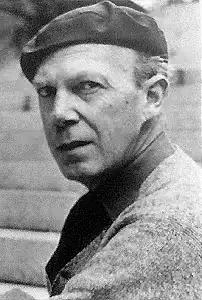
Gunnar Ekelöf
1907–1968
· lived 60 years
 SE
SE
SE
Gunnar Ekelöf was one of the most important Swedish poets of the 20th century, known for his innovative work and his deep exploration of the human condition. His poetry is characterized by rich language, complex symbolism, and a constant search for meaning in a fragmented world. Ekelöf is considered a central figure in Swedish modernism.
n. 1907-09-15, Estocolmo · m. 1968-03-16, Sigtuna
20
Views
Bio
Identification and basic context
Gunnar Ekelöf was a Swedish poet, considered one of the most influential of the 20th century. He was born in Skövde and died in Sigtuna. He is often associated with Scandinavian modernism and a deep existential quest that permeates his entire work.Childhood and education
Ekelöf had a childhood marked by fragile health and a complex family environment. He studied classical philology and comparative literature at Uppsala University, which gave him a vast knowledge of various literary and philosophical traditions. His academic training and personal experiences shaped his worldview.Literary career
His literary career began in the 1930s with the publication of "Sent på jorden" (Late on Earth), a work that already demonstrated his originality. Over the decades, his poetry evolved, exploring different phases and styles, but always maintaining unusual depth and rigor. He collaborated in various literary magazines, contributing to the cultural debate of the time.Work, style, and literary characteristics
Ekelöf's work is vast and complex, marked by themes such as identity, time, solitude, spirituality, and the search for meaning in a chaotic universe. His style is known for its dense language, use of symbolism, mythological and historical allusions, and a peculiar musicality. He explored both free verse and more traditional forms, adapting them to his vision. His poetic voice is often fragmented, questioning, and introspective. Ekelöf introduced innovations in Swedish poetry by mixing diverse traditions and approaching the human condition with unprecedented philosophical depth. He is often associated with modernism, but his work transcends easy classifications.Work, style, and literary characteristics
Cultural and historical context Ekelöf lived in a period of great social, political, and technological changes, from the World Wars to the Cold War. His work reflects the anxiety and uncertainty of the 20th century, engaging with the existential dilemmas of the time. He maintained contact with other writers and intellectuals, actively participating in Swedish cultural life. He belongs to a generation that sought to renew poetry and explore new forms of expression.Work, style, and literary characteristics
Personal life Ekelöf's personal life was marked by health challenges and an intense introspective search. His personal experiences, including a strong connection to ancient cultures and unconventional spirituality, are deeply reflected in his poetry. He was known for his complex personality and his dedication to art.Work, style, and literary characteristics
Recognition and reception Gunnar Ekelöf achieved considerable recognition during his lifetime, being considered one of the great Swedish poets. He received several important literary awards, and his work has been the subject of numerous academic studies. His critical reception has been consistently positive, both in Sweden and internationally.Work, style, and literary characteristics
Influences and legacy Ekelöf was influenced by a wide range of authors, from classical Greek poets to philosophers and mystics from various traditions. His legacy is immense, having influenced generations of poets in Sweden and other Scandinavian countries. His ability to blend erudition, lyricism, and existential depth made him an unavoidable figure in modern literature.Work, style, and literary characteristics
Interpretation and critical analysis Ekelöf's work is a fertile ground for interpretation, with critical debates about his explorations of identity, memory, and the nature of reality. The analysis focuses on his ability to evoke the ineffable and question established certainties.Work, style, and literary characteristics
Curiosities and lesser-known aspects A curiosity about Ekelöf is his fascination with ancient cultures and his ability to create poetic personas that transcend the biographical self. His correspondence and manuscripts reveal a meticulous creative process and deep reflection on language.Work, style, and literary characteristics
Death and memory He passed away in 1968, leaving behind a vast and complex body of work that continues to be studied and appreciated. Posthumous publications and the continued relevance of his poetry solidify his memory as one of Scandinavia's greatest poets.Poems
0No poems found
Comments (0)
Log in
to post a comment.
No comments yet. Be the first to comment.