
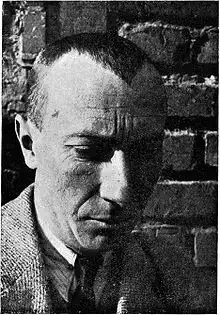
Hans Arp
 FR
FR
Hans Arp, also known as Jean Arp, was a Franco-German visual artist and poet, a prominent figure in the 20th-century avant-garde movements. His artistic work, characterized by organic and biomorphic forms, often abstract and playful, extended to poetry, where he explored language experimentally, breaking with semantic and syntactic conventions. A key collaborator of Dadaism and co-founder of Surrealism, Arp sought to liberate art and poetry from rational and bourgeois constraints. His poetry, often composed of word and sound collages, reflects a quest for spontaneity, the unconscious, and pure creative energy, leaving a lasting legacy in Surrealist art and literature.
n. 1886-09-16, Estrasburgo · m. 1966-06-07, Basileia
Bio
Identification and Basic Context
Jean Arp (born Hans Peter Wilhelm Arp) was a Franco-German visual artist, sculptor, and poet, also known by the French name Jean Arp. He was born in Strasbourg, Alsace, which at the time was part of the German Empire, and died in Basel, Switzerland. He held dual nationality, French and German, and wrote in both languages, as well as publishing in English. Arp lived in a period of great historical turbulence, including World War I and World War II, which significantly shaped his journey and his artistic and literary vision.Childhood and Education
Born in an Alsace with a cultural identity contested between France and Germany, Arp's early education was marked by this duality. He studied at the School of Arts and Crafts in Strasbourg (1905-1907) and attended the Académie Julian in Paris. Early in his career, he was influenced by movements such as Symbolism. His training was shaped by experimentation and the search for new forms of expression, absorbing the avant-garde ideas emerging in Europe.Literary Career
Arp's literary career was intrinsically linked to his artistic production. He began writing poetry in parallel with his visual art activities. He was one of the founders of the Dada movement in Zurich in 1916, where his poetry gained notoriety for its experimental and playful nature. Later, he became involved with Surrealism, a movement to which he contributed with his anti-rational and intuitive approach. He published several books of poetry, often accompanied by his illustrations or collages.Work, Style, and Literary Characteristics
Arp's poetry is marked by radical experimentation with language. He frequently used collage techniques, combining words and phrases taken from various sources, creating an effect of illogicality and surprise. His style is characterized by spontaneity, wordplay, sound, and an apparent simplicity that hides profound reflections on the nature of art and existence. Themes such as chance, dreams, nature, and the pursuit of creative freedom are recurrent. Arp sought to deconstruct conventional language to achieve a purer, more instinctive expression, aligned with the principles of Dadaism and Surrealism.Cultural and Historical Context
Arp was a central figure in the European avant-garde of the early 20th century. His participation in Dadaism in Zurich during World War I and, later, in Surrealism in Paris, placed him at the epicenter of the artistic and literary revolutions of the time. He associated and collaborated with artists and writers such as Tristan Tzara, André Breton, Max Ernst, Sophie Taeuber-Arp, and Marcel Duchamp. His work reflects the spirit of rupture and the questioning of social and artistic norms of that period.Personal Life
Jean Arp was married to the artist Sophie Taeuber-Arp, with whom he maintained a deep artistic and personal collaboration. His life was marked by constant changes of residence due to wars and political instability. Arp had a strong connection with nature, which was reflected in his work. His philosophical beliefs tended towards a humanism linked to freedom of expression and the rejection of dogmas.Recognition and Reception
Arp achieved considerable recognition during his lifetime, both as a visual artist and as a poet. His works were exhibited in important galleries and museums, and his poems were published in literary magazines and avant-garde anthologies. He is considered one of the pioneers of abstract art and a key figure in the development of Dadaism and Surrealism.Influences and Legacy
Arp was influenced by Symbolism and by ideas of artistic freedom. His legacy is immense, especially in abstract art and Surrealist poetry. He influenced generations of artists and poets who sought formal experimentation and the exploration of the unconscious. His approach to collage and abstraction, both in visual art and literature, left an indelible mark.Interpretation and Critical Analysis
Arp's poetry is often interpreted as a manifestation of the freedom of the creative spirit, an attempt to access the "unconscious" before reason imprisons it. Word collages can be seen as a metaphor for the fragmentation of modern reality or for the random and surprising nature of existence itself. His work defies purely logical analysis, inviting a more intuitive and sensory appreciation.Curiosities and Lesser-Known Aspects
Arp had a habit of creating his word collages and poems based on chance, often dropping pieces of paper and arranging them as they fell. He believed that chance was a way of revealing deeper truths. His connection with the Dada movement was also a reflection of his rejection of war and the rationality that produced it.Death and Memory
Jean Arp died in 1966 at the age of 79. His memory is celebrated through his numerous works of art and poetic writings, which continue to be studied and admired as landmarks of the artistic and literary avant-garde of the 20th century.Poems
0No poems found
Comments (0)
No comments yet. Be the first to comment.