
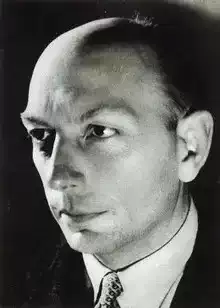
Henri Michaux
1899–1984
· lived 85 years
 BE
BE
BE
Henri Michaux was a Belgian poet, writer, and painter, known for his deep exploration of the human psyche, imaginary journeys, and experimentation with psychotropic substances. His work, marked by raw language and disturbing imagery, defies easy categorization, moving between poetry, diary, and narrative.
n. 1899-05-24, Namur · m. 1984-10-19, 14.º arrondissement de Paris
48
Views
Bio
Identification and Basic Context
Henri Michaux, whose full name was Henri-Robert-Marcel Michaux, was born in Namur, Belgium, on May 24, 1899. He was a multifaceted artist, excelling as a poet, writer, and painter. His nationality was Belgian, and he wrote predominantly in French. He lived most of his life in the 20th century, a period of profound social, political, and cultural transformations.Childhood and Education
Details about Michaux's childhood and education are scarce, but it is known that he came from a bourgeois family. His youth was marked by a family atmosphere that did not particularly stimulate him, leading him to a self-taught pursuit of knowledge and experiences. He received a formal education, but his true learning occurred through reading and personal exploration.Literary Career
Michaux began his literary activity late, after having explored various other activities, including the merchant navy. His literary work began to take shape in the 1920s and 1930s, marked by constant evolution and a refusal to settle into a single style. He published in various magazines and anthologies, but his notoriety grew gradually throughout his life.Work, Style, and Literary Characteristics
Michaux's major works include "Les Gardiens du Silence" (1942), "Voyage en Grande Garabagne" (1947), "L'Éspace intérieur" (1966), and "Connaissance par les gouffres" (1961). The dominant themes in his work are the exploration of the self, alienation, fear, the desire for transcendence, and the analysis of the human condition in altered states of consciousness. Michaux frequently experimented with poetic form, using free verse and fragmented prose that resembled diaries or travelogues. His language is direct, sometimes brutal, and loaded with strong, dreamlike images. The tone can vary between confessional, anthropological, and visionary. His poetic voice is unique, exploring the abysses of the mind and existence. His style is marked by imagistic density and the ability to evoke the inexplicable. He introduced innovations by addressing themes such as madness and the use of psychotropic drugs in a pioneering way in literature. Michaux associated himself with movements like Surrealism, although he maintained artistic independence.Work, Style, and Literary Characteristics
Cultural and Historical Context Henri Michaux lived in a period of great historical upheaval, with the two World Wars deeply marking Europe. His work sometimes reflects a sense of disorientation and anguish in the face of the world. He maintained relationships with other writers and artists, but his reserved nature meant he did not easily integrate into established literary circles. His philosophical position was one of profound questioning about the nature of reality and identity.Work, Style, and Literary Characteristics
Personal Life Henri Michaux was known for his reclusive and introspective nature. There are not many public records about his affective or family relationships that directly shaped his work. His main source of exploration seemed to be his own inner world. Professionally, he lived from his art, painting, and writing, although his life was also marked by experiences with travel and psychotropic substances, which profoundly influenced his worldview and his creation.Work, Style, and Literary Characteristics
Recognition and Reception Henri Michaux's recognition grew gradually throughout his career. He received several important awards, such as the Grand Prix National des Lettres in 1965. His work is today widely recognized for its originality and depth, both in academia and among readers interested in experimental poetry and the exploration of consciousness.Work, Style, and Literary Characteristics
Influences and Legacy Michaux was influenced by authors such as Arthur Rimbaud and by Eastern philosophy. His legacy lies in his courageous approach to exploring the unconscious and subjective reality, influencing later generations of poets and artists seeking new forms of expression. His work is studied and admired for its uniqueness and the way it expanded the boundaries of poetry.Work, Style, and Literary Characteristics
Interpretation and Critical Analysis Michaux's work is often interpreted as an investigation into the limits of human language and perception. His texts invite multiple readings, exploring philosophical themes such as identity, alterity, and the search for meaning in an increasingly fragmented world. There have been debates about his relationship with drug use and its impact on his work.Work, Style, and Literary Characteristics
Curiosities and Lesser-Known Aspects Michaux was known for his discretion and mystery. His relationship with psychotropic substances, which he used in controlled settings to explore the mind, is one of the most fascinating and controversial aspects of his life. His diaries and notebooks reveal an intense creative process and a constant search for new ways of apprehending reality.Work, Style, and Literary Characteristics
Death and Memory Henri Michaux passed away in Paris, France, on October 19, 1984. There were no significant posthumous publications that altered the perception of his work, which was already well-established.Poems
0No poems found
Quotes
1No poems found
Comments (0)
Log in
to post a comment.
No comments yet. Be the first to comment.