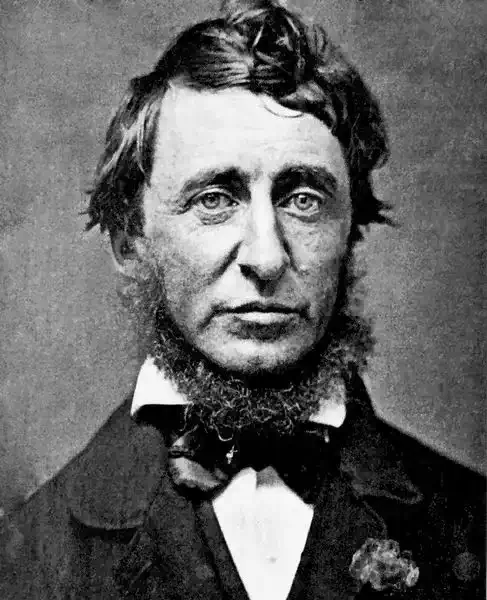
Identification and basic context
Henry David Thoreau was an American essayist, poet, philosopher, abolitionist, naturalist, tax resister, development critic, surveyor, and historian. He was born in Concord, Massachusetts. His death also occurred in Concord. He came from a family of modest means, with his father operating a pencil-manufacturing business. He was of French Huguenot and English ancestry. He was an American national and wrote in English.
Childhood and education
Thoreau's childhood was spent in Concord, where he developed an early appreciation for nature, often exploring the surrounding woods and rivers. He attended Concord Academy and later entered Harvard College in 1833. At Harvard, he studied classical languages, philosophy, and natural history, graduating in 1837. Following his graduation, he pursued various professions, including teaching, surveying, and writing, all while deepening his philosophical inquiries and his observation of the natural world. He was profoundly influenced by the writings of Ralph Waldo Emerson and the Transcendentalist movement.
Literary trajectory
Thoreau's literary career began in earnest with his association with Emerson and the Transcendentalist circle in Concord. He kept extensive journals throughout his life, which became the source material for his major works. His first published book, 'A Week on the Concord and Merrimack Rivers' (1849), a travelogue and philosophical reflection, initially met with little success. His most famous work, 'Walden; or, Life in the Woods' (1854), is a philosophical meditation on simple living in natural surroundings, based on his two-year experiment living in a cabin by Walden Pond. He was also a prolific essayist, publishing numerous pieces on nature, society, and politics in magazines and newspapers. He was known for his powerful oratory and lectures.
Works, style, and literary characteristics
Thoreau's most significant works are 'Walden' and 'A Week on the Concord and Merrimack Rivers.' Other important essays include 'Civil Disobedience' (originally published as 'Resistance to Civil Government,' 1849), 'Walking' (1862), and 'Nature.' His dominant themes include nature, simplicity, self-reliance, individualism, civil disobedience, social reform, and the critique of industrial society. His style is characterized by its directness, precision, vivid imagery drawn from nature, aphoristic wisdom, and a profound sense of moral conviction. He often employed a direct, conversational tone mixed with elevated philosophical discourse. His poetic voice is that of a keen observer, a moralist, and a prophet urging a return to authentic living. He experimented with blending prose and poetry in his works.
Cultural and historical context
Thoreau lived during a period of immense social and intellectual ferment in America, including the height of the Transcendentalist movement, the abolitionist cause, and the burgeoning Industrial Revolution. He was a staunch abolitionist and a supporter of John Brown. His ideas on civil disobedience, particularly in response to the Mexican-American War and slavery, were radical for their time and have had a lasting impact on political thought and activism. He was part of a vibrant intellectual community in Concord that included Emerson, Hawthorne, and Alcott.
Personal life
Thoreau's personal life was deeply intertwined with his intellectual and philosophical pursuits. He lived a relatively simple life, often relying on manual labor and the hospitality of friends, most notably Ralph Waldo Emerson, who provided him with land to build his cabin at Walden Pond. He never married and had no children. His close relationships with his family and friends, particularly Emerson, were central to his life. He maintained a lifelong commitment to his principles, even when it led to personal hardship, such as his brief arrest for refusing to pay his poll tax.
Recognition and reception
During his lifetime, Thoreau's works were not widely popular, and he struggled financially as a writer. 'Walden' sold poorly in its initial years. However, he gained a reputation as a formidable thinker and a powerful lecturer among his intellectual peers. Posthumously, his influence grew exponentially. 'Civil Disobedience' became a foundational text for leaders like Mahatma Gandhi and Martin Luther King Jr. 'Walden' is now considered a classic of American literature, celebrated for its insights into nature, self-sufficiency, and societal critique.
Influences and legacy
Thoreau was influenced by Ralph Waldo Emerson, the ancient Greek philosophers, Eastern philosophies (particularly Hinduism and Buddhism), and the writings of the Romantic poets. His legacy is immense, particularly his articulation of civil disobedience as a moral imperative and his enduring advocacy for a life lived in harmony with nature. He inspired countless writers, activists, and thinkers, shaping environmentalism, libertarian thought, and the broader understanding of individual conscience in relation to the state. His writings continue to be a touchstone for those seeking a more meaningful and principled existence.
Interpretation and critical analysis
Thoreau's work is subject to ongoing critical analysis, focusing on his philosophy of nature, his critique of consumerism and industrialization, his complex relationship with American democracy, and his radical ideas on individual liberty and resistance to unjust laws. Debates continue regarding his views on race, his place within the abolitionist movement, and the precise meaning and application of his concept of civil disobedience.
Curiosities and lesser-known aspects
Thoreau was an avid collector of natural specimens and kept meticulous records of the flora and fauna he encountered. He was also a skilled surveyor and used his knowledge of the land to supplement his income. He had a peculiar habit of sleeping outdoors in all seasons. He was a vegetarian and an advocate for temperance. Despite his solitary nature, he was known for his sharp wit and occasional cantankerousness.
Death and memory
Henry David Thoreau died of tuberculosis in Concord, Massachusetts, at the age of 44. His death was mourned by his intellectual circle, but his true impact on American thought and literature was not fully realized until later. His journals, published posthumously, further revealed the depth and breadth of his observations and reflections. His legacy is preserved through the continued study of his writings and the enduring relevance of his ideas on nature, freedom, and individual conscience.