
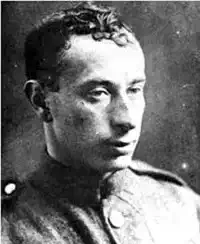
Isaac Rosenberg
1890–1918
· lived 27 years
 GB
GB
GB
Isaac Rosenberg was an English poet and painter, known for his vivid descriptions of life in World War I. Born into an immigrant Jewish family, his work reflects social struggles and the brutality of war. Despite his short life, he left a significant legacy in British war poetry, with poems that stand out for their emotional strength and raw realism.
n. 1890-11-25, Bristol · m. 1918-04-03, Arras
23
Views
Bio
Identification and Basic Context
Isaac Rosenberg was a British poet and painter, primarily known for his war poetry. He was born in Bristol, England, to a Russian Jewish immigrant family. He spoke Yiddish and English at home. His nationality was British. The historical context of his life was marked by working-class poverty in the early 20th century and, crucially, by World War I.Childhood and Education
He grew up in the East End of London, in a large family with financial difficulties. His father passed away when Rosenberg was young, forcing him to work early to support the family. He had some formal education but was largely self-taught, developing his artistic and literary talent through observation and personal study. He was influenced by readings of classical poetry and Renaissance art. His artistic training took place at the Slade School of Fine Art.Literary Career
Rosenberg began writing poetry in his adolescence, but his path was interrupted by his experience in World War I. The war had a profound impact on his work, making it darker and more intense. He tried to balance his painting career with writing, publishing poems in newspapers and literary magazines of the time. His literary output, though limited by his premature death, is considered of great value.Work, Style, and Literary Characteristics
His best-known works include poems such as 'Break of Day in the Trenches', 'Enlistment', and 'Dead Man's Dump'. The central themes of his poetry are war, death, the human condition, identity, and his experience as a Jew in the context of war. In terms of form, Rosenberg frequently used free verse, with direct language and powerful imagery that depict the brutality and absurdity of the conflict. His tone is often somber, but with moments of deep humanity and existential reflection. His writing is marked by emotional intensity and raw realism, distinguishing him from other war poets. He was associated with Modernism, although his work possesses a uniqueness that transcends specific movements.Cultural and Historical Context
Rosenberg served in World War I, an experience that profoundly shaped his worldview and his poetry. His social circle included other artists and writers who, like him, faced economic and social hardships. His generation of war poets, which included figures like Wilfred Owen and Siegfried Sassoon, brought a new perspective to the conflict, moving away from heroic ideals and embracing dark realism. His position as a Jew in a British context also influenced his perspective.Personal Life
Rosenberg's life was marked by financial difficulties and the tragedy of war. He had close relationships with his family, especially his mother. His friendships in the art world were important, although his career was cut short by his death. The experience of war was a traumatic turning point in his life. His dedication to art and poetry was remarkable, despite the challenges.Recognition and Reception
Although Rosenberg had some visibility during his lifetime, his broader recognition came after his death. His war poetry gained prominence in the following decades and is now considered among the most important in English literature. He received few formal distinctions during his life, but his work is widely studied and admired in academic and literary circles.Influences and Legacy
Rosenberg was influenced by avant-garde poetry and visual art. His legacy lies in his powerful depiction of war and his contribution to modern British poetry. His work has influenced subsequent generations of poets who have addressed themes of conflict and the human condition. He is an important figure in the canon of war poetry, with his poems being widely translated and studied.Interpretation and Critical Analysis
Rosenberg's work is often analyzed for its psychological depth and its brutal honesty in depicting war. His reflections on identity, existence, and human nature in times of crisis are recurring themes in critical studies. His poetry challenges idealizations and confronts the reader with the raw reality of the human experience in extreme circumstances.Curiosities and Lesser-Known Aspects
Rosenberg was a talented painter, and his artistic training is evident in the visual strength of his poetry. A curiosity is that he enlisted voluntarily, perhaps feeling a need to experience firsthand what was happening in his country. His poems were largely written in the trenches, under difficult circumstances.Death and Memory
Isaac Rosenberg died in 1918 from pneumonia on the battlefield in France, shortly before the end of the war. His works were published posthumously, gradually gaining lasting recognition. His memory is kept alive through his poetry, which continues to be read and admired for its strength and authenticity.Poems
0No poems found
Comments (0)
Log in
to post a comment.
No comments yet. Be the first to comment.