
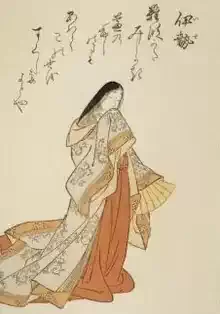
Ise no miyasudokoro
 JP
JP
Ise no Miyasudokoro, whose name means "Lady of the Ise Palace", was a Japanese court lady and a tanka poet active during the Heian period. Although little is known about her personal life, her literary contribution lies in her participation in the famous anthology "Kokin Wakashū", where some of her poems were included. Her work, although scarce, reflects the sensitivity and aesthetics of classical Japanese poetry, addressing themes such as love, nature, and the transience of life with an elegance characteristic of the era.
n. 0875-01-01, Província de Ise · m. -938, Ise-ji Temple
Bio
Identification and basic context
Ise no Miyasudokoro (伊勢の御息所) was a Japanese court lady and poet from the Heian period (794-1185). Her birth name is unknown, with "Ise no Miyasudokoro" being a title that refers to her position and the fact that she served in the palace. No pseudonym or heteronym is known. She was born on an uncertain date but lived during the 10th century. Her family origin and social class were likely high, given her access to the imperial court and the literary production of the time. She was Japanese and wrote in classical Japanese. She lived during a period of cultural and literary flourishing in Japan, known as the golden age of tanka poetry and court literature.Childhood and education
Little is known about Ise no Miyasudokoro's childhood and education. However, as a court lady, it is reasonable to assume that she received an education that included calligraphy, classical Japanese literature, poetry composition, and other arts valued in the palace environment. The influence of classical literature and the observation of nature and the social conventions of the court would have been her main sources of learning. Writing poetry was a common and expected activity among the ladies-in-waiting of the nobility.Literary career
Ise no Miyasudokoro's literary career is intrinsically linked to her participation in the compilation of the imperial anthology "Kokin Wakashū" (古今和歌集), completed around 905 AD. Some of her poems were selected for this important collection, attesting to their quality and recognition among her contemporaries and the compilers of the work. Her activity as a critic, translator, or editor is unknown. Her known work is limited to the poems included in "Kokin Wakashū" and other later imperial anthologies, such as "Gosen Wakashū".Work, style, and literary characteristics
The known poems of Ise no Miyasudokoro are essentially tanka (短歌), a Japanese poetic form of 31 syllables divided into five lines (5-7-5-7-7). The dominant themes in her work include courtly love, longing, the beauty of nature (especially the seasons and the moon), the ephemerality of life, and subtle human emotions. Her style is characterized by elegance, conciseness, and suggestiveness, typical of the wabi-sabi and yūgen aesthetics of Heian poetry. She uses poetic devices such as metaphor and comparison in a delicate and evocative way. Her poetic voice is lyrical and personal, expressing feelings in a restrained but profound manner. The language is refined and aligned with the poetic conventions of the time. Her work is part of the tradition of classical Japanese tanka poetry and contributed to its development through its inclusion in prestigious anthologies.Cultural and historical context
Ise no Miyasudokoro lived during the Heian period, an era of great cultural and artistic refinement in Japan, marked by the dominance of the aristocracy and the development of a unique court culture. Tanka poetry was an essential art form in this context, used to express feelings, celebrate nature, and strengthen social bonds. She interacted with other poets and court ladies, whose works were also compiled in anthologies. Her position at court allowed her to actively participate in this vibrant literary environment. Heian society valued beauty, sensitivity, and erudition, elements that are reflected in her poetry.Personal life
We know very little about Ise no Miyasudokoro's personal life. As a court lady, her emotional and family relationships would have been subject to the strict conventions of the time. Her title of "Miyasudokoro" suggests that she may have had a relationship with a member of the imperial family or a high court figure. Her work, although lyrical, offers no explicit biographical details but suggests a keen sensitivity to the nuances of human relationships and the beauty of the natural world.Recognition and reception
Ise no Miyasudokoro's recognition comes mainly from the inclusion of her poems in the "Three Imperial Collections of Tanka Poetry" (San-dai Shū), namely "Kokin Wakashū" and "Gosen Wakashū". This inclusion ensures her place in the canon of classical Japanese literature. Her reception over time has been that of a representative poet of the sensitivity and poetic art of the Heian period, admired for her elegance and lyrical depth.Influences and legacy
Ise no Miyasudokoro was influenced by the great masters of earlier tanka poetry, such as Kakinomoto no Hitomaro and Ono no Komachi. Her legacy lies in her contribution to the "Kokin Wakashū" and other anthologies, which helped shape the Japanese poetic tradition. Her poems continue to be studied and appreciated for their aesthetic beauty and their ability to evoke universal feelings of love, loss, and contemplation of nature. Her work is a testament to the literary sophistication of the Heian period.Interpretation and critical analysis
Ise no Miyasudokoro's poems are often analyzed from the perspective of classical Japanese aesthetics, highlighting her skill in conveying complex emotions through concise and suggestive imagery. Her work is seen as an example of court poetry, which balances personal expression with the social and artistic conventions of the time. Critical debates about her poetry tend to focus on the subtlety of her emotions and the formal mastery with which she expresses them.Curiosities and lesser-known aspects
The fact that her birth name is unknown and that we know her by a title rather than a given name is in itself a curious aspect, reflecting the importance of position and the relative anonymity of women in the Heian court. Her poems are, in many cases, the only window into her existence and sensibility.Death and memory
The circumstances and date of Ise no Miyasudokoro's death are unknown. Her memory is preserved through the poems that have survived and were compiled in imperial anthologies, ensuring her place in the history of Japanese literature.Poems
0No poems found
Comments (0)
No comments yet. Be the first to comment.