
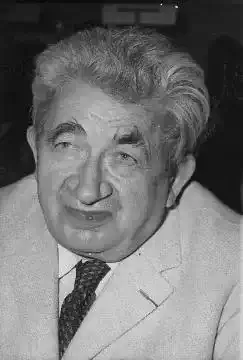
Jean Follain
 FR
FR
Jean Follain was a French poet, novelist, and journalist, whose work is recognized for its lyrical quality and exploration of daily life and the rural landscape. With a precise style and keen attention to detail, Follain captured the essence of small things, giving them a deep poetic dimension. His poetry is an invitation to contemplate simplicity, nature, and human relationships, seen through a sensitive and sometimes melancholic gaze. Follain's work is distinguished by its lyrical objectivity, avoiding grand emotional outbursts in favor of meticulous and suggestive description. His poems and novels often portray country life, traditions, the occupations of peasants, and the passage of time, always with formal elegance and intrinsic musicality.
n. 1903-08-29, Canisy · m. 1971-03-10, 4.º arrondissement de Paris
Bio
Identification and basic context
Jean Follain (born Jean-Pol-Louis Le Follain) was a French writer, known mainly for his poetry, but also an author of novels and journalistic activity. He was born in 1903 and died in 1971. His work is intrinsically linked to the landscape and rural life of Normandy, the region where he was born and lived for much of his life. His nationality was French and he wrote in French.Childhood and education
Jean Follain was born into a family of modest origins in Normandy. His childhood and youth were marked by the rural environment, which would be a constant source of inspiration in his work. His education, while not explicitly detailed in terms of higher academic studies, was shaped by deep engagement with reading and careful observation of the world around him.Literary career
Follain's literary career began to take shape in the 1920s with the publication of his first texts. He quickly distinguished himself in the French literary scene, not only as a poet but also as a novelist and chronicler. His writing gradually evolved, maintaining a strong connection to rural themes and the observation of daily life, while deepening his technical mastery and his capacity for lyrical synthesis.Work, style, and literary characteristics
Jean Follain's main works include poetry collections such as "L'Âge nouveau" (1921), "Le Manteau de Grand-père" (1926), "La Métamorphose des parcs" (1931), "Choses de la vie courante" (1937), "La Tête d'un homme" (1940), "Appel de la chasse" (1947), "Élégies romaines" (1950), "Les Chasseurs parmi les ombres" (1954), "Huit Jours en Sicile" (1958), "Terre de la Nuit" (1965), and "L'Arbre" (1973, posthumous). He also wrote novels such as "L'Île aux oiseaux" (1924), "Le Petit Chemin" (1932), and "Le Village" (1947). The dominant themes in his work include the rural landscape, nature, time, memory, daily life, farm work, death, and the human condition. His style is characterized by great precision, sobriety, and lyrical objectivity, avoiding excessive sentimentalism. Follain uses clear and concise language, with a vocabulary rich in references to the rural world. His poetic tone is often serene, contemplative, and sometimes elegiac.Work, style, and literary characteristics
Cultural and historical context Jean Follain lived and produced during a turbulent period in European history, including the two World Wars. His work, however, remained true to a vision more focused on the permanence of nature and rural traditions, as a counterpoint to the instability of the modern world. He belonged to a generation of writers who, while integrated into the French literary context, maintained a strong connection to their regional roots.Work, style, and literary characteristics
Personal life Jean Follain was married and had children. He dedicated a large part of his life to writing and journalism, having been an attentive observer of society. His personal relationships and life experiences, especially his connection to Normandy, were fundamental in shaping his worldview and his work.Work, style, and literary characteristics
Recognition and reception Jean Follain achieved considerable recognition in France, being considered one of the important poets and prose writers of the 20th century. He received several literary awards, such as the Grand Prize for Poetry from the French Academy. His work is valued for its authenticity and its ability to evoke the atmosphere of French rural life.Work, style, and literary characteristics
Influences and legacy Follain's influences can be found in poets who knew how to capture the essence of everyday life and nature with a lyrical and precise gaze. His legacy lies in his contribution to French poetry and prose, with a body of work that celebrates simplicity, the land, and human resilience. His attention to detail and his refined language influenced later generations of writers interested in exploring lyrical realism.Work, style, and literary characteristics
Interpretation and critical analysis Follain's work is often analyzed from the perspective of its relationship with the land, memory, and the passage of time. His ability to describe rural scenes with almost pictorial precision, combined with deep lyrical sensitivity, is a central point of critical analysis.Work, style, and literary characteristics
Curiosities and lesser-known aspects Jean Follain was known for his discretion and dedication to writing. He spent much of his time in contact with nature, which fueled his inspiration. His connection to journalism allowed him to maintain a perspective on social events, although his literary work focused more on timeless themes and rural life.Work, style, and literary characteristics
Death and memory Jean Follain passed away in 1971. His memory is kept alive through his published work and ongoing studies of his literary legacy. Posthumous publications, such as "L'Arbre," attest to his continuous output and his importance in French literature.Poems
0No poems found
Videos
50
Comments (0)
No comments yet. Be the first to comment.