
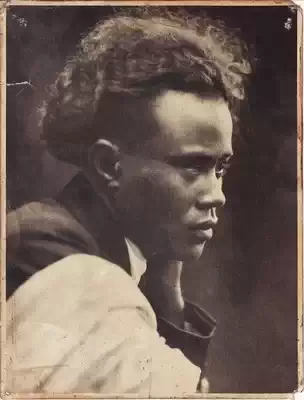
Jean-Joseph Rabearivelo
1901–1937
· lived 36 years
 MG
MG
MG
Jean-Joseph Rabearivelo was a Malagasy poet, often considered Madagascar's greatest poet. His poetic work, marked by deep melancholy and a strong connection to the history and culture of his homeland, explores themes such as identity, memory, loss, and cultural resistance. Rabearivelo is recognized for his ability to merge Western influences with Malagasy oral tradition, creating a unique and powerful poetic voice that continues to resonate.
n. 1901-03-04, Antananarivo · m. 1937-06-23, Antananarivo
42
Views
Bio
Identification and basic context
Jean-Joseph Rabearivelo was a prominent Malagasy poet. Pseudonym of Rabearivelo, he is widely recognized as Madagascar's greatest poet. He was born in Antananarivo. The historical context in which he lived was that of French colonization of Madagascar, a period of profound social and cultural transformations that marked his work.Childhood and education
Rabearivelo had a childhood marked by hardship, having lost his parents early and been raised by relatives. His education was largely self-taught, devouring books in French and Portuguese, and absorbing both Western culture and the rich Malagasy oral tradition. Formal education, although limited, provided him with access to a wide range of knowledge. He was strongly influenced by his readings of French symbolist poets, such as Baudelaire and Verlaine, but also by Malagasy history and mythology.Literary career
Rabearivelo began writing in his youth, driven by a deep desire to express his identity and the complexities of his land under the colonial yoke. His work evolved over time, moving from an initial exploration of more universal themes to an increasingly deep dive into the specifics of Malagasy culture and his own existential experience. He collaborated in various literary publications of the time, contributing to the dissemination of his poetry.Work, style and literary characteristics
Rabearivelo's main works include "La Coupe de Sève" (The Sap Cup), "Sylves" (Woods), and "Traduit de tous les soleils" (Translated from All Suns). The dominant themes in his poetry are Malagasy identity, nostalgia, death, the passage of time, the relationship with ancestors, and cultural resistance in the face of colonization. He used a rich and evocative language, with strong musicality and imagistic density, often inspired by oral tradition. His style is often melancholic, lyrical, and introspective, with a poetic voice that seeks universality in particular experience. Rabearivelo is associated with the symbolist movement, but his originality lies in the unique fusion with African cultural elements.Cultural and historical context
Rabearivelo lived and wrote under French colonial rule, a period of cultural repression and exploitation. This historical reality permeates his work, which frequently evokes the loss of sovereignty and the search for an authentic Malagasy identity. His poetry dialogues with Malagasy oral tradition and European symbolist poetry, creating a bridge between the local and the universal. He was one of the first African poets to gain international recognition.Personal life
Rabearivelo's personal life was marked by financial difficulties and fragile health. His family relationships, though complex due to the early loss of his parents, nurtured his sensitivity and his search for roots. His dedication to poetry was total, dedicating his life to writing and the exploration of his culture. His spiritual and philosophical beliefs were deeply connected to the Malagasy worldview.Recognition and reception
Although recognition during his lifetime was limited to specific circles, Jean-Joseph Rabearivelo is today acclaimed as one of the greatest African poets of the 20th century. His work has been the subject of study and admiration, and has been translated into several languages, attesting to his place in the international literary canon.Influences and legacy
Rabearivelo was influenced by French symbolist poets such as Charles Baudelaire and Paul Verlaine, but also by the rich oral and mythological tradition of Madagascar. His legacy lies in his ability to fuse these influences, creating an unmistakable poetic voice that has influenced later generations of African and Malagasy poets. His work is a testament to cultural resilience and the richness of African artistic expression.Interpretation and critical analysis
Rabearivelo's work has been interpreted from various perspectives, including post-colonial analysis and comparative studies with Western literature. His poetry invites reflection on identity, historical memory, and the universality of human experience, even in the specific context of colonization.Curiosities and lesser-known aspects
Rabearivelo was known for his intense dedication to writing and his deep melancholy. He spent long hours immersed in reading and poetic creation, often in conditions of great poverty. His work reflects his struggle for cultural expression in an oppressive environment.Death and memory
Jean-Joseph Rabearivelo passed away in 1937. The circumstances of his death are often associated with his fragility and melancholy. Posthumous publications continued to disseminate his work, consolidating his importance in world literature.Poems
0No poems found
Comments (0)
Log in
to post a comment.
No comments yet. Be the first to comment.