
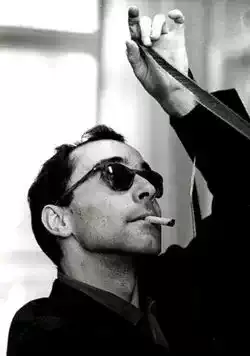
Jean-Luc Godard
1930–2022
· lived 91 years
 FR
FR
FR
Jean-Luc Godard was a Franco-Swiss filmmaker, a seminal figure in the French "Nouvelle Vague." His work is known for radical experimentation in terms of narrative, structure, and cinematic aesthetics, challenging conventions and exploring the nature of image and language. Godard addressed themes such as alienation, politics, philosophy, and the very condition of cinema, leaving a legacy of films that continue to influence and provoke.
n. 1930-12-03, 7.º arrondissement de Paris · m. 2022-09-13, Rolle
36
Views
Bio
Identification and Basic Context
Jean-Luc Godard was a Franco-Swiss filmmaker, screenwriter, and film critic. Born on December 3, 1930, in Paris, France, he passed away on September 13, 2022, in Rolle, Switzerland. He was the son of Paul Godard, a physician, and Madeleine Othenin-Girard, from a Swiss family of bankers.Childhood and Education
Godard grew up in an upper-middle-class Protestant family. He spent part of his childhood in Switzerland, where he attended boarding schools. His youth was marked by an interest in cinema and literature. He attended Lycée Henri-IV in Paris and later studied ethnology at the Sorbonne, graduating in 1950. During his time at university, he became involved in the Parisian cultural scene, frequenting film clubs and writing for film magazines. This academic background and his immersion in the cinematic world were crucial to the development of his artistic and intellectual vision.Literary Path
Godard's path in cinema truly began with his writing for film publications. He was one of the most influential critics for the magazine "Cahiers du Cinéma" in the 1950s, where he developed the "politique des auteurs" (author's policy) theory, advocating for the director's vision as the primary author of a film. This phase as a critic was fundamental to the formation of his own cinematic language. His first short films, such as "Opération béton" (1954), already demonstrated his inclination for experimentation. His first feature film, "À bout de souffle" (Breathless, 1960), marked the beginning of his career as one of the leading figures of the French New Wave.Work, Style, and Literary Characteristics
Godard's works are vast and diverse, including iconic films such as "Vivre sa vie" (My Life to Live, 1962), "Le Mépris" (Contempt, 1963), "Pierrot le Fou" (Pierrot the Madman, 1965), "Alphaville" (1965), "Week-end" (1967), "Tout va bien" (Everything's Fine, 1972), and "Je vous salue, Marie" (Hail Mary, 1985), among many others. His recurring themes include alienation in modern society, critique of capitalism and consumerism, the nature of cinema and language, politics, love, and the search for meaning. Godard is renowned for his radically innovative approach, breaking narrative conventions with abrupt cuts, philosophical dialogues, breaking the fourth wall, using on-screen text, and a bold visual aesthetic. He frequently used handheld cameras, improvisation, and exploration of new technologies. His cinematic language was dense, full of artistic, philosophical, and political references. Godard is associated with Modernism and Postmodernism, and his work is characterized by constant reinvention and experimentation.Cultural and Historical Context
Godard emerged in the effervescent context of the French "Nouvelle Vague" of the 1950s and 1960s, a movement that sought to renew French cinema with more auteur-driven, experimental, and critical approaches. He lived and produced during periods of intense social and political turmoil, such as the May 1968 protests, which profoundly influenced his work, leading him to a more politically engaged phase and to question the film industry itself. Godard maintained a constant dialogue with philosophy, politics, and the arts, engaging with and sometimes confronting other filmmakers and thinkers of his time.Personal Life
Godard married actress Anna Karina, the muse of many of his early films, and later married actress Anne Wiazemsky. His personal life was marked by intense relationships and an almost absolute dedication to cinema, often at the expense of his family life. He was known for his complex personality, sometimes reclusive and dogmatic in his artistic and political convictions. His search for authenticity and his critique of society led him to live a relatively modest life and avoid the spotlight of the traditional film industry.Recognition and Reception
Although not always understood by the general public and part of the more conservative criticism, Jean-Luc Godard is widely recognized as one of the most important and influential filmmakers in cinema history. He received numerous awards throughout his career, including the Golden Bear at the Berlin Film Festival and an honorary Oscar. His work challenged and expanded the boundaries of what cinema could be, influencing generations of filmmakers worldwide, in both art-house and mainstream cinema.Influences and Legacy
Godard was influenced by filmmakers such as Alfred Hitchcock, Robert Bresson, Jean Renoir, and by thinkers like Bertolt Brecht and Karl Marx. His legacy is immeasurable. He revolutionized cinematic language, inspiring movements such as Brazil's Cinema Novo, New Hollywood, and independent cinema worldwide. His approach to narrative, editing, and aesthetics continues to be studied and revisited, proving his lasting relevance and impact on cinema.Interpretation and Critical Analysis
Godard's work invites multiple interpretations, serving as a constant invitation to reflect on the nature of reality, representation, and existence itself. His films are often seen as philosophical essays in motion, exploring the human condition in a world increasingly mediated by images and technology. Criticism has debated the evolution of his cinema, from his early, more playful and romantic works to his later, more abstract and politically engaged films.Curiosities and Lesser-Known Aspects
Godard was known for his aversion to certain Hollywood conventions and his critical stance towards the film industry. He frequently used improvised filming and collaborated closely with his actors, but he could also be demanding in his visions. His home in Switzerland was a production hub where he experimented with new technologies and filming approaches. Godard was an inveterate cinephile, with an encyclopedic knowledge of film history.Death and Memory
Jean-Luc Godard passed away at the age of 91 at his residence in Rolle, Switzerland, through medical assistance. His death prompted a wave of tributes and reflections on his immense legacy in world cinema. His work continues to be screened, studied, and to inspire new creators, ensuring his living memory in the history of the seventh art.Poems
0No poems found
Quotes
5Comments (0)
Log in
to post a comment.
No comments yet. Be the first to comment.