
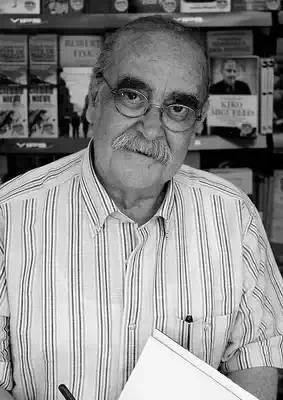
José Antonio Labordeta
1935–2010
· lived 75 years
 --
--
--
José Antonio Labordeta was a Spanish poet, singer-songwriter, politician, and professor, an emblematic figure of Aragonese culture and singer-songwriter tradition in Spain. His poetic and musical work is characterized by deep social and political commitment, a strong connection to his native land, Aragon, and an authentic, combative voice. Labordeta is remembered for his defense of freedoms, his criticism of power, and his ability to express the concerns of his people.
n. 1935-03-10, Saragoça · m. 2010-09-19, Saragoça
20
Views
Bio
Identification and Basic Context
José Antonio Labordeta Subías was a Spanish poet, singer-songwriter, essayist, and politician, born in Zaragoza. He is a key figure in Aragonese culture and a benchmark for singer-songwriters in Spain, known for his social and political commitment and his defense of freedoms.Childhood and Education
Labordeta was born into a bourgeois family in Zaragoza. His father was a doctor and his mother, although she did not work outside the home, came from a family with some cultural inclination. He studied Philosophy and Letters at the University of Zaragoza, where his interest in literature and poetry began to take shape.Literary Career
Labordeta's literary career began with poetry writing, publishing his first collections in the 1960s. In parallel, he began to develop his facet as a singer-songwriter, setting his own poems to music and composing songs with a marked social and protest character. His fame grew from the 1970s onwards, especially with the rise of the singer-songwriter movement in Spain. He also worked as a high school teacher and engaged in politics, being elected as a deputy.Work, Style, and Literary Characteristics
Labordeta's poetry is eminently social and protest-oriented, with strong roots in his native land, Aragon. His poems address themes such as Aragonese identity, social injustice, freedom, historical memory, and criticism of power. He uses direct language, often colloquial, but charged with emotion and expressive force. His style is characterized by sincerity, passion, and denunciation. Among his most notable poetic works are "Usura," "Re-lato de un náufrago," and "Día de la Furia." As a singer-songwriter, songs like "Cantares de guerra," "Lucharemos hoy," and "La memoria del agua" are anthems of protest and resistance.Cultural and Historical Context
Labordeta lived and developed his work during the Spanish Franco dictatorship and the subsequent Transition. His political and social commitment led him to be a critical and dissenting voice. He belonged to a generation of artists and intellectuals who used art as a tool for denunciation and social transformation. His connection with Aragon was fundamental, making him a defender of its culture and identity.Personal Life
Labordeta was married and had children. His political and vital commitment was a constant in his life, balancing his artistic and teaching work with his activism. He was a widely beloved and respected public figure, known for his approachable nature and integrity.Recognition and Reception
José Antonio Labordeta enjoyed great popular recognition throughout his life, both for his poetic and musical work and for his political contributions. He was named Favorite Son of Aragon and received various awards and distinctions throughout his career. His figure became a symbol of Aragonese resistance and identity.Influences and Legacy
Labordeta was influenced by Spanish social poetry and by the oral and musical tradition of Aragon. His own legacy is that of a committed artist who knew how to channel the concerns of his time and his land through poetry and song. He has inspired numerous generations of artists and activists in Spain and, especially, in Aragon.Interpretation and Critical Analysis
Labordeta's work is often interpreted as a testimony of his time, a chronicle of the struggle for freedom and justice. His poetry is valued for its authenticity, emotional power, and ability to connect with the realities of ordinary people.Childhood and Education
Although best known as a poet and singer-songwriter, Labordeta was also an amateur and scholar of history, especially the history of Aragon. His role as a politician allowed him to bring his claims to institutions.Death and Memory
José Antonio Labordeta passed away in his native Zaragoza. His death represented a great loss to Aragonese and Spanish culture. His memory endures through his work, which continues to be studied, interpreted, and honored, consolidating his place as an indispensable figure in contemporary Spanish culture.Poems
0No poems found
Comments (0)
Log in
to post a comment.
No comments yet. Be the first to comment.