
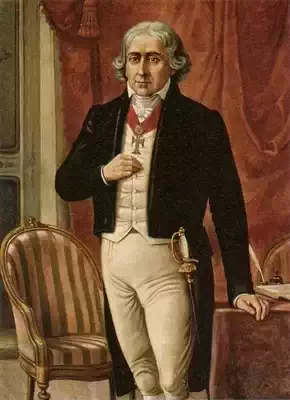
José Bonifácio de Andrada e Silva
1763–1838
· lived 74 years
 BR
BR
BR
José Bonifácio de Andrada e Silva was an influential Brazilian statesman, naturalist, and poet, a central figure in the Independence of Brazil. He stood out for his political and scientific work, being considered the Patriarch of Independence. His poetic work, although less known than his public activity, reflects the spirit of his time and his convictions.
n. 1763-06-13, Santos · m. 1838-04-06, Niterói
40
Views
Bio
Identification and Basic Context
José Bonifácio de Andrada e Silva, known as the Patriarch of the Independence of Brazil, was born in the town of Santos, then Province of São Paulo, Brazil, on June 13, 1763. He passed away in Rio de Janeiro on April 6, 1838. He was the son of a wealthy family with strong ties to the land and colonial tradition. His nationality was Brazilian, and his written language was Portuguese. He lived during a crucial period of historical transition, marked by Enlightenment ideas and the imminence of the emancipation of the American colonies.Childhood and Education
Born into a family of farmers and merchants, José Bonifácio had a privileged childhood in Santos. He received his initial formal education in his hometown and was later sent to Coimbra, Portugal, to study at the University of Coimbra, where he graduated in Law in 1788. During his stay in Europe, he absorbed the Enlightenment ideas circulating in intellectual circles of the time, as well as delving deeper into scientific studies, such as mineralogy and botany. Events such as the French Revolution and the Napoleonic Wars, which took place during his youth and adult life, influenced his worldview and his political thought.Literary Career
José Bonifácio's writing began during his studies in Coimbra, where he participated in literary gatherings and produced poems of an Arcadian and Neoclassical nature. His poetic work evolved timidly, always overshadowed by his prominent political and scientific career. He published some poems in newspapers and anthologies of the time but did not dedicate himself intensely to large-scale literary production. His activity as a translator and editor was modest.Work, Style, and Literary Characteristics
José Bonifácio's poetic work is scarce and mostly of a more personal or occasional nature. There are no major works published during his lifetime with the notoriety of his political contributions. The predominant themes in his poetry, when present, can be associated with nature, the exaltation of the homeland, and reflections on the human condition, often with a didactic or moralizing touch, in line with Enlightenment thought. His poetic form generally aligns with the standards of the time, such as the sonnet, but without major experimentation. The poetic tone varies between lyrical and didactic. The language is cultured and aligned with the Portuguese of his time. Although he did not introduce radical formal innovations, his work reflects the dialogue between classical tradition and new ideas that foreshadowed Romanticism.Work, Style, and Literary Characteristics
Cultural and Historical Context José Bonifácio lived in a period of intense historical transformations, including the arrival of the Royal Family in Brazil, Independence, and the early years of the Empire. His political actions placed him at the center of these events, making him one of the main architects of Brazilian emancipation. He belonged to the generation that fought for independence and the consolidation of the nation-state. His philosophical stance was strongly influenced by the Enlightenment, with an emphasis on reason, progress, and the importance of education. Brazilian society of the time, with its contradictions and colonial structure, profoundly shaped his vision and actions.Work, Style, and Literary Characteristics
Personal Life José Bonifácio was married to Carlota Emília de Andrada e Paes de Alvarenga, with whom he had children. He maintained friendships with important intellectual and political figures of his time. His life was marked by personal crises, such as exile during wartime and complex political power struggles. Professionally, in addition to his political career, he was a notable scientist, dedicating himself to mineralogy and botany, which earned him international recognition. His belief in reason and progress was fundamental, and he actively engaged in civic and developmental issues for Brazil.Work, Style, and Literary Characteristics
Recognition and Reception José Bonifácio is widely recognized as a central figure in Brazilian history, especially for his role in Independence. His scientific work also earned him distinctions in European academies. At the time, his political actions were the subject of great debate and recognition, but his poetic work had a more modest reception, being seen more as a complement to his public figure than as a literary corpus of great impact.Work, Style, and Literary Characteristics
Influences and Legacy José Bonifácio was influenced by Enlightenment authors such as Rousseau and Montesquieu, and by classical and Arcadian poets. His main legacy lies in his political contribution to the formation of Brazil. As a poet, his influence is less direct, but his work reflects the thought and sensibility of a transitional period. His entry into the literary canon is modest; he is more remembered as a politician and scientist. His writings, however, are important for understanding the intellectual and cultural context of Brazil in the 19th century.Work, Style, and Literary Characteristics
Interpretation and Critical Analysis José Bonifácio's poetic work can be interpreted in light of his Enlightenment convictions and his vision of a Brazil in formation. Existential and philosophical themes are present, but often under the prism of public morality and an ideal of civility. Critical analyses of his poetry generally place it as a reflection of his time and his multifaceted personality, rather than as a vanguard lyrical expression.Work, Style, and Literary Characteristics
Curiosities and Less Known Aspects A less known aspect of José Bonifácio is his deep dedication to science, which led him to exploratory journeys and detailed studies of Brazilian flora and fauna. Despite his austere public image, there are accounts of his involvement in intellectual debates and his strong, sometimes controversial, personality. His writing habits were likely governed by his intense political and scientific activity. Manuscripts and correspondence, especially on scientific and political topics, exist in important archives.Work, Style, and Literary Characteristics
Death and Memory José Bonifácio de Andrada e Silva passed away in Rio de Janeiro on April 6, 1838, after a life dedicated to Brazil. His memory is celebrated as one of the great figures in Brazilian history, the Patriarch of Independence. There are no posthumous publications of great relevance of his poetic work; his figure is immortalized by his political and administrative contributions.Poems
0No poems found
Videos
50
Comments (0)
Log in
to post a comment.
No comments yet. Be the first to comment.