
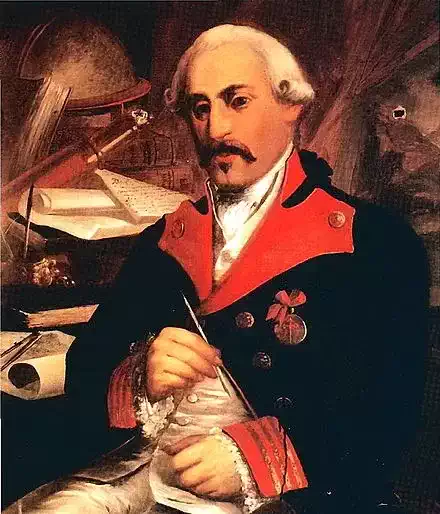
José Cadalso
 --
--
José Cadalso was a Spanish military officer, writer, and thinker of the Enlightenment, known mainly for his satirical and critical work of the society of his time. His agile prose and wit allowed him to address topics such as morality, customs, and national identity, often with an ironic and reflective tone. His most famous work, 'Cartas marruecas' (Moroccan Letters), is a paradigmatic example of the didactic and moralizing literature of the 18th century, where through the eyes of foreign characters, the vices and virtues of Spain are criticized. Cadalso is a key figure for understanding Enlightenment thought in Spanish literature.
n. 1741-10-08, Cádis · m. 1782-02-26, Gibraltar
Bio
Identification and basic context
José Cadalso y Vázquez was a Spanish military officer, writer, and essayist, born and died in Spain. He is a representative figure of the Spanish Enlightenment.Childhood and education
Born into a wealthy family, he received a solid education that included studies at the Universities of Salamanca and Bologna. His education was influenced by the intellectual currents of the time, Neoclassicism, and Enlightenment thought.Literary career
His literary career developed mainly in the second half of the 18th century. He became known for works of diverse character, from poems to essays and plays, but achieved fame with his 'Cartas marruecas' and 'Los eruditos a la violeta'. His writing was characterized by social and moral criticism.Work, style, and literary characteristics
Cadalso's work is part of the Enlightenment. His recurring themes are the criticism of social customs, education, the decline of Spain, and the need for reforms. He employed a clear, witty, and often ironic style. His 'Cartas marruecas' (1789) are an epistolary work that, through the eyes of gazelles and a Spaniard, criticize the vices of Spanish society. 'Los eruditos a la violeta' (1772) satirizes the pedantry and superficiality of certain intellectuals. He also cultivated poetry, with a melancholic and reflective tone, and theater.Cultural and historical context
Cadalso lived in a period of transition and debate in Spain, marked by the ideas of the Enlightenment and attempts at modernization. He belonged to a generation of intellectuals who sought to renew Spanish culture and society. His work reflects the tensions between tradition and modernity, and his military service gave him a particular perspective on the country's reality.Personal life
He was a military man and participated in campaigns, which allowed him to know Spanish reality closely. He had a life marked by intellectual and patriotic commitment. He maintained relationships with other intellectuals of the time.Recognition and reception
Although in life he was recognized for his wit and critical thinking, his work acquired greater importance posthumously as a reflection of the Spanish Enlightenment spirit. His 'Cartas marruecas' became a benchmark for didactic and satirical prose.Influences and legacy
Influenced by French and classical thinkers, Cadalso in turn influenced later writers who addressed social criticism and reflection on Spanish identity. He is considered one of the precursors of the modern essay in Spain.Interpretation and critical analysis
His work is valued for its psychological acuity and its ability to dissect the ills of the society of his time, implicitly proposing paths for improvement. The figure of the 'Moor' or the foreigner as a critical observer is an effective stylistic device.Childhood and education
He was a great admirer of the works of Cervantes and Quevedo, and his social criticism often draws from the tradition of these authors, adapting it to the Enlightenment spirit.Death and memory
He died in an attack on Gibraltar. His memory endures as a fundamental author of the Spanish Enlightenment, whose work remains relevant for understanding the thought of his time.Poems
0No poems found
Comments (0)
No comments yet. Be the first to comment.