
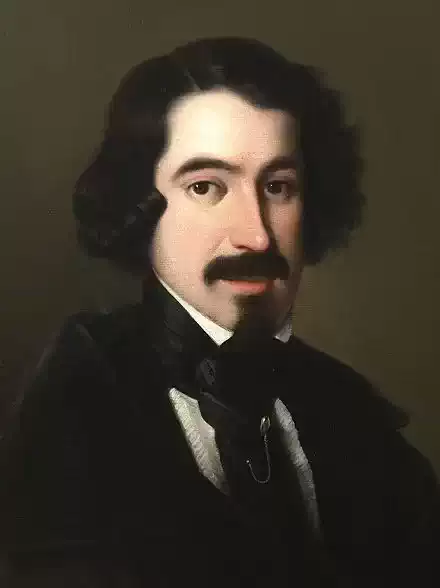
José de Espronceda
1808–1842
· lived 34 years
 --
--
--
José de Espronceda was a Spanish poet and playwright, a leading figure of Romanticism in his country. His life, marked by rebellion, exile, and overflowing passions, is reflected in a body of work charged with lyricism, melancholy, and a profound spirit of freedom. Espronceda is known for his narrative poems, his passionate sonnets, and his historical dramas, establishing himself as a symbol of romantic dissatisfaction and quest.
n. 1808-03-25, Almendralejo · m. 1842-05-23, Madrid
47
Views
Bio
Identification and Basic Context
José de Espronceda y de Argüelles was a Spanish poet and playwright, considered the foremost exponent of Romanticism in Spain. His life was marked by intensity, rebellion, and exile, characteristics that are clearly reflected in his literary work.Childhood and Education
Born in the province of Badajoz, Espronceda showed a restless and rebellious nature from a young age. His intellectual formation was influenced by liberal ideas and the revolutionary movements of the era. He studied at universities in Madrid and Seville, where he came into contact with literary and political circles that would shape his thinking and writing.Literary Career
Espronceda's literary career was intrinsically linked to his political and personal life. His early writings were marked by a neoclassical style, but he soon evolved towards Romanticism, influenced by his readings of Lord Byron and other European romantic authors. His exile in London and Portugal was a fertile period for his literary production. He published in various magazines of the time, and his plays had a significant impact.Work, Style, and Literary Characteristics
Among his most celebrated works are "El estudiante de Salamanca" (The Student of Salamanca), "El diablo mundo" (The Devil World) (incomplete), and "Canciones" (Songs). His recurring themes include freedom, rebellion, melancholy, passionate love, death, and social criticism. Espronceda experimented with various poetic forms, from the sonnet to free verse, and his style is characterized by a sonorous, passionate, and often grandiloquent language, reflecting the romantic spirit. His poetic voice is intensely lyrical and often confessional, exploring the torments of the romantic soul. He was an innovator in Spanish poetry, introducing elements of European literature and adapting them to the Spanish reality.Cultural and Historical Context
Espronceda lived in a turbulent period in Spanish history, marked by political instability, the Carlist Wars, and the struggle between liberals and absolutists. His political commitment led him to exile on several occasions. He belonged to the first generation of Spanish Romanticism, a movement that sought to break with the conventions of Neoclassicism and explore subjectivity, emotion, and freedom.Personal Life
Espronceda's personal life was as passionate and turbulent as his work. He had intense and often conflictive love affairs, such as the one he had with Teresa Mancha, to whom he dedicated many of his poems. His life was marked by duels, arrests, and exiles due to his liberal ideas and his participation in political conspiracies.Recognition and Reception
During his lifetime, Espronceda enjoyed recognition in certain literary and political circles, but his figure took on a legendary dimension after his death. He was admired for his audacity and rebellious spirit, becoming an archetype of the romantic poet.Influences and Legacy
Espronceda was deeply influenced by poets such as Lord Byron, Victor Hugo, and Walter Scott. His work, in turn, significantly influenced later poets of Spanish Romanticism and post-Romanticism. His legacy lies in his ability to embody the romantic spirit and in the introduction of new forms and themes into Spanish poetry.Interpretation and Critical Analysis
Espronceda's work has been interpreted as an expression of the social and political discontent of his time, as well as a reflection of the existential anguish of the romantic individual. His poems explore the tension between freedom and destiny, passion and reason, life and death.Childhood and Education
Espronceda was known for his charisma and adventurous spirit. He actively participated in political conspiracies and was even imprisoned for his liberal ideas. His relationship with Teresa Mancha, who inspired him to write some of his most famous poems, is an episode that illustrates the intensity of his passions.Death and Memory
José de Espronceda died young, at the age of thirty-four, in Madrid. Despite his short life, he left an indelible work that established him as one of the great poets of Spanish literature. His memory endures as a symbol of rebellion and romantic genius.Poems
0No poems found
Comments (0)
Log in
to post a comment.
No comments yet. Be the first to comment.