
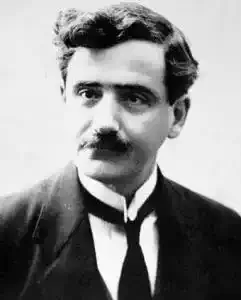
José María Eguren
1874–1942
· lived 67 years
 --
--
--
Peruvian poet, precursor of modernism and avant-garde in his country. His work is characterized by introspection, melancholy, and the exploration of themes such as time, death, and identity. Eguren is known for his lyrical and musical style, which often evokes dreamlike and mysterious atmospheres. Considered one of the great renovators of Hispanic American poetry, his influence extended to subsequent generations of poets, consolidating him as a fundamental figure of Peruvian and universal literature.
n. 1874-07-07, Lima · m. 1942-04-19, Lima
42
Views
Bio
Identification and Basic Context
José María Eguren Rodríguez was a Peruvian poet, born in Lima. He is often considered a precursor to modernism and literary avant-gardes in Peru. His work is distinguished by deep introspection, characteristic melancholy, and the exploration of universal themes such as time, death, memory, and identity.Childhood and Education
Eguren was born into a well-to-do family, which allowed him to receive a thorough education. Despite delicate health and a life marked by seclusion, his education was solid, with a notable inclination towards literature and art from an early age. His readings and family environment influenced his aesthetic sensibility and his worldview.Literary Career
Eguren's literary career began discreetly, but its impact was significant. He published his first poems in magazines of the time, but his recognition was consolidated with the publication of his main works. His evolution was marked by a constant search for formal perfection and thematic depth, exploring various facets of the human condition. He is associated with modernism, but his work transcends this label, anticipating avant-garde elements.Work, Style, and Literary Characteristics
Among his most outstanding works are "Motivos" (1906), "Canciones y romances" (1909), "Poesías" (1917, definitive edition of his poetic work), and "Romances" (1927). His recurring themes include melancholy, loneliness, the passage of time, death, dreams, and evasion of reality. His style is characterized by musicality, suggestion, the use of dreamlike imagery, and careful, precise language. He masterfully employs resources such as metaphor and symbol to create evocative and profound atmospheres. Eguren is recognized for his uniqueness and for having introduced an introspective and modern lyrical voice into Peruvian poetry, breaking with the conventions of his time.Cultural and Historical Context
Eguren lived in a time of significant social and political transformations in Peru and the world. Although his work is predominantly introspective and detached from immediate events, his poetic sensibility is nourished by the spirit of his time, marked by modernity and the aesthetic concerns of the avant-gardes. He was a contemporary of important literary figures but maintained a distance from the most active literary circles, dedicating himself to his creation.Personal Life
José María Eguren's life was marked by fragile health and an introspective nature. This led him to a relatively secluded existence, focused on literary creation. His personal relationships, although not widely documented in detail, are reflected in the intimacy and subjectivity of his poetry.Recognition and Reception
Although his recognition during his lifetime was moderate, Eguren's work was revalued posthumously, consolidating him as one of the peaks of Spanish-language poetry. His influence on later poets is undeniable, and today he is considered a master and a fundamental reference of Peruvian literature.Influences and Legacy
Eguren was influenced by French symbolism and Hispanic American modernism. In turn, his work exerted a profound influence on subsequent generations of Peruvian and Latin American poets, laying the groundwork for modern poetry in the region. His legacy lies in his ability to explore subjectivity and create a unique and timeless poetic universe.Interpretation and Critical Analysis
Critics have highlighted Eguren's originality, his profound lyrical sensitivity, and his ability to transcend the labels of his time. His poetry invites multiple interpretations, exploring the depths of the human soul and the complexities of existence.Childhood and Education
Eguren maintained a close relationship with photography, exploring image and visual composition, which may have influenced his poetics of suggestion and atmosphere.Death and Memory
José María Eguren passed away in Lima. His work, however, transcends his time and continues to be studied and admired for its aesthetic and human value.Poems
0No poems found
Comments (0)
Log in
to post a comment.
No comments yet. Be the first to comment.